

Sexagesima Sunday-The Good Soil: Bearing Fruit Through Tribulation
The Church's Season of Preparation
This morning we find ourselves in the season of Sexagesima—approximately sixty days before the joy of Easter morning. The Church in her wisdom has given us these weeks as a time of spiritual preparation, a season when we are called to examine our hearts and ready our souls for the trials and triumphs that lie ahead.
Today's Gospel and Epistle readings are not chosen by accident. They are divinely appointed to teach us a profound truth: that the Word of God bears fruit in our lives precisely through tribulation, through suffering, through the very trials that we might be tempted to avoid. Our Lord Jesus Christ gives us the Parable of the Sower, and the Apostle Paul reveals to us the cost of faithful ministry. Together, these passages form a complete picture of what it means to be a faithful disciple in a world that often opposes the Gospel.
As we prepare our hearts for Lent, which draws near, we must ask ourselves a searching question: What kind of soil am I? When the Word of God falls upon my heart, what response does it find? And when trials come—as they surely will—do I endure with patience, or do I fall away?
Let us turn our attention first to our Lord's parable, recorded for us in the eighth chapter of Luke's Gospel.
The Parable of the Sower: Four Soils, Four Responses
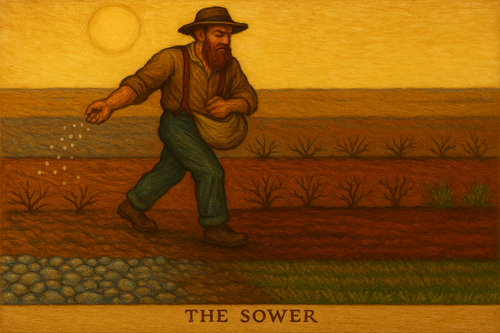
Our Lord begins with these words: "A sower went out to sow his seed: and as he sowed, some fell by the way side; and it was trodden down, and the fowls of the air devoured it" (Luke 8:5). The sower is generous, scattering seed everywhere—on good ground and bad alike. This is the nature of God's grace: it is offered freely to all, without partiality. The seed is the Word of God, as our Lord Himself explains, and it is the same seed in every case. The difference lies not in the seed, but in the soil.
The first soil is the wayside—the hard-packed path where travelers walk. Our Lord explains: "Those by the way side are they that hear; then cometh the devil, and taketh away the word out of their hearts, lest they should believe and be saved" (Luke 8:12). Here is a heart that has been hardened by the traffic of worldly concerns, by the constant trampling of ungodly influences. The Word cannot even penetrate the surface. It lies exposed, and Satan—ever watchful—snatches it away before it can take root.
How many souls in our day have hearts like the wayside? They hear the Gospel preached, they sit in the pew Sunday after Sunday, but the Word never penetrates. Their hearts are too busy, too distracted, too hardened by the cares of this world. They are, as the Apostle Paul warns Timothy, "Ever learning, and never able to come to the knowledge of the truth" (2 Timothy 3:7).
The second soil is the rocky ground: "And some fell upon a rock; and as soon as it was sprung up, it withered away, because it lacked moisture" (Luke 8:6). Our Lord explains: "They on the rock are they, which, when they hear, receive the word with joy; and these have no root, which for a while believe, and in time of temptation fall away" (Luke 8:13).
This is perhaps the most tragic of all the soils, for here we see an initial response of joy and enthusiasm. The seed sprouts quickly—there is excitement, there is emotion, there is what appears to be genuine faith. But beneath the surface, there is no depth. There is a thin layer of soil, but underneath lies solid rock. When the sun of tribulation rises, when persecution comes, when the cost of discipleship becomes clear, these souls wither and fall away.
The Tridentine Catechism warns us about this very danger when it speaks of those who "receive the word of God with a certain joy, but being without root, they believe for a time, and in the time of temptation fall away." How many have we seen who began well but did not endure? They loved the blessings of the Gospel but could not bear its cross.
The third soil is that which is choked with thorns: "And some fell among thorns; and the thorns sprang up with it, and choked it" (Luke 8:7). Our Lord's explanation is piercing: "And that which fell among thorns are they, which, when they have heard, go forth, and are choked with cares and riches and pleasures of this life, and bring no fruit to perfection" (Luke 8:14).
Here is a heart that receives the Word, and the Word begins to grow. But it is not alone. Growing alongside the good seed are the thorns—the cares of this world, the deceitfulness of riches, the pleasures of life. At first, both seem to coexist. But gradually, imperceptibly, the thorns grow stronger. They draw away the nutrients, they block the sunlight, they strangle the life out of the good plant. And in the end, though there was growth, there is no fruit.
How subtle is this danger! These are not people who openly reject the Gospel. They are church members, they are baptized believers, they profess faith in Christ. But their lives are so entangled with worldly concerns that the Word never reaches maturity. They bring no fruit to perfection.
But thanks be to God, there is a fourth soil: "And other fell on good ground, and sprang up, and bare fruit an hundredfold" (Luke 8:8). Our Lord explains: "But that on the good ground are they, which in an honest and good heart, having heard the word, keep it, and bring forth fruit with patience" (Luke 8:15).
Mark well these characteristics of the good soil. First, it is an honest and good heart—a heart that has been prepared by God's grace, softened by the Holy Spirit, made ready to receive the Word. Second, having heard the word, they keep it—they hold fast to it, they treasure it, they do not let it slip away. And third—and this is crucial for our meditation today—they bring forth fruit with patience.
The word translated "patience" here is the Greek word "hypomone," which means steadfast endurance, perseverance under trial. The good soil does not bring forth fruit easily or quickly. It brings forth fruit through patience, through endurance, through remaining faithful even when circumstances are difficult.
This brings us directly to our Epistle reading, where we see this principle lived out in the life of the Apostle Paul.
St. Paul's Sufferings: The Cost of Apostolic Ministry
In our Epistle reading from Second Corinthians, we encounter the Apostle Paul at a moment of profound vulnerability. He is writing to a church that he founded, a church that he loves, but a church that has been influenced by false apostles who boast of their credentials and question Paul's authority. And so, though it pains him to do so, Paul is compelled to speak of his own sufferings for the sake of the Gospel.
He begins with irony: "For ye suffer fools gladly, seeing ye yourselves are wise. For ye suffer, if a man bring you into bondage, if a man devour you, if a man take of you, if a man exalt himself, if a man smite you on the face" (2 Corinthians 11:19-20). The Corinthians have been willing to endure the abuse of false teachers, but they question the legitimacy of Paul's ministry. How often does this happen in the Church? We tolerate those who tickle our ears with smooth words, but we resist those who speak the truth in love.
Then Paul launches into what has been called his "catalog of sufferings": "Are they ministers of Christ? (I speak as a fool) I am more; in labours more abundant, in stripes above measure, in prisons more frequent, in deaths oft. Of the Jews five times received I forty stripes save one. Thrice was I beaten with rods, once was I stoned, thrice I suffered shipwreck, a night and a day I have been in the deep" (2 Corinthians 11:23-25).
Let us pause and consider what Paul is describing. Five times he received thirty-nine lashes from the Jews—a punishment so severe that many did not survive it. Three times he was beaten with Roman rods. Once he was stoned and left for dead. Three times he was shipwrecked, spending a night and a day clinging to debris in the open sea. And this is only the beginning of his list.
He continues: "In journeyings often, in perils of waters, in perils of robbers, in perils by mine own countrymen, in perils by the heathen, in perils in the city, in perils in the wilderness, in perils in the sea, in perils among false brethren; In weariness and painfulness, in watchings often, in hunger and thirst, in fastings often, in cold and nakedness" (2 Corinthians 11:26-27).
Paul faced danger from every quarter—from nature, from men, from false brothers within the church. He knew physical exhaustion, sleepless nights, hunger, thirst, exposure to the elements. And beyond all these physical sufferings, he carried "the care of all the churches" (2 Corinthians 11:28)—the spiritual burden of shepherding God's flock.
Now, we might expect that such a faithful servant would be rewarded with strength, with health, with freedom from further trials. But instead, Paul tells us of his "thorn in the flesh": "And lest I should be exalted above measure through the abundance of the revelations, there was given to me a thorn in the flesh, the messenger of Satan to buffet me, lest I should be exalted above measure" (2 Corinthians 12:7).
We do not know precisely what this thorn was—perhaps a physical ailment, perhaps ongoing persecution, perhaps some other form of suffering. What we do know is that it was painful, it was persistent, and it was permitted by God for Paul's spiritual good. Three times Paul pleaded with the Lord to remove it. And three times the answer was the same: "My grace is sufficient for thee: for my strength is made perfect in weakness" (2 Corinthians 12:9).
Here is the great paradox of the Christian life: God's strength is made perfect in our weakness. Paul's response to this revelation is remarkable: "Most gladly therefore will I rather glory in my infirmities, that the power of Christ may rest upon me. Therefore I take pleasure in infirmities, in reproaches, in necessities, in persecutions, in distresses for Christ's sake: for when I am weak, then am I strong" (2 Corinthians 12:9-10).
Paul learned to glory in his weaknesses, to take pleasure in his sufferings, because he understood that they were the very means by which Christ's power was manifested in his life. This is the testimony of a man who was good soil—who received the Word and brought forth fruit with patience, through endurance, through tribulation.
The Connection: Fruitfulness Through Tribulation
Now we come to the heart of our meditation: How do these two passages connect? What is the Holy Spirit teaching us through the parable of the sower and the sufferings of Paul?
The connection is this: The good soil brings forth fruit with patience—and patience is forged in the furnace of tribulation. The seed that falls on good ground does not have an easy path to fruitfulness. It must endure the heat of the sun, the storms of wind and rain, the long seasons of waiting. But because it has deep roots, because it is well-established, it endures and ultimately bears fruit—thirty, sixty, even a hundredfold.
So it was with Paul. His ministry was extraordinarily fruitful. He planted churches throughout the Roman world. He wrote epistles that have guided the Church for two thousand years. He turned the world upside down with the Gospel. But this fruit came at tremendous cost. It came through beatings and imprisonments, through shipwrecks and stoning, through weariness and pain. It came through the thorn in the flesh that God refused to remove.
The Tridentine Catechism, in its treatment of the virtue of patience, teaches us that "patience is that virtue by which we bear present evils with an equal mind, without sadness or resentment." It goes on to explain that patience is necessary for salvation, for our Lord Himself said, "In your patience possess ye your souls" (Luke 21:19). Without patience, we cannot endure the trials that test our faith and prove the genuineness of our discipleship.
The saints understood this truth and lived it out in their own lives. Consider St. Ignatius of Antioch, who faced martyrdom in the early second century. As he was being transported to Rome to be thrown to the wild beasts, he wrote to the churches, saying, "I am God's wheat, and I am being ground by the teeth of wild beasts, that I may prove to be pure bread." He saw his suffering not as an obstacle to fruitfulness, but as the very means of it.
Or consider St. Perpetua, the young mother who was martyred in Carthage in the year 203. In her prison diary, she recorded a vision in which she saw a ladder reaching to heaven, with swords and lances on either side. She understood that the path to glory led through suffering, and she climbed that ladder with courage and faith.
St. Lawrence, the deacon of Rome martyred in 258, demonstrated such joy in his suffering that even his executioners were amazed. When he was being roasted alive on a gridiron, he is reported to have said to his tormentors, "Turn me over; I'm done on this side." His cheerfulness in the face of death bore powerful witness to the reality of his faith.
These saints were good soil. They received the Word of God, they kept it, and they brought forth fruit with patience—even unto death. Their sufferings did not destroy their faith; rather, their faith was perfected through suffering.
But we must not think that this principle applies only to apostles and martyrs. It applies to every Christian, in every age, in every circumstance. The question is not whether we will face trials, but how we will respond to them. Will we be like the rocky ground, falling away when tribulation comes? Will we be like the thorny ground, allowing the cares of this world to choke out our spiritual life? Or will we be like the good soil, enduring with patience and bringing forth fruit?
Our Lord Jesus Christ Himself is the supreme example of fruitfulness through suffering. He was "a man of sorrows, and acquainted with grief" (Isaiah 53:3). He endured the contradiction of sinners, the betrayal of friends, the mockery of enemies, and finally the agony of the cross. But it was precisely through His suffering that He accomplished our redemption. "Except a corn of wheat fall into the ground and die, it abideth alone: but if it die, it bringeth forth much fruit" (John 12:24).
The cross teaches us that there is no fruitfulness without death to self, no resurrection without crucifixion, no crown without a cross. This is the pattern of the Christian life. We are called to take up our cross daily and follow Christ. We are called to die to sin and live to righteousness. We are called to suffer with Christ that we may also be glorified with Him.
This is why the Church, in her wisdom, gives us these readings during Sexagesima. She is preparing us for Lent, that season of fasting and self-denial. She is reminding us that the path to Easter joy leads through Good Friday suffering. She is calling us to examine our hearts and ask: Am I good soil? Am I willing to endure tribulation for the sake of bearing fruit?
Application: Becoming Good Soil in Our Trials
And so we come to the practical application of these truths. How do we become good soil? How do we endure tribulation with patience? How do we ensure that our lives bear fruit for the glory of God?
First, we must examine our hearts honestly. What kind of soil are we? Have we allowed our hearts to become hardened like the wayside, trampled by the constant traffic of worldly concerns? If so, we must cry out to God for a softened heart. We must ask Him to break up the fallow ground, to make us receptive to His Word once again.
Are we like the rocky ground, with a shallow faith that cannot withstand the heat of trial? If so, we must seek to deepen our roots. We must spend time in prayer and meditation on Scripture. We must cultivate a relationship with Christ that goes beyond mere emotion to genuine commitment. We must count the cost of discipleship and resolve, by God's grace, to endure whatever may come.
Are we like the thorny ground, allowing the cares and riches and pleasures of this life to choke out our spiritual vitality? If so, we must ruthlessly cut away these thorns. We must simplify our lives, reduce our entanglements with the world, and make room for the Word of God to grow. As our Lord warned, "No man can serve two masters" (Matthew 6:24). We must choose whom we will serve. But how do we become good soil?
How do we develop the kind of heart that receives the Word and brings forth fruit with patience? Let me suggest several practical means:
First, we must be diligent in the use of the means of grace that God has provided. The Scriptures are the seed of the Word. We must read them, study them, memorize them, meditate upon them. As the Psalmist says, "Thy word have I hid in mine heart, that I might not sin against thee" (Psalm 119:11). The Word of God is living and active; it has power to transform us if we will give it room to work.
Second, we must be faithful in prayer. Prayer is the means by which we draw near to God and receive strength from Him. When trials come, we must not rely on our own strength, but cast ourselves upon the Lord. Like Paul, we may plead for the removal of our thorns, but we must also be willing to accept God's answer: "My grace is sufficient for thee." In prayer, we learn to trust God's wisdom even when we do not understand His ways.
Third, we must be regular in our participation in the life of the Church. We need the fellowship of other believers, the encouragement of the saints, the accountability of the body of Christ. When we are tempted to fall away, the prayers and support of our brothers and sisters can sustain us. When we are weary, they can bear us up. When we are confused, they can help us see clearly.
Fourth, we must cultivate the virtue of patience through practice. Patience is not something we are born with; it is something we develop through exercise. Every trial, every difficulty, every frustration is an opportunity to practice patience. Instead of complaining or giving up, we can choose to endure with grace. We can ask God to use our trials to make us more like Christ.
Fifth, we must keep an eternal perspective. The sufferings of this present time are not worthy to be compared with the glory that shall be revealed in us (Romans 8:18). Our light affliction, which is but for a moment, is working for us a far more exceeding and eternal weight of glory (2 Corinthians 4:17). When we remember that this life is not all there is, when we fix our eyes on the prize that awaits us, we can endure present hardships with hope and joy.
Let me speak now to those of you who are currently facing trials. Perhaps you are dealing with illness or pain. Perhaps you are struggling financially. Perhaps you are facing opposition or persecution for your faith. Perhaps you are wrestling with doubt or discouragement. Whatever your trial may be, hear the Word of the Lord to you today:
Your suffering is not meaningless. God is using it to deepen your roots, to strengthen your faith, to prepare you to bear fruit. Like Paul, you may have a thorn in the flesh that God has chosen not to remove. But also like Paul, you can experience the sufficiency of God's grace. His strength is made perfect in your weakness.
Do not be discouraged if the fruit is not yet visible. The farmer who plants seed does not see the harvest immediately. There is a season of waiting, a time of hidden growth beneath the soil. But if you remain faithful, if you endure with patience, the fruit will come. It may be thirtyfold, it may be sixtyfold, it may be a hundredfold—but it will come.
And let me speak to those of you who have been falling away. Perhaps you once had zeal for the Lord, but the trials of life have caused you to grow cold. Perhaps you have allowed the thorns of worldly cares to choke out your spiritual life. It is not too late. God is calling you back today. He is inviting you to repent, to return, to allow Him to restore your soul. The same grace that sustained Paul can sustain you. The same Word that transforms hearts can transform yours.
The path forward is clear: We must humble ourselves before God, confess our sins, and ask Him to make us good soil. We must commit ourselves to faithfulness, regardless of the cost. We must resolve, by His grace, to endure with patience whatever trials may come. And we must trust that He who began a good work in us will complete it until the day of Jesus Christ (Philippians 1:6).
God's Word Cannot Fail
As we close, I want to leave you with a word of hope and assurance. Despite all the obstacles, despite all the opposition, despite all the trials and tribulations, God's Word cannot fail. The prophet Isaiah declares: "For as the rain cometh down, and the snow from heaven, and returneth not thither, but watereth the earth, and maketh it bring forth and bud, that it may give seed to the sower, and bread to the eater: So shall my word be that goeth forth out of my mouth: it shall not return unto me void, but it shall accomplish that which I please, and it shall prosper in the thing whereto I sent it" (Isaiah 55:10-11).
God's Word will accomplish its purpose. It will bear fruit. The question is not whether the seed is good—it is always good. The question is whether we will be good soil.
The same Word that sustained Paul through beatings and imprisonments, through shipwrecks and stoning, through weariness and pain—that Word is available to you today. The same grace that was sufficient for him is sufficient for you. The same strength that was made perfect in his weakness can be made perfect in yours.
As we prepare for the season of Lent, as we anticipate the trials and disciplines that lie ahead, let us resolve to be good soil. Let us receive the Word of God with honest and good hearts. Let us keep it, treasuring it, holding fast to it no matter what may come. And let us bring forth fruit with patience—enduring tribulation, persevering through trials, remaining faithful even when the way is hard.
Remember the words of our Lord: "He that hath ears to hear, let him hear" (Luke 8:8). You have heard the Word today. The seed has been sown. What will you do with it? Will you allow Satan to snatch it away? Will you let it wither for lack of depth? Will you permit the thorns to choke it? Or will you, by God's grace, become good soil that brings forth fruit—thirtyfold, sixtyfold, a hundredfold?
The choice is before you. The grace is available. The promise is sure. May God grant us all the faith to endure, the patience to persevere, and the fruitfulness that comes through tribulation. For His is the kingdom, and the power, and the glory, forever and ever. Amen.