
Lesson 5: The Foundation of Catholic Faith: Understanding the Church and Baptism
Welcome to the fifth session in our eight-part series on the foundational doctrines of our Catholic faith. Today, we shift from the more theoretical theological concepts we've been exploring to examining two pillars of our faith: the Church and Baptism. We will explore what Holy Scripture and Sacred Tradition teach about these essential elements of our Catholic identity, drawing from the timeless wisdom of the Church's traditional teachings. As we begin, let us approach this topic with reverence and humility, recognizing that these teachings connect us to the one, holy, catholic, and apostolic Church established by Christ Himself over two millennia ago. As our Lord Himself declared: "And I tell you, you are Peter, and on this rock I will build my church, and the gates of hell shall not prevail against it. I will give you the keys of the kingdom of heaven" (Matthew 16:18-19). St. Ignatius of Antioch, writing around 107 AD, reminds us of the centrality of the Church: "Wherever the bishop appears, there let the people be; as wherever Jesus Christ is, there is the Catholic Church." This early witness shows the ancient understanding of the Church's nature and importance.
The Nature of the Church
The Church must be understood as both a visible and mystical reality:
The Visible Church
Christ established a visible Church on earth with St. Peter as its head, saying: "Thou art Peter, and upon this rock I will build my church, and the gates of hell shall not prevail against it" (Matthew 16:18). This visible Church has a hierarchical structure with the Pope as the successor of Peter, bishops as successors to the Apostles, priests, and the faithful. As the Baltimore Catechism (1891) teaches: "The Church is the congregation of all baptized persons united in the same true faith, the same sacrifice, and the same sacraments, under the authority of the Sovereign Pontiff and the bishops in communion with him."
St. Cyprian of Carthage (d. 258) affirmed: "He can no longer have God for his Father who has not the Church for his mother." And in his treatise On the Unity of the Catholic Church, he wrote: "The episcopate is one, each part of which is held by each one for the whole."
Scripture further affirms the visible nature of the Church in 1 Timothy 3:15, where St. Paul calls it "the household of God, which is the church of the living God, the pillar and bulwark of the truth." In Acts 20:28, we see the hierarchical structure when St. Paul tells the bishops: "Take heed to yourselves and to all the flock, in which the Holy Ghost has made you overseers, to care for the church of God which he obtained with his own blood."
The Mystical Body
The Church is also the Mystical Body of Christ. As St. Paul teaches in 1 Corinthians 12:27: "Now you are the body of Christ and individually members of it." This truth is elaborated in Ephesians 1:22-23: "And he has put all things under his feet and has made him the head over all things for the church, which is his body, the fullness of him who fills all in all."
St. Augustine (354-430) beautifully expressed this reality: "Let us rejoice and give thanks that we have become not only Christians but Christ. Do you understand, brothers, the grace of Christ our Head? Marvel and rejoice: we have become Christ."
In Colossians 1:18, St. Paul further explains: "He is the head of the body, the church; he is the beginning, the firstborn from the dead, that in everything he might be preeminent." Pope Pius XII in his encyclical Mystici Corporis Christi (1943) beautifully elaborated on this doctrine, explaining how all the faithful are united to Christ as their Head and to one another as members of the same body. The Holy Spirit animates this body, giving it life and unity.
The Church is not merely a human institution but a divine one, established by Christ Himself and guided by the Holy Spirit. It is both human and divine, visible and invisible, earthly and heavenly, as reflected in Ephesians 2:19-22: "So then you are no longer strangers and sojourners, but you are fellow citizens with the saints and members of the household of God, built upon the foundation of the apostles and prophets, Christ Jesus himself being the cornerstone, in whom the whole structure is joined together and grows into a holy temple in the Lord; in whom you also are built into it for a dwelling place of God in the Spirit."
Church Structure and Authority
The Catholic Church possesses a divinely instituted hierarchical structure. Christ established the Church with the Apostles, with Peter as their head. This apostolic succession continues today in the Pope and the bishops in communion with him.
The Pope, as the successor of St. Peter, holds primacy of jurisdiction over the universal Church. This is rooted in Christ's words in Matthew 16:18-19: "And I tell you, you are Peter, and on this rock I will build my church, and the gates of hell shall not prevail against it. I will give you the keys of the kingdom of heaven, and whatever you bind on earth shall be bound in heaven, and whatever you loose on earth shall be loosed in heaven." The First Vatican Council (1870) solemnly defined this primacy, drawing from these scriptural foundations.
St. Irenaeus of Lyons (c. 130-202) testified to the primacy of Rome when he wrote: "For with this Church, because of its superior origin, all churches must agree, that is, all the faithful in the whole world; and it is in her that the faithful everywhere have maintained the apostolic tradition." In his work Against Heresies, he also provided one of the earliest lists of the succession of Roman pontiffs, beginning with Peter.
St. Jerome (347-420) declared: "I follow no leader but Christ and join in communion with none but Your Beatitude [Pope Damasus I], that is, with the chair of Peter. I know that this is the rock on which the Church has been built."
The authority of the bishops is seen in Acts 1:20-26, where Matthias is chosen to replace Judas, and in Acts 14:23: "And when they had appointed elders for them in every church, with prayer and fasting they committed them to the Lord in whom they believed." St. Paul instructed Titus: "This is why I left you in Crete, that you might amend what was defective, and appoint elders in every town as I directed you" (Titus 1:5).
St. Ignatius of Antioch, writing around 107 AD, emphasized the importance of the bishop: "Let no one do anything of concern to the Church without the bishop. Let that be considered a valid Eucharist which is celebrated by the bishop or by one whom he ordains. Wherever the bishop appears, let the people be; as wherever Jesus Christ is, there is the Catholic Church."
Priests assist the bishops in their pastoral duties, particularly in administering the sacraments and teaching the faith. Deacons are ordained to a ministry of service, as seen in Acts 6:1-6, where the first seven deacons were appointed to serve the community.
The Church possesses teaching authority (Magisterium) in matters of faith and morals. Christ promised the Apostles: "When the Spirit of truth comes, he will guide you into all the truth" (John 16:13). He also said: "He who hears you hears me, and he who rejects you rejects me, and he who rejects me rejects him who sent me" (Luke 10:16). This teaching authority is exercised by the Pope alone when he speaks ex cathedra, or by the Pope together with the bishops in communion with him.
St. Vincent of Lérins (d. c. 445) provided a famous rule for discerning Catholic truth: "Now in the Catholic Church itself we take the greatest care to hold that which has been believed everywhere, always and by all."
The authority to forgive sins was granted by Christ after His resurrection: "Receive the Holy Spirit. If you forgive the sins of any, they are forgiven; if you retain the sins of any, they are retained" (John 20:22-23). As Pope Pius XI taught in Mortalium Animos (1928): "For the teaching authority of the Church, which in the divine wisdom was constituted on earth in order that revealed doctrines might remain intact forever, and that they might be brought with ease and security to the knowledge of men."
The Seven Sacraments
Christ instituted seven sacraments as efficacious signs of grace. As the Catechism of the Council of Trent (1566) teaches, sacraments are visible signs instituted by God to effect the grace they signify. They are not mere symbols but actually confer the grace they represent.
St. Augustine (354-430) defined a sacrament as "a visible sign of an invisible grace," and taught that "the word is added to the element, and there results the Sacrament, as if itself also a kind of visible word."
The seven sacraments, as enumerated by the Council of Trent, are:
- Baptism: The gateway to the Christian life and to all other sacraments. "Go therefore and make disciples of all nations, baptizing them in the name of the Father and of the Son and of the Holy Spirit" (Matthew 28:19). Tertullian (c. 155-240) wrote extensively on baptism, saying: "Happy is our sacrament of water, in that, by washing away the sins of our early blindness, we are set free and admitted into eternal life."
- Confirmation: Strengthens baptismal grace and confers the Holy Spirit. In Acts 8:14-17, we read: "Now when the apostles at Jerusalem heard that Samaria had received the word of God, they sent to them Peter and John, who came down and prayed for them that they might receive the Holy Spirit; for it had not yet fallen on any of them, but they had only been baptized in the name of the Lord Jesus. Then they laid their hands on them and they received the Holy Spirit." St. Cyril of Jerusalem (c. 313-386) in his Catechetical Lectures described the anointing with chrism: "Having been counted worthy of this Holy Chrism, ye are called Christians, verifying the name also by your new birth."
- Holy Eucharist: The Body, and Blood of Christ under the appearances of bread and wine. Jesus said: "This is my body, which is given for you. Do this in remembrance of me... This cup which is poured out for you is the new covenant in my blood" (Luke 22:19-20). And in John 6:53-54: "Truly, truly, I say to you, unless you eat the flesh of the Son of man and drink his blood, you have no life in you; he who eats my flesh and drinks my blood has eternal life, and I will raise him up at the last day." St. Ignatius of Antioch (c. 35-107) affirmed the Real Presence when he wrote of those who "abstain from the Eucharist and from prayer, because they confess not the Eucharist to be the flesh of our Savior Jesus Christ, which suffered for our sins, and which the Father, of His goodness, raised up again." St. Justin Martyr (c. 100-165) explained: "For not as common bread and common drink do we receive these; but in like manner as Jesus Christ our Savior, having been made flesh by the Word of God, had both flesh and blood for our salvation, so likewise have we been taught that the food which is blessed by the prayer of His word, and from which our blood and flesh by transmutation are nourished, is the flesh and blood of that Jesus who was made flesh."
- Penance: Reconciles sinners with God and the Church. Christ instituted this sacrament when He said to the Apostles: "Receive the Holy Spirit. If you forgive the sins of any, they are forgiven; if you retain the sins of any, they are retained" (John 20:22-23). St. Ambrose (c. 340-397) wrote: "There are water and tears: the water of Baptism and the tears of repentance."
- Extreme Unction (Anointing of the Sick): Provides spiritual and sometimes physical healing. St. James wrote: "Is any among you sick? Let him call for the elders of the church, and let them pray over him, anointing him with oil in the name of the Lord; and the prayer of faith will save the sick man, and the Lord will raise him up; and if he has committed sins, he will be forgiven" (James 5:14-15). Origen (c. 185-254) mentioned this practice in his homilies.
- Holy Orders: Confers sacred power for service to the faithful. St. Paul reminded Timothy: "Do not neglect the gift you have, which was given you by prophetic utterance when the council of elders laid their hands upon you" (1 Timothy 4:14). St. Clement of Rome (c. 35-99), in his Letter to the Corinthians, already shows a clear understanding of apostolic succession and the ordained ministry.
- Matrimony: Unites a man and woman in an indissoluble bond. Jesus taught: "Have you not read that he who made them from the beginning made them male and female, and said, 'For this reason a man shall leave his father and mother and be joined to his wife, and the two shall become one flesh'? So they are no longer two but one flesh. What therefore God has joined together, let not man put asunder" (Matthew 19:4-6). Tertullian described Christian marriage as "a union sealed by the Church, confirmed by the oblation, consecrated by the blessing, proclaimed by the angels and ratified by the Father." The Baltimore Catechism (1891) explains: "The Sacraments are outward signs instituted by Christ to give grace." Of these, we will focus today particularly on Baptism, while the Holy Eucharist will be addressed in greater detail in a future session.
The Sacrament of Baptism
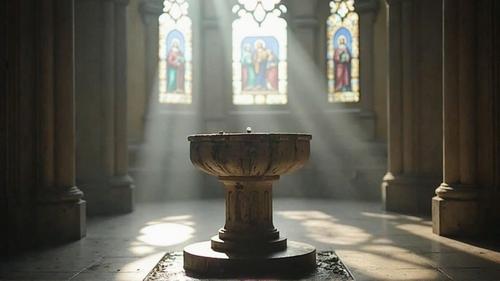
Baptism is the first and most necessary sacrament, the door through which we enter the Church. As Christ commanded: "Going therefore, teach ye all nations: baptizing them in the name of the Father and of the Son and of the Holy Ghost" (Matthew 28:19).
The Matter and Form of Baptism
The Catechism of the Council of Trent (1566) teaches that the matter of Baptism is natural water, and the form is the words: "I baptize thee in the name of the Father, and of the Son, and of the Holy Ghost." The ordinary ministers of Baptism are bishops, priests, and deacons, though in case of necessity, anyone can baptize with the proper intention.
Tertullian (c. 155-240), in his treatise On Baptism, wrote: "Happy is our sacrament of water, in that, by washing away the sins of our early blindness, we are set free and admitted into eternal life!" He also noted: "There is absolutely nothing which makes men's minds more obdurate than the simplicity of the divine works which are visible in the act, when compared with the grandeur which is promised thereto in the effect."
Effects of Baptism
According to the Council of Trent and the Roman Catechism, Baptism:
- Remits original sin and any personal sins. "Rise and be baptized, and wash away your sins, calling on his name" (Acts 22:16). St. Cyril of Jerusalem (c. 313-386) taught: "You descended into the water bearing your sins, but the invocation of grace, having sealed your soul, did not permit you afterwards to be swallowed up by the terrible dragon. Having descended dead in sins, you ascend alive in righteousness."
- Remits all punishment due to sin. "There is therefore now no condemnation for those who are in Christ Jesus" (Romans 8:1). St. Gregory of Nazianzus (329-390) called Baptism "the splendid robe of immortality."
- Imprints an indelible character on the soul, making one a member of Christ and His Church. "For as many of you as were baptized into Christ have put on Christ" (Galatians 3:27). St. Augustine affirmed: "The character is not removed from the soul even of those who leave the Church."
- Infuses sanctifying grace, the theological virtues, and the gifts of the Holy Spirit. "He saved us, not because of deeds done by us in righteousness, but in virtue of his own mercy, by the washing of regeneration and renewal in the Holy Spirit, which he poured out upon us richly through Jesus Christ our Savior, so that we might be justified by his grace and become heirs in hope of eternal life" (Titus 3:5-7). St. Basil the Great (330-379) described Baptism as "the beginning and source of the Christian life."
- Incorporates one into the Church. "For by one Spirit we were all baptized into one body—Jews or Greeks, slaves or free—and all were made to drink of one Spirit" (1 Corinthians 12:13). St. John Chrysostom (347-407) declared: "It is through Baptism that we received the Holy Spirit, through which we were admitted into citizenship in heaven, and entered into the kingdom of God, and were made sons of God." St. Paul describes this transformation in Romans 6:3-4: "Know you not that all we who are baptized in Christ Jesus are baptized in his death? For we are buried together with him by baptism into death: that, as Christ is risen from the dead by the glory of the Father, so we also may walk in newness of life." And further in Romans 6:8-11: "But if we have died with Christ, we believe that we shall also live with him. For we know that Christ being raised from the dead will never die again; death no longer has dominion over him. The death he died he died to sin, once for all, but the life he lives he lives to God. So you also must consider yourselves dead to sin and alive to God in Christ Jesus."
Necessity of Baptism
The Baltimore Catechism (1891) states: "Baptism is necessary to salvation, because without it we cannot enter into the kingdom of heaven." This reflects Christ's words: "Unless a man be born again of water and the Holy Ghost, he cannot enter into the kingdom of God" (John 3:5). While the Church recognizes Baptism of desire and Baptism of blood for those who cannot receive the sacrament, the ordinary means of salvation is through sacramental Baptism. St. Ambrose (c. 340-397) spoke of the catechumen Valentinian II who died before receiving Baptism: "I have heard that you grieve because he did not receive the sacrament of Baptism. Tell me, what else is there in us except the will and the asking? But he had long desired to be initiated before he came to Italy, and expressed his intention to be baptized by me as soon as possible... Surely, because he asked for it, he received it." The importance of Baptism is further emphasized in Mark 16:16, where Jesus says: "He who believes and is baptized will be saved; but he who does not believe will be condemned." And in 1 Peter 3:20-21, we read how the flood in Noah's time prefigured Baptism: "God's patience waited in the days of Noah, during the building of the ark, in which a few, that is, eight persons, were saved through water. Baptism, which corresponds to this, now saves you, not as a removal of dirt from the body but as an appeal to God for a clear conscience, through the resurrection of Jesus Christ."
Living as a Member of the Church
As baptized Catholics, we have both privileges and responsibilities within the Church:
1. Participation in the Sacramental Life: Regular reception of the sacraments, particularly the Holy Eucharist and Penance, is essential for spiritual growth. Pope St. Pius X, in his decree Sacra Tridentina (1905), encouraged frequent and even daily Communion for the faithful. Scripture affirms this in Acts 2:42: "And they devoted themselves to the apostles' teaching and fellowship, to the breaking of bread and the prayers." And in 1 Corinthians 11:26: "For as often as you eat this bread and drink the cup, you proclaim the Lord's death until he comes."
St. John Chrysostom (347-407) exhorted the faithful: "Consider how indignant you are against the traitor, against those who crucified Him. Look therefore lest you also yourself become guilty of the Body and Blood of Christ. They slaughtered the all-holy Body, but you receive it in a filthy soul after such great benefits."
2. Fidelity to Church Teaching: We must accept the Church's teaching authority in matters of faith and morals. As Pope Pius IX stated in the Syllabus of Errors (1864), it is an error to believe that "Every man is free to embrace and profess that religion which, guided by the light of reason, he shall consider true." Scripture exhorts us: "Stand firm and hold to the traditions which you were taught by us, either by word of mouth or by letter" (2 Thessalonians 2:15). And in 1 Timothy 3:15, the Church is called "the pillar and bulwark of the truth."
St. Vincent of Lérins (d. c. 445) provided a famous rule for discerning Catholic truth: "Now in the Catholic Church itself we take the greatest care to hold that which has been believed everywhere, always and by all."
3. Prayer and Devotion: Developing a rich prayer life, including devotion to the Blessed Virgin Mary through practices such as the Holy Rosary, helps us grow in holiness. Pope Leo XIII, in Supremi Apostolatus Officio (1883), strongly encouraged the faithful to pray the Rosary. Scripture commands us to "pray constantly" (1 Thessalonians 5:17) and to "continue steadfastly in prayer, being watchful in it with thanksgiving" (Colossians 4:2). Regarding devotion to Mary, we recall her prophetic words: "For behold, henceforth all generations will call me blessed" (Luke 1:48).
St. Ephrem the Syrian (306-373) wrote beautifully of the Mother of God: "After the mediator, you [Mary] are the mediatrix of the whole world." And St. Augustine affirmed: "The holy Virgin Mary excepted, concerning whom, on account of the honor of the Lord, I wish to have absolutely no question when treating of sins—for how do we know what abundance of grace for the total overcoming of sin was conferred upon her who merited to conceive and bear Him in whom there was no sin?"
4. Charitable Works: As members of Christ's Body, we are called to express our faith through works of mercy and charity, as Pope Pius XI emphasized in Quadragesimo Anno (1931). Jesus taught: "Let your light so shine before men, that they may see your good works and give glory to your Father who is in heaven" (Matthew 5:16). St. James reminds us: "Faith by itself, if it has no works, is dead" (James 2:17). And our Lord's parable of the Last Judgment emphasizes the importance of charitable works: "Truly, I say to you, as you did it to one of the least of these my brethren, you did it to me" (Matthew 25:40).
St. John Chrysostom exhorted: "Do you wish to honor the body of Christ? Do not ignore him when he is naked. Do not pay him homage in the temple clad in silk, only then to neglect him outside where he is cold and ill-clad. He who said: 'This is my body' is the same who said: 'You saw me hungry and you gave me no food.'" St. Basil the Great taught: "The bread which you do not use is the bread of the hungry; the garment hanging in your wardrobe is the garment of him who is naked."
5. Evangelization: Each Catholic has a duty to share the faith with others, not only through our explicit proclamation but also by the witness of a holy life. Pope Pius XI's encyclical Rerum Ecclesiae (1926) emphasized the importance of missionary work. Christ commanded: "Go into all the world and preach the gospel to the whole creation" (Mark 16:15). And St. Paul asks: "But how are men to call upon him in whom they have not believed? And how are they to believe in him of whom they have never heard? And how are they to hear without a preacher?" (Romans 10:14). St. Augustine wrote: "The Church goes forward between the persecutions of the world and the consolations of God." And St. John Chrysostom reminded the faithful: "There is nothing colder than a Christian who does not seek to save others."
The parish is the primary community where Catholics live out their faith. It is where we receive the sacraments, hear the Word of God, and grow in community with fellow believers. Active participation in parish life is an important expression of our Catholic identity. As Hebrews 10:24-25 exhorts us: "Let us consider how to stir up one another to love and good works, not neglecting to meet together, as is the habit of some, but encouraging one another, and all the more as you see the Day drawing near."
Conclusion
Our exploration of the Church and Baptism reveals God's providential design for our salvation. The Church is not merely an institution but the Mystical Body of Christ, the extension of the Incarnation through time. Through Baptism, we are incorporated into this Body and begin our journey toward eternal life.
As members of Christ's Church, we are heirs to a rich tradition of faith, worship, and service. We are never alone in our spiritual journey but are accompanied by the communion of saints—those in heaven, in purgatory, and on earth. As St. Paul writes: "Therefore, since we are surrounded by so great a cloud of witnesses, let us also lay aside every weight, and sin which clings so closely, and let us run with perseverance the race that is set before us, looking to Jesus the pioneer and perfecter of our faith" (Hebrews 12:1-2).
St. Augustine reminds us: "The Church even now is the kingdom of Christ and the kingdom of heaven." And St. Cyprian declared: "He cannot have God for his Father who has not the Church for his mother."
Let us heed the words of Pope Pius XII in Mediator Dei (1947): "The Church has further used her right of control over liturgical observance to protect the purity of divine worship against abuse from dangerous and imprudent innovations introduced by private individuals and particular churches."
May this understanding deepen your appreciation for the Church and inspire your faithful participation in its life and mission. When we return, we'll continue our journey through the essential doctrines of our faith with a study of the Holy Eucharist.
Remember the words of Christ: "I am with you always, to the close of the age" (Matthew 28:20). And the promise of St. Paul: "For I am sure that neither death, nor life, nor angels, nor principalities, nor things present, nor things to come, nor powers, nor height, nor depth, nor anything else in all creation, will be able to separate us from the love of God in Christ Jesus our Lord" (Romans 8:38-39).
Let us close with the words of St. Ignatius of Antioch: "Where the bishop is, there let the multitude of believers be; even as where Jesus Christ is, there is the Catholic Church."
Let us pray: Almighty and eternal God, who in the Sacrament of Baptism has made us members of Your Son's Mystical Body, grant that we may always remain faithful to our baptismal promises. Help us to live as worthy members of Your Church, guided by the Holy Father and our bishops, nourished by the sacraments, and inspired by the examples of the saints. We ask this through Jesus Christ our Lord. Amen.
Bible Memorization: Understanding the Church and Baptism