

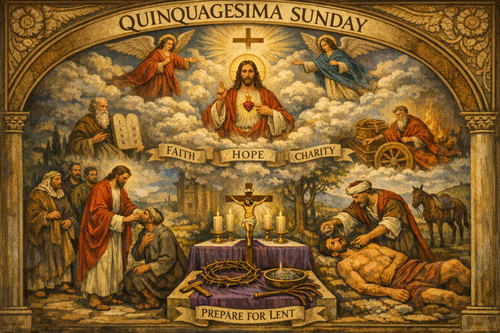
Quinquagesima Sunday: Love Prepares Us for Sacrifice
The Threshold of Lent
Quinquagesima Sunday, a name that means "fiftieth day." We stand precisely fifty days before the glorious celebration of Easter, at the very threshold of the holy season of Lent. This coming Wednesday, Ash Wednesday, will mark us with ashes and remind us that we are dust, and to dust we shall return. But today, the Church in her wisdom gives us one final Sunday to prepare our hearts for the journey ahead.
The liturgical calendar is not arbitrary. Our Mother Church, guided by the Holy Spirit across the centuries, has arranged these seasons to form us in the image of Christ. Quinquagesima is like standing at the foot of a mountain, looking up at the path we must climb. We can see Calvary in the distance. We know where this journey leads. And the Church asks us today: Are you ready? Have you prepared your heart?
The readings appointed for this Sunday are not coincidental. They reveal to us the essential truth we must grasp before we begin our Lenten journey: Love prepares us for sacrifice. This is not merely a nice sentiment or a pious thought. It is the very heart of the Gospel, the pattern of Christ's own life, and the path each of us must walk if we would be His disciples.
Saint Paul writes to us about the supremacy of charity. Our Lord Jesus foretells His Passion and heals a blind man. These are not separate lessons but one unified message: authentic love always leads to sacrifice, and only through love can we truly see the meaning of the Cross. As we stand on this threshold, let us ask Christ to open our eyes, that we might see clearly where He is leading us and follow Him with generous hearts.
The Hymn of Charity
Listen again to the words of Saint Paul from today's Epistle, taken from his First Letter to the Corinthians, chapter thirteen: "If I speak in the tongues of men and of angels, but have not love, I am a noisy gong or a clanging cymbal. And if I have prophetic powers, and understand all mysteries and all knowledge, and if I have all faith, so as to remove mountains, but have not love, I am nothing. If I give away all I have, and if I deliver up my body to be burned, but have not love, I gain nothing."
These are sobering words. Saint Paul strips away every pretense, every false confidence. He takes the most impressive spiritual gifts imaginable—speaking in tongues, prophecy, knowledge, mountain-moving faith, radical generosity, even martyrdom—and declares them worthless without charity. Worthless! Not merely diminished or less valuable, but actually nothing at all.
Why does the Apostle speak so strongly? Because charity is not one virtue among many. The Roman Catechism teaches us that charity is the form and soul of all the virtues. Without charity, our other virtues are like a body without a soul—they may have the appearance of life, but they are dead. Saint Thomas Aquinas, the great Doctor of the Church, wrote that "charity is the mother and root of all the virtues, inasmuch as it is the form of them all." Every good work, every prayer, every sacrifice must be animated by love, or it profits us nothing.
But what is this charity that Saint Paul exalts? He tells us: "Love is patient and kind; love does not envy or boast; it is not arrogant or rude. It does not insist on its own way; it is not irritable or resentful; it does not rejoice at wrongdoing, but rejoices with the truth. Love bears all things, believes all things, hopes all things, endures all things."
Notice what charity does: it bears all things, it endures all things. Here we begin to see the connection between love and sacrifice. True charity is not a warm feeling or a pleasant emotion. It is a power that enables us to bear what is difficult, to endure what is painful, to give when it costs us something. Saint Augustine wrote, "Love, and do what you will"—not because love permits us to sin, but because genuine love will always choose what is good, even when it is hard.
As we prepare for Lent, we must examine our hearts. Do we have this charity? Not the sentimental affection that loves only when it is convenient, but the supernatural virtue that loves even when it hurts? The charity that Saint Paul describes is the charity that will carry us through the forty days ahead. It is the charity that will enable us to fast when we are hungry, to pray when we are tired, to give when we feel we have little to spare.
The Apostle concludes his hymn with these words: "So now faith, hope, and love abide, these three; but the greatest of these is love." Faith will give way to sight when we see God face to face. Hope will be fulfilled when we possess what we have longed for. But charity will endure forever, because God Himself is love, and in heaven we will love Him and one another perfectly for all eternity. This is why we must cultivate charity now, in this life, in this season of Lent that begins this coming Wednesday.
Christ Foretells His Passion
Now let us turn to the Holy Gospel according to Saint Luke, chapter eighteen, beginning at verse thirty-one: "And taking the twelve, he said to them, 'See, we are going up to Jerusalem, and everything that is written about the Son of Man by the prophets will be accomplished. For he will be delivered over to the Gentiles and will be mocked and shamefully treated and spit upon. And after flogging him, they will kill him, and on the third day he will rise.'"
This is the third time in Luke's Gospel that Jesus has predicted His Passion. He is walking toward Jerusalem, and He knows exactly what awaits Him there. He knows He will be betrayed, arrested, mocked, beaten, and crucified. Every detail of His suffering is clear before His eyes. And yet He continues walking. He does not turn aside. He does not seek an easier path. He goes up to Jerusalem deliberately, willingly, with full knowledge of what He will endure.
Why? What drives our Lord toward such suffering? The answer is charity. Perfect, infinite, divine charity. Jesus loves His Father with an infinite love, and He loves us—you and me, every human person who has ever lived or will ever live—with that same infinite love. And because He loves us, He is willing to suffer for us. He is willing to die for us.
This is the mystery we must contemplate as we enter Lent: the mystery of love that leads to sacrifice. Christ's charity was not merely a feeling of benevolence toward humanity. It was an active, costly, painful love that gave everything. Saint Paul writes elsewhere, "Christ loved the church and gave himself up for her." This is the pattern of authentic love: it gives itself up. It empties itself. It suffers for the beloved.
But notice what Saint Luke tells us next: "But they understood none of these things. This saying was hidden from them, and they did not grasp what was said." The disciples heard Jesus' words, but they could not comprehend them. They were walking beside the Lord, they had left everything to follow Him, and yet they were blind to the central mystery of His mission. They could not yet see that the Messiah must suffer, that love and sacrifice are inseparable, that the path to glory leads through Calvary.
Why were they blind? Not because they lacked intelligence or devotion, but because they had not yet received the grace to see. They were still thinking in worldly terms, imagining an earthly kingdom, hoping for positions of honor and power. They loved Jesus, yes, but they did not yet understand what His love would require—both from Him and from them.
How often are we like those disciples? We follow Christ, we call ourselves Christians, we come to Mass and receive the sacraments, and yet we remain blind to the demands of charity. We want the consolations of faith without the Cross. We want Easter without Lent. We want to love God and neighbor, but only if it doesn't cost us too much.
The Roman Catechism teaches that Christ's Passion was necessary, not because God could not have saved us in some other way, but because this was the way that most perfectly revealed His love and most powerfully moved our hearts to love Him in return. When we see Christ on the Cross, when we contemplate what He suffered for us, we cannot help but be moved to gratitude and love. And that love, if it is genuine, will lead us to take up our own cross and follow Him.
As Jesus walks toward Jerusalem, He invites us to walk with Him. Lent is our annual journey with Christ to Calvary. We accompany Him through the desert of temptation, through the agony in the garden, through the way of the Cross. And as we walk, we learn what He tried to teach the disciples: that love always involves sacrifice, that we cannot follow Him without dying to ourselves, that the grain of wheat must fall into the ground and die if it is to bear fruit.
The Blind Man's Cry
Immediately after Jesus predicts His Passion and the disciples fail to understand, Saint Luke narrates a healing that illuminates everything we have heard. "As he drew near to Jericho, a blind man was sitting by the roadside begging. And hearing a crowd going by, he inquired what this meant. They told him, 'Jesus of Nazareth is passing by.' And he cried out, 'Jesus, Son of David, have mercy on me!' And those who were in front rebuked him, telling him to be silent. But he cried out all the more, 'Son of David, have mercy on me!'"
Here is a man who cannot see, sitting by the roadside, dependent on the charity of others for his daily bread. He hears that Jesus is passing by, and something stirs in his heart. Perhaps he has heard stories of Jesus' miracles. Perhaps he has heard that this rabbi from Nazareth has compassion on the poor and the sick. Whatever he knows, it is enough to kindle hope in his heart.
And so he cries out: "Jesus, Son of David, have mercy on me!" Notice his words carefully. He does not simply call Jesus by name. He addresses Him as "Son of David," a messianic title. This blind beggar sees something that the disciples, with all their advantages, have failed to grasp. He recognizes Jesus as the promised Messiah, the heir to David's throne, the one who will establish God's kingdom.
But the crowd rebukes him. They tell him to be quiet, to stop making a scene, to know his place. How often does the world try to silence those who cry out to Jesus? How often do we ourselves discourage others from seeking the Lord with persistence and passion? The crowd thought they were protecting Jesus from an annoying interruption. In reality, they were trying to prevent exactly the kind of encounter Jesus came to bring about.
But the blind man will not be silenced. "He cried out all the more, 'Son of David, have mercy on me!'" His persistence is remarkable. He has nothing to offer Jesus, no claim on His attention, no right to demand anything. He can only beg for mercy. And yet he begs with confidence, with faith, with a refusal to give up.
This is the prayer that must be on our lips as we enter Lent: "Lord, have mercy on me." Not a casual request, not a routine formula, but a cry from the depths of our need. We are all beggars before God. We are all blind, sitting by the roadside of life, dependent on His mercy for everything. And like this man, we must cry out persistently, refusing to be discouraged by obstacles or silenced by opposition.
"And Jesus stopped and commanded him to be brought to him. And when he came near, he asked him, 'What do you want me to do for you?' He said, 'Lord, let me recover my sight.' And Jesus said to him, 'Recover your sight; your faith has made you well.' And immediately he recovered his sight and followed him, glorifying God. And all the people, when they saw it, gave praise to God."
Jesus stops. The Lord of heaven and earth, on His way to Jerusalem to accomplish the salvation of the world, stops for one blind beggar. This is the heart of our God: He hears the cry of the poor, He attends to the plea of the needy, He stops for the one who calls on His name with faith.
And He asks a question that seems obvious: "What do you want me to do for you?" Of course the blind man wants to see! Why does Jesus ask? Because He wants to hear the request spoken aloud. He wants the man to articulate his need, to express his faith, to make himself vulnerable. Prayer is not informing God of things He doesn't know. Prayer is opening our hearts to receive what He wants to give.
"Lord, let me recover my sight." This is the perfect Lenten prayer. We are all blind in various ways. We are blind to our own sins, blind to God's will, blind to the needs of our neighbor, blind to the meaning of the Cross. We need Jesus to touch our eyes and give us sight. And He will, if we ask with faith.
Both Physical and Spiritual Sight
The healing of the blind man operates on two levels. On the surface, it is a miracle of physical restoration. A man who could not see receives his sight. This is wonderful in itself—a demonstration of Jesus' divine power and compassion. But the Gospel writers, inspired by the Holy Spirit, intend us to see more than the physical miracle. They want us to understand the spiritual reality that the physical healing represents.
Throughout Scripture, blindness is a symbol of spiritual ignorance and sin. The prophets spoke of Israel as a people who have eyes but do not see. Jesus Himself said, "If you were blind, you would have no guilt; but now that you say, 'We see,' your guilt remains." The Pharisees were physically sighted but spiritually blind. They could read the Scriptures but could not recognize the Messiah standing before them.
The blind man in today's Gospel is physically blind, yes, but he sees spiritually what the disciples cannot yet see. He recognizes Jesus as the Son of David, the Messiah. He has faith that Jesus can heal him. He persists in crying out despite opposition. In his physical blindness, he demonstrates spiritual sight. And when Jesus heals his eyes, both kinds of sight are perfected.
Saint John Chrysostom, preaching on this passage, said: "The blind man's eyes were opened twice—once in his body, and once in his understanding. For he not only received bodily sight, but also recognized who it was that healed him." This is crucial. The man doesn't simply receive his sight and go on his way. Saint Luke tells us, "immediately he recovered his sight and followed him, glorifying God." He becomes a disciple. He joins the company of those walking with Jesus to Jerusalem.
This is what true sight produces: discipleship. When our eyes are opened to see who Jesus really is, when we grasp the mystery of His love and the meaning of His sacrifice, we cannot help but follow Him. We cannot remain sitting by the roadside. We must get up and walk with Him, wherever He leads, even if He leads us to the Cross.
But we need both kinds of sight. We need to see Christ clearly—who He is, what He has done for us, what He asks of us. And we need to see our neighbor with eyes of charity. These two kinds of sight are connected. Saint Gregory the Great wrote, "We cannot truly see God unless we also see our brother. For how can we claim to love God whom we have not seen, if we do not love our brother whom we have seen?"
As we enter Lent, we must pray for both kinds of sight. We must ask Jesus to heal our spiritual blindness, to help us see Him more clearly in prayer, in Scripture, in the sacraments. We must ask Him to help us see the truth about ourselves—our sins, our weaknesses, our need for His mercy. And we must ask Him to help us see others as He sees them: not as obstacles or annoyances, not as competitors or enemies, but as brothers and sisters for whom Christ died, as souls precious in God's sight, as neighbors whom we are commanded to love.
The Roman Catechism teaches that charity has two objects: God and neighbor. We love God above all things for His own sake, and we love our neighbor for God's sake. These two loves are inseparable. We cannot truly love God while hating our neighbor, and we cannot truly love our neighbor except through the love of God working in us.
During Lent, we will have many opportunities to practice seeing with eyes of charity. We will encounter people who annoy us, who disagree with us, who make demands on our time and patience. We will be tempted to judge, to criticize, to turn away. But if we have asked Jesus to open our eyes, we will see these encounters differently. We will see Christ in the face of our neighbor. We will see opportunities to practice the charity that Saint Paul describes: patient, kind, bearing all things, enduring all things.
This is not easy. It requires grace. It requires daily prayer and daily dying to self. But this is precisely what Lent is for: to train us in charity, to open our eyes, to prepare us to walk with Christ to Calvary and beyond to the empty tomb.
Love Prepares Us for Sacrifice
Now we come to the heart of our reflection, the truth that unites all we have heard today: Love prepares us for sacrifice. This is not merely a theme for Lent. This is the pattern of Christian life, the way of the Cross, the path that Jesus walked and calls us to walk.
Consider again our Lord's journey to Jerusalem. Why does He go? Because He loves. He loves His Father and desires to do His will perfectly. He loves us and desires to save us from sin and death. This love is not passive or sentimental. It is active, determined, costly. It drives Him forward even when He knows what awaits Him. In the Garden of Gethsemane, He will sweat drops of blood and pray, "Father, if you are willing, remove this cup from me. Nevertheless, not my will, but yours, be done." His human nature shrinks from suffering, but His love is stronger than His fear.
This is the mystery we must understand: authentic charity always involves sacrifice. The Roman Catechism teaches that charity is the virtue by which we love God above all things for His own sake, and our neighbor as ourselves for the love of God. But this love is not cheap. It costs us our selfishness, our pride, our comfort, our will. It requires us to put God first and others before ourselves. It demands that we die to ourselves daily.
Saint Francis de Sales, that gentle doctor of charity, wrote: "The measure of love is to love without measure." True love gives without counting the cost. It does not calculate what it will receive in return. It does not hold back or protect itself. It pours itself out completely, as Christ poured Himself out on the Cross.
But here is the beautiful paradox: this dying is the path to life. Jesus said, "Whoever would save his life will lose it, but whoever loses his life for my sake will find it." When we sacrifice ourselves out of love, we do not become less but more. We do not lose our true self but find it. We become who God created us to be.
Think of a mother caring for her newborn child. She sacrifices her sleep, her comfort, her freedom. She gives herself completely to this tiny, helpless person who can offer nothing in return. Is she diminished by this sacrifice? No! She is fulfilled. Her love makes the sacrifice not only bearable but joyful. This is a pale image of the love God has for us and the love He calls us to have for Him and for one another.
Saint John Vianney, the holy Curé of Ars, used to say: "The good God has given us a beautiful gift: the Cross. We must embrace it with love." He understood that suffering accepted out of love is transformed. It is no longer merely pain to be endured but a participation in Christ's redemptive work. When we unite our small sacrifices to Christ's great sacrifice, they take on infinite value.
This is what Lent is meant to teach us. Through forty days of fasting, prayer, and almsgiving, we practice dying to ourselves. We learn that we can live with less food, less entertainment, less comfort than we thought we needed. We discover that prayer and self-denial, though difficult, bring a deep joy and peace. We experience the truth that it is more blessed to give than to receive.
But we must be clear about the purpose of these Lenten disciplines. We do not fast to prove how strong we are or to earn God's favor. We cannot earn what God freely gives. We fast because fasting trains our will, weakens our attachment to created things, and strengthens our hunger for God. We pray because prayer opens our hearts to receive God's grace. We give alms because giving to others in need is a concrete expression of charity.
The Roman Catechism teaches that these three practices—prayer, fasting, and almsgiving—correspond to our threefold obligation: to God, to ourselves, and to our neighbor. Through prayer, we honor God and grow in love for Him. Through fasting, we discipline ourselves and grow in self-control. Through almsgiving, we serve our neighbor and grow in charity toward others. All three work together to form us in the image of Christ, who perfectly loved His Father, perfectly mastered Himself, and perfectly served humanity.
Love prepares us for sacrifice by changing our hearts. When we truly love someone, we want to give to them, to do things for them, to make them happy even at cost to ourselves. Parents understand this. Spouses understand this. Friends understand this. And as our love for God grows, we find that we want to sacrifice for Him, to give Him our time, our resources, our very selves.
This is why the Church gives us Lent every year. We need this annual training in love and sacrifice. We need to be reminded that following Christ means taking up our cross. We need to practice dying to ourselves so that when real trials come—and they will come—we will be prepared. Our Lenten sacrifices are like a soldier's training exercises. They prepare us for the real battles of life: the temptation to sin, the suffering that comes to all, the final surrender of death itself.
But we do not walk this path alone. Christ walks with us. He who went before us to Jerusalem, who suffered and died and rose again, He accompanies us through our Lenten journey. He gives us His grace in the sacraments. He speaks to us in Scripture. He prays for us at the right hand of the Father. And He promises that if we die with Him, we will also rise with Him.
Lenten Call: Daily Prayer and Sacrifice
My dear brothers and sisters, this coming Wednesday we begin the holy season of Lent. The Church will mark our foreheads with ashes and remind us: "Remember that you are dust, and to dust you shall return." This is a sobering moment, but it is not meant to discourage us. Rather, it is meant to wake us up, to remind us of what matters most, to call us back to God.
I want to issue you a specific invitation for these forty days. I ask you to commit to two practices: daily prayer and daily sacrifice. These are not new or revolutionary ideas. They are the ancient, proven path of Christian discipleship. But they require intention and commitment.
First, daily prayer. I am not asking you to add hours to your prayer life, though some of you may feel called to do that. I am asking you to establish a regular, daily time of prayer if you do not already have one, or to deepen the prayer time you already keep. This might be fifteen minutes, or thirty minutes, or an hour. The length is less important than the consistency and the quality.
What should this prayer time include? I recommend that you begin with Scripture. Read the daily Mass readings, or work through a Gospel, or pray with the Psalms. Let God speak to you through His Word. Then spend time in silence, simply being present to God, listening for His voice in your heart. Bring Him your needs, your struggles, your gratitude. Pray for others. And if you are able, spend time before the Blessed Sacrament. There is no prayer more powerful than sitting in the presence of Jesus, truly present in the Eucharist.
The Roman Catechism teaches that prayer is the raising of the mind and heart to God. It is conversation with our Father, communion with our Savior, openness to the Holy Spirit. Without prayer, we cannot grow in charity. Without prayer, we cannot sustain our Lenten sacrifices. Without prayer, we will not have the strength to carry our cross.
Make a specific plan. Decide when you will pray each day. Morning is often best, before the demands of the day crowd in, but choose the time that works for you. Decide where you will pray—a quiet corner of your home, a church, a place outdoors. And then keep your commitment, even when you don't feel like it, even when it's difficult, even when it seems like nothing is happening. God honors faithfulness.
Second, daily sacrifice. Again, I am not asking for heroic penances or extreme mortifications. I am asking you to choose specific, concrete ways to die to yourself each day. This might mean fasting from certain foods or drinks. It might mean giving up entertainment or social media. It might mean performing acts of service that cost you time or comfort. It might mean biting your tongue when you want to complain or criticize.
The key is that your sacrifices should be real. They should cost you something. If giving up chocolate is easy for you because you don't like chocolate, that's not much of a sacrifice. Choose something that you will actually feel, something that will remind you throughout the day that you are walking with Christ to Calvary.
But remember the purpose. We do not sacrifice to punish ourselves or to earn God's love. We sacrifice to train our will, to weaken our attachment to created things, to grow in self-control, and to unite ourselves to Christ's sacrifice. Every time you feel the hunger of fasting, offer it to God. Every time you deny yourself something you want, remember that Christ denied Himself everything for you. Every time you serve someone else at cost to yourself, know that you are imitating the One who came not to be served but to serve.
I also encourage you to practice almsgiving during Lent. Give to the poor, support the Church's charitable works, help someone in need. Give generously, even sacrificially. Remember the widow who gave her two small coins—all she had to live on. Jesus praised her because she gave not from her abundance but from her poverty. When we give in a way that costs us something, we are practicing the charity that prepares us for sacrifice.
Let me be practical. Here are some specific suggestions for daily sacrifice during Lent:
Fast from one meal each week, or give up meat on all Fridays, or abstain from snacks between meals. Use the money you save to give to the poor.
Give up television or social media or other entertainment for the forty days. Use that time for prayer, spiritual reading, or service to others.
Perform one act of hidden service each day—something no one will see or thank you for. Clean something, help someone, do a task that needs doing.
Get up fifteen minutes earlier each day to pray. Offer that sacrifice of sleep to God.
Visit someone who is lonely—an elderly neighbor, a shut-in from the parish, someone in a nursing home.
Read a spiritual book during Lent. Feed your soul with the wisdom of the saints.
Go to Confession at least once during Lent, and if possible, more often. There is no better way to prepare for Easter than to be reconciled with God and receive His mercy.
Attend one extra Mass during the week if you are able. Or spend time in Adoration before the Blessed Sacrament.
Pray the Stations of the Cross each Friday. Walk with Jesus through His Passion and let it touch your heart.
Choose one or several of these practices, or come up with your own. But make a plan, write it down, and commit to it. And when you fail—because we all fail—do not be discouraged. Go to Confession, receive God's mercy, and begin again. Lent is not about perfection. It is about conversion, about turning our hearts back to God again and again.
Saint Augustine wrote, "God does not ask for much, but He asks for everything." During Lent, God is asking for your heart. He is inviting you to love Him more deeply, to follow Him more closely, to die to yourself more completely. He is preparing you for the great mysteries of Holy Week and Easter. He is forming you into the image of His Son.
Will you accept His invitation? Will you commit to daily prayer and daily sacrifice? Will you let this Lent be different, a time of real conversion and growth? The choice is yours. But know this: God will give you the grace you need. He will not ask you to do anything without giving you the strength to do it. Trust Him. Follow Him. Let love prepare you for sacrifice.
Lord, That I May See
As we conclude, I want to return to the blind man sitting by the roadside in Jericho. He heard that Jesus was passing by, and he cried out, "Jesus, Son of David, have mercy on me!" When Jesus asked him what he wanted, he replied simply, "Lord, let me recover my sight."
This must be our prayer as we enter Lent: "Lord, that I may see." We need Jesus to open our eyes. We need Him to heal our spiritual blindness. We need Him to help us see clearly who He is, what He has done for us, and what He is calling us to do.
We need to see the truth about ourselves. We are sinners in need of mercy. We are blind beggars sitting by the roadside, dependent on God's grace for everything. We cannot save ourselves. We cannot even see our own need without God's help. This is humbling, but it is also liberating. When we acknowledge our poverty, we are ready to receive God's riches.
We need to see the truth about God. He is not distant or indifferent. He is not a harsh judge waiting to punish us. He is our Father who loves us with an infinite love. He is the Good Shepherd who seeks the lost sheep. He is the Savior who went to the Cross for us. When we see God as He truly is, we cannot help but love Him in return.
We need to see the truth about our neighbor. Every person we encounter is created in God's image, redeemed by Christ's blood, called to eternal life. Every person, no matter how difficult or different, is someone for whom Christ died. When we see others with eyes of charity, we treat them differently. We are patient, kind, forgiving. We bear with their faults and pray for their good.
We need to see the truth about the Cross. It is not a tragedy or a defeat. It is the supreme act of love, the means of our salvation, the pattern we must follow. When we see the Cross clearly, we understand that love and sacrifice are inseparable. We grasp that we cannot follow Christ without taking up our own cross. We accept that the path to Easter leads through Good Friday.
During these forty days of Lent, make the blind man's prayer your own. Each morning when you wake, pray: "Lord, that I may see." When you face temptation, pray: "Lord, that I may see the path of righteousness." When you encounter someone difficult, pray: "Lord, that I may see You in this person." When you are asked to sacrifice, pray: "Lord, that I may see the value of dying to myself." When you are discouraged, pray: "Lord, that I may see Your love and mercy."
And Jesus will answer your prayer, just as He answered the blind man. He will stop for you. He will touch your eyes. He will give you sight. And when you can see clearly, you will do what the blind man did: you will follow Jesus, glorifying God.
Remember what happened after the blind man was healed. Saint Luke tells us that "all the people, when they saw it, gave praise to God." Your conversion, your growth in charity, your faithful observance of Lent—these things will not only transform you, they will give glory to God and witness to others. When people see the change in you, when they see your joy and peace despite your sacrifices, they will wonder. They will ask questions. They will be drawn to seek Jesus themselves.
This is the ultimate purpose of Lent: not just our personal sanctification, but the glory of God and the salvation of souls. We fast and pray and give alms not only for ourselves but for the whole Church, for the whole world. We unite our small sacrifices to Christ's great sacrifice, and through Him, with Him, and in Him, we participate in the redemption of the world.
The Roman Catechism teaches that Christ's Passion is sufficient to save all people, but it must be applied to each individual soul. How is it applied? Through faith, through the sacraments, through charity, through our cooperation with God's grace. When we embrace the Cross in our own lives, when we die to ourselves out of love, we are allowing Christ's Passion to bear fruit in us and through us.
We stand at the threshold of a great grace. This coming Wednesday we will be marked with ashes and begin our journey through the desert to Jerusalem. It will not be easy. There will be moments of struggle, of temptation, of discouragement. But we do not walk alone. Christ walks with us. The Church accompanies us. The saints in heaven pray for us. And the Holy Spirit dwells within us, giving us the strength we need.
Let us enter this Lent with faith and hope and charity. Let us commit to daily prayer and daily sacrifice. Let us ask Jesus to open our eyes, to heal our blindness, to teach us to love as He loves. And let us trust that if we die with Him during these forty days, we will rise with Him on Easter morning.
The blind man cried out, "Jesus, Son of David, have mercy on me!" And Jesus stopped, and healed him, and changed his life forever. He will do the same for you, if you call on Him with faith. He is passing by even now. Do not let this moment pass. Cry out to Him. Ask Him for sight. Follow Him wherever He leads.
And when Easter comes, when we celebrate the Resurrection, we will see clearly what we could only glimpse today: that love has conquered death, that sacrifice has brought forth life, that the Cross has become the tree of life, that our Savior reigns forever.
May this Lent be for all of us a time of conversion, of growth in charity, of preparation for the great mysteries we will celebrate. May we learn that love prepares us for sacrifice, and that sacrifice, offered in love, leads to resurrection and eternal life.-F.D.