

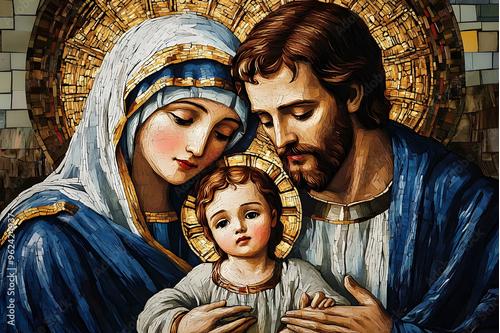
The Unity of the Holy Family: A Model for Christian Families Today
The Perfect Family Portrait
When we think of the perfect family, our minds often turn to idealized images - perhaps a Norman Rockwell painting or a holiday card scene. But the Church presents us with a different kind of perfect family portrait: the Holy Family of Jesus, Mary, and Joseph. This family wasn't perfect because they avoided difficulties, but because they lived in perfect harmony with God's will.
The Catechism of the Council of Trent teaches us that the family is "the first school of Christian life and a community of grace and prayer." In today's terms, this means our families are meant to be the primary place where we learn to love God and serve others. The Holy Family shows us exactly what this looks like in practice.
Saint John Chrysostom, the golden-tongued preacher of the 4th century, beautifully captured this truth when he wrote: "When husband and wife are united in marriage, they no longer seem like something earthly, but rather like the image of God himself." The Holy Family embodies this divine image perfectly.
Their unity wasn't based on shared interests or compatible personalities - it was rooted in their shared commitment to God's plan. Mary, the ever-virgin Mother of God; Joseph, the just and faithful guardian; and Jesus, the Son of God made man - three distinct persons united by divine love and purpose.
Today, when families are pulled in countless directions by work, technology, and cultural pressures, the Holy Family stands as our beacon. They show us that true family unity comes not from having everything go smoothly, but from facing life's challenges together with faith, hope, and love.
Unity in Obedience: The Annunciation and Joseph's Response
The foundation of the Holy Family's unity was laid in two separate moments of profound obedience to God. In Luke 1:26-38, we witness Mary's response to the angel Gabriel's announcement. When told she would conceive the Son of God, Mary didn't demand explanations or negotiate terms. Instead, she responded with perfect trust: "Behold the handmaid of the Lord; be it unto me according to thy word."
Saint Augustine marveled at Mary's response, writing: "Mary conceived Christ first in her heart by faith, and then in her womb by the Holy Spirit." The Council of Trent's Catechism explains that Mary's "yes" was not just personal consent, but the moment when "the Word became flesh and dwelt among us." In modern language, Mary's obedience literally changed the course of human history.
Meanwhile, Joseph faced his own moment of decision. Matthew 1:18-25 tells us that when he discovered Mary was with child, "being a just man, and not willing to make her a publick example, was minded to put her away privily." But God intervened through a dream, and Joseph chose to trust and obey.
Saint Bernard of Clairvaux wrote beautifully of Joseph's dilemma: "Joseph, being a just man, was torn between his legal obligation and his love for Mary. But God's grace resolved what human wisdom could not." The Catechism teaches that Joseph's obedience made him "the guardian of the mysteries of God." Today, we'd say that Joseph's willingness to step into an uncertain situation with faith made him the protector of God's greatest gift to humanity.
Notice that both Mary and Joseph said "yes" to God individually, but their separate acts of obedience created their unity. This teaches us that family unity begins with each person's personal relationship with God. When spouses both seek God's will above their own preferences, when parents and children alike strive to obey God's commandments, the family naturally grows in unity.
Unity in Crisis: The Flight to Egypt
The Holy Family's unity was immediately tested by crisis. In Matthew 2:13-15, we read: "And when they were departed, behold, the angel of the Lord appeareth to Joseph in a dream, saying, Arise, and take the young child and his mother, and flee into Egypt, and be thou there until I bring thee word: for Herod will seek the young child to destroy him."
Saint Jerome reflected on this moment: "See how the Holy Family becomes a family of refugees, teaching us that following God's will sometimes requires leaving our comfort behind." The Catechism of Trent explains that this flight to Egypt fulfilled the prophecy "Out of Egypt have I called my son," showing that even in crisis, God's plan was unfolding perfectly.
Think about what this meant practically: Joseph had to wake his family in the middle of the night, pack only essentials, and begin a dangerous journey to a foreign land. They left behind their home, their livelihood, their extended family, and everything familiar. Mary had to trust Joseph's leadership completely, even though the message came to him in a dream.
Saint John Damascene wrote: "Joseph's immediate obedience to the angel's command shows us that true faith acts without delay when God speaks." They became refugees, dependent on God's providence for their daily survival. The Catechism teaches us that the Holy Family's exile represents how all Christian families are "pilgrims on earth, seeking their true homeland in heaven."
Notice how the Holy Family responded to crisis: there was no arguing, no second-guessing, no blame. Joseph received God's direction and acted immediately. Mary trusted Joseph's leadership. They faced uncertainty together, supporting each other through faith rather than fear.
This teaches us that family unity in crisis comes from having clear spiritual leadership, mutual trust, and shared dependence on God's providence. When families face job loss, illness, or other emergencies today, the Holy Family's example shows us how to respond with faith rather than panic, unity rather than division.
Unity in Daily Life: The Finding in the Temple
Perhaps the most relatable story of the Holy Family is found in Luke 2:41-52 - the finding of Jesus in the temple. Here we see that even the Holy Family faced the everyday challenges that all families experience: misunderstandings, worry, and the growing pains of raising children.
The family had traveled to Jerusalem for Passover, as faithful Jewish families did each year. The Catechism of Trent emphasizes that the Holy Family was "perfectly observant of the law," meaning they faithfully participated in religious practices together. Saint Ambrose noted: "The Holy Family's annual pilgrimage teaches us that families grow in holiness through shared worship and religious observance."
When they began the journey home, Mary and Joseph discovered that twelve-year-old Jesus was missing. Luke tells us they "sought him among their kinsfolk and acquaintance" for a full day before returning to Jerusalem. Can you imagine their worry? Even the Mother of God experienced the anxiety that every parent knows when their child goes missing.
Saint Bonaventure wrote: "Mary and Joseph's three days of searching represent every parent's anguish when their child seems lost to them, whether physically or spiritually." The Catechism teaches that their search represents the "sorrow of separation from Christ" that all believers experience when sin creates distance from God.
When they finally found Jesus in the temple, "sitting in the midst of the doctors, both hearing them, and asking them questions," Mary's response was very human: "Son, why hast thou thus dealt with us? behold, thy father and I have sought thee sorrowing." Jesus' reply - "How is it that ye sought me? wist ye not that I must be about my Father's business?" - initially puzzled them. Saint Thomas Aquinas explained: "This moment marked Jesus' first declaration of his divine mission, teaching parents that children must eventually follow their own calling from God."
The key to their unity through this misunderstanding was their response: "And he went down with them, and came to Nazareth, and was subject unto them: but his mother kept all these sayings in her heart." Jesus submitted to their authority, while Mary pondered these events with faith rather than resentment.
Unity in Sacrifice: At the Foot of the Cross
The ultimate test of the Holy Family's unity came at Calvary. In John 19:25-27, we read: "Now there stood by the cross of Jesus his mother, and his mother's sister, Mary the wife of Cleophas, and Mary Magdalene. When Jesus therefore saw his mother, and the disciple standing by, whom he loved, he saith unto his mother, Woman, behold thy son! Then saith he to the disciple, Behold thy mother!"
Saint Anselm of Canterbury wrote: "Mary's presence at the cross was not mere maternal devotion, but cooperation in our redemption. Her suffering united with Christ's became our salvation." The Catechism of Trent teaches that Mary's presence at the cross fulfilled Simeon's prophecy that "a sword shall pierce through thy own soul also."
Think about what this moment required of the Holy Family. Mary had to watch her beloved son suffer the most brutal death imaginable. She could have stayed home, unable to bear the sight. Instead, she stood at the foot of the cross, united with Jesus in his sacrifice.
Saint Bernard wrote: "Mary stood at the cross not as a mere spectator, but as a co-offerer of the sacrifice. Her maternal heart was pierced so that our hearts might be healed." The Catechism explains that Mary's presence there made her "the Mother of all the living," cooperating in our salvation through her maternal suffering.
Joseph, though likely deceased by this time according to tradition, had prepared Mary for this moment through years of faithful partnership. Saint Francis de Sales observed: "Joseph's hidden life of faithful service prepared the Holy Family for their ultimate sacrifice. His quiet strength supported Mary through her greatest trial."
Jesus, even in his agony, was concerned for his mother's future. By entrusting her to John's care, he ensured that the family bonds formed in Nazareth would continue beyond his earthly life. The Catechism explains that this gesture made Mary the "Mother of the Church," extending the Holy Family's unity to include all believers.
This teaches us that true family unity isn't broken by death or suffering - it's actually perfected through sacrifice. When families face terminal illness, the death of a loved one, or other profound losses, the Holy Family shows us that love transcends physical separation.
Practical Application: Building Holy Family Unity Today
Having examined the Holy Family's example, how do we build this kind of unity in our own families today? Let me suggest several practical applications based on what we've learned, grounded in the wisdom of the Church's teaching and the saints who have gone before us.
First, establish family unity through shared obedience to God. The Catechism of Trent teaches that "the family is the domestic church," meaning our homes should be places where God's will is sought and followed. Saint John Chrysostom advised: "Let your home be a church, where prayers are offered, where Scripture is read, where all members encourage each other in virtue."
Second, develop clear spiritual leadership and mutual trust for times of crisis. Saint Augustine wrote: "The husband should lead his family as Christ leads the Church - with sacrificial love, not domineering authority." The Catechism explains that the father is called to be "the head of the family as Christ is head of the Church," while the mother shares in this leadership through her unique gifts.
Third, prioritize your family's spiritual life together. Saint Monica, mother of Augustine, exemplifies this perfectly. Despite her husband's initial hostility to Christianity, she persevered in prayer and gentle example, eventually converting both her husband and her wayward son. The Catechism teaches that parents are "the first educators in the faith" for their children.
Fourth, navigate misunderstandings with patience and faith. Saint Rita of Cascia, who endured an abusive marriage with remarkable patience, shows us how to respond to family difficulties with prayer rather than retaliation. The Catechism reminds us that "the family is the school of love," where we learn to forgive and be forgiven.
Finally, embrace sacrifice as the path to deeper unity. Saint Anne, mother of Mary, and Saint Joachim demonstrate how parents can sacrifice for their children's spiritual good. According to tradition, they dedicated Mary to God's service from her earliest years, showing us that family love sometimes requires letting go.
Saint Louis IX of France, who balanced his duties as king with his role as husband and father, wrote: "The greatest inheritance we can leave our children is not gold or land, but the example of a life lived in service to God." The Catechism teaches that "love is proved by deeds," and family love requires daily acts of self-sacrifice.
Remember, the goal isn't to avoid all conflict or difficulty - even the Holy Family faced challenges. The goal is to face life's ups and downs together, united in faith, hope, and love.
Closing Prayer and Commitment
As we conclude our reflection on the Holy Family's unity, I invite you to make a commitment to building this same kind of unity in your own family. The Holy Family's example isn't just a beautiful story from the past - it's a living model for Christian families today.
Saint Teresa of Avila wrote: "Let nothing disturb you. All things pass. God does not change. Patience obtains all." This wisdom applies perfectly to family life - when we root our unity in God's unchanging love, we can weather any storm.
The Catechism of the Council of Trent teaches us that the Holy Family is "the prototype of every Christian family," meaning they show us what God intends for all families. In today's language, this means their unity isn't an impossible ideal, but an achievable goal through God's grace.
Saint Thérèse of Lisieux, the Little Flower, grew up in a family that embodied Holy Family virtues. Her parents, Saints Louis and Zélie Martin, created a home so filled with love and faith that it produced not one but five religious vocations. Zélie Martin once wrote: "Our children are lent to us for such a short time. We must do everything we can to help them reach heaven."
Their unity was built on obedience to God's will, tested through crisis and misunderstanding, and perfected through sacrifice. These same elements can transform your family relationships if you're willing to follow their example.
Let us pray together: "Holy Family of Nazareth, Jesus, Mary, and Joseph, we consecrate our family to your protection and guidance. Help us to build the same unity you shared - unity rooted in obedience to God, strengthened through trials, and perfected through love.
Saint Joseph, guardian of the Holy Family, protect our family from all harm and guide our decisions with your wisdom. Mary, Mother of the Church, intercede for us that our family may reflect your perfect cooperation with God's will. Jesus, Son of God and Son of Mary, be the center of our family life, the source of our unity, and our eternal destination.
We ask this through Christ our Lord, who lives and reigns with the Father and the Holy Spirit, one God, forever and ever. Amen."
Go forth now, strengthened by the Holy Family's example and empowered by their intercession. As Saint Paul wrote to the Colossians: "And above all these put on love, which binds everything together in perfect harmony." Build families that reflect God's love, and be instruments of his peace in our broken world.