

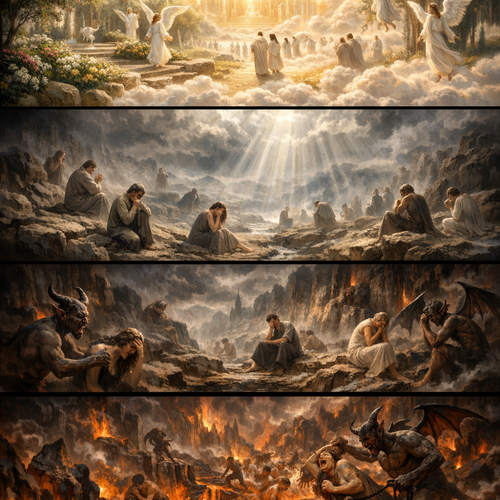
Lesson 6:The Foundation of Catholic Faith: Heaven, Hell, and End Times
Welcome to our sixth lesson in our series on the foundational beliefs of the Catholic faith. Today, we explore one of the most profound aspects of our theology: what happens after our earthly life concludes. The time we spend in this world represents merely a brief chapter in our eternal existence. As the Catechism of Trent teaches, we are created for eternal life, and our earthly pilgrimage is directed toward our ultimate end with God. As future priests, understanding these truths is essential not only for your own spiritual formation but for guiding the faithful entrusted to your care. The Church has consistently taught that death is not the end of our existence but a transition to eternal life. Today, we will explore the Catholic understanding of the afterlife as presented in the Tridentine Catechism: the nature of death, the particular judgment, the states of heaven, hell, and purgatory, and the final resurrection and general judgment.
I. The Tripartite Nature of Humanity
The Catechism of Trent affirms that humans are created as composite beings of body and soul, with the soul being spiritual and immortal. While maintaining this essential distinction, we can understand our nature in a tripartite manner as reflected in Scripture and interpreted through Catholic tradition: - The body: our material being, through which we interact with the physical world - The soul: our immortal spiritual principle, created directly by God - The spirit: not a separate substance from the soul, but rather the soul's capacity for divine communion As Saint Paul writes in 1 Thessalonians 5:23 (ESV-CE): "Now may the God of peace himself sanctify you completely, and may your whole spirit and soul and body be kept blameless at the coming of our Lord Jesus Christ." The Catechism of Trent explains, "Man consists of soul and body, but vastly different is the condition of each. The body is by nature corruptible and returns to dust, while the soul is immortal." Hebrews 4:12 (ESV-CE) further illuminates this understanding: "For the word of God is living and active, sharper than any two-edged sword, piercing to the division of soul and of spirit, of joints and of marrow, and discerning the thoughts and intentions of the heart." At death, the soul separates from the body, but this separation is not the natural state intended by God. The soul, though separated from the body, retains its identity and consciousness, awaiting the final resurrection when body and soul will be reunited.
II. Death and Judgment
The Catechism of Trent teaches that death entered the world as a consequence of original sin: "The first man, by transgressing the commandment of God, incurred the penalty of death." This aligns with Romans 5:12 (ESV-CE): "Therefore, just as sin came into the world through one man, and death through sin, and so death spread to all men because all sinned." Yet through Christ's redemption, death has been transformed from a punishment into a passage to eternal life for the faithful. As we read in 1 Corinthians 15:54-55 (ESV-CE): "When the perishable puts on the imperishable, and the mortal puts on immortality, then shall come to pass the saying that is written: 'Death is swallowed up in victory.' 'O death, where is your victory? O death, where is your sting?'" Death marks the end of our earthly pilgrimage and the moment when our eternal destiny is sealed. As the Catechism explains, "The time for meriting or increasing merit for eternal life ends at death."
The Particular Judgment
Immediately after death, each person undergoes what the Church calls the Particular Judgment. The Catechism of Trent affirms that "when the course of each one's life is completed, we shall all stand before the tribunal of God to render an account of all our thoughts, actions, and words, and receive from the eternal Judge the sentence we deserve." This teaching is rooted in Scripture, as Hebrews 9:27 (ESV-CE) states: "And just as it is appointed for man to die once, and after that comes judgment." At this judgment, the soul immediately receives its eternal retribution: either entrance into the blessedness of heaven—directly or through purification in purgatory—or immediate and everlasting damnation.
The Conscious State After Death
The Catechism clearly teaches that the soul remains conscious after death. The souls of the just who have completed their purification "are admitted to the vision of God in heaven, where they are replenished with all good." Meanwhile, the souls of the damned "are tormented in hell with eternal and most excruciating torments." This is illustrated in our Lord's account of the rich man and Lazarus in Luke 16:22-25 (ESV-CE): "The poor man died and was carried by the angels to Abraham's side. The rich man also died and was buried, and in Hades, being in torment, he lifted up his eyes and saw Abraham far off and Lazarus at his side. And he called out, 'Father Abraham, have mercy on me, and send Lazarus to dip the end of his finger in water and cool my tongue, for I am in anguish in this flame.' But Abraham said, 'Child, remember that you in your lifetime received your good things, and Lazarus in like manner bad things; but now he is comforted here, and you are in anguish.'" This teaching refutes the error of "soul sleep" or the idea that souls are unconscious between death and the final resurrection.
III. Purgatory: The State of Purification
The Catechism of Trent affirms the Church's ancient teaching on purgatory: "There is a purgatorial fire, in which the souls of the pious are purified by a temporary punishment, in order to be admitted into their eternal country, 'where nothing defiled can enter.'" This doctrine finds scriptural support in passages such as 1 Corinthians 3:13-15 (ESV-CE): "Each one's work will become manifest, for the Day will disclose it, because it will be revealed by fire, and the fire will test what sort of work each one has done. If the work that anyone has built on the foundation survives, he will receive a reward. If anyone's work is burned up, he will suffer loss, though he himself will be saved, but only as through fire." The reference to "nothing defiled" entering heaven comes from Revelation 21:27 (ESV-CE): "But nothing unclean will ever enter it, nor anyone who does what is detestable or false, but only those who are written in the Lamb's book of life."
Purgatory is not a "second chance" for conversion but rather a process of purification for those who have died in Christ but still bear the temporal effects of sin. As the Catechism explains, "The debt which we owe to the justice of God must be paid in full, either in this life or in the next." This understanding is supported by Matthew 5:26 (ESV-CE), where our Lord says: "Truly, I say to you, you will never get out until you have paid the last penny."
Suffrages for the Dead
The Catechism teaches that the faithful on earth can assist the souls in purgatory through prayers, almsgiving, and especially the Holy Sacrifice of the Mass: "The souls detained in purgatory are aided by the suffrages of the faithful, but especially by the acceptable sacrifice of the altar." This practice finds its scriptural basis in 2 Maccabees 12:42-45 (ESV-CE), where Judas Maccabeus takes up a collection for a sin offering on behalf of the dead: "He then took up a collection among all his soldiers, amounting to two thousand silver drachmas, which he sent to Jerusalem to provide for an expiatory sacrifice. In doing this he acted in a very excellent and noble way, inasmuch as he had the resurrection in mind; for if he were not expecting the fallen to rise again, it would have been superfluous and foolish to pray for the dead. But if he did this with a view to the splendid reward that awaits those who had gone to rest in godliness, it was a holy and pious thought. Thus he made atonement for the dead that they might be absolved from their sin." This practice flows from the doctrine of the Communion of Saints, which unites all members of Christ's Mystical Body—whether in heaven, on earth, or in purgatory—in a bond of charity and mutual assistance.
IV. Heaven: The Beatific Vision
The Catechism of Trent describes heaven as the state of supreme and perfect happiness, which consists primarily in the vision of God: "The happiness of heaven consists in the clear vision of God and in the perfect enjoyment of His eternal beauty." This Beatific Vision—seeing God face to face—is the fulfillment of all human desires and the purpose for which we were created. As 1 Corinthians 13:12 (ESV-CE) expresses it: "For now we see in a mirror dimly, but then face to face. Now I know in part; then I shall know fully, even as I have been fully known." And as 1 John 3:2 (ESV-CE) promises: "Beloved, we are God's children now, and what we will be has not yet appeared; but we know that when he appears we shall be like him, because we shall see him as he is."
The Communion of Saints in Heaven
In heaven, the blessed form a community of all who are perfectly incorporated into Christ. They enjoy perfect communion with the Holy Trinity and with one another. The Catechism teaches that the saints in heaven "continually intercede with God for us," serving as our advocates and models of holiness. This communion is depicted in Revelation 7:9-10 (ESV-CE): "After this I looked, and behold, a great multitude that no one could number, from every nation, from all tribes and peoples and languages, standing before the throne and before the Lamb, clothed in white robes, with palm branches in their hands, and crying out with a loud voice, 'Salvation belongs to our God who sits on the throne, and to the Lamb!'"
The Degrees of Heavenly Glory
While all in heaven enjoy perfect happiness, the Catechism affirms that there are different degrees of glory according to each person's merit: "In the house of my Father there are many mansions, in which greater or less rewards are rendered according to greater or less merit." This teaching is based on our Lord's words in John 14:2 (ESV-CE): "In my Father's house are many rooms. If it were not so, would I have told you that I go to prepare a place for you?" Saint Paul also indicates degrees of heavenly glory in 1 Corinthians 15:41-42 (ESV-CE): "There is one glory of the sun, and another glory of the moon, and another glory of the stars; for star differs from star in glory. So is it with the resurrection of the dead." This teaching maintains both God's justice in rewarding virtue and the perfect happiness of all the blessed, who each receive the fullness of joy according to their capacity.
V. The Reality of Hell
The Catechism of Trent clearly affirms the reality of hell as the state of eternal separation from God: "The wicked shall be cast into eternal fire, which is prepared for the devil and his angels." This teaching directly echoes our Lord's words in Matthew 25:41 (ESV-CE): "Then he will say to those on his left, 'Depart from me, you cursed, into the eternal fire prepared for the devil and his angels.'" Hell is not simply a metaphorical state but an actual condition of eternal punishment for those who die in mortal sin without repentance. As the Catechism explains, "The chief punishment of hell is eternal separation from God, in whom alone man can possess the life and happiness for which he was created." Our Lord emphasizes the reality of hell in Mark 9:47-48 (ESV-CE): "And if your eye causes you to sin, tear it out. It is better for you to enter the kingdom of God with one eye than with two eyes to be thrown into hell, 'where their worm does not die and the fire is not quenched.'"
The Justice of Eternal Punishment
The eternity of hell's punishments corresponds to the gravity of rejecting God's infinite love and mercy. The Catechism teaches that "even a single mortal sin contains an infinite malice" because it offends the infinite goodness of God. God's justice demands that those who have definitively rejected His love through unrepented mortal sin should remain separated from Him forever. Yet this punishment is ultimately self-chosen, as the sinner has freely rejected communion with God. This eternal separation is described in 2 Thessalonians 1:9 (ESV-CE): "They will suffer the punishment of eternal destruction, away from the presence of the Lord and from the glory of his might."
The Church's Pastoral Approach
While firmly teaching the reality of hell, the Church approaches this doctrine with pastoral sensitivity. The Catechism instructs priests to teach these truths "with great prudence, lest, overwhelmed by fear, the faithful despair of salvation." The proper response to the doctrine of hell is not despair but a healthy fear of the Lord, sincere repentance for sin, and trust in God's mercy through the sacraments of the Church. As Psalm 103:11-13 (ESV-CE) reminds us: "For as high as the heavens are above the earth, so great is his steadfast love toward those who fear him; as far as the east is from the west, so far does he remove our transgressions from us. As a father shows compassion to his children, so the Lord shows compassion to those who fear him."
VI. The Resurrection of the Body
The Catechism of Trent emphasizes the resurrection of the body as a fundamental article of Catholic faith: "All men, both good and bad, shall rise from the dead in their own bodies which they now have, though these bodies shall have the quality of immortality." This doctrine is firmly grounded in Scripture, as our Lord himself teaches in John 5:28-29 (ESV-CE): "Do not marvel at this, for an hour is coming when all who are in the tombs will hear his voice and come out, those who have done good to the resurrection of life, and those who have done evil to the resurrection of judgment." This resurrection is not the creation of new bodies but the restoration and transformation of our current bodies. As the Catechism states, "The very same body which belongs to each one during life, though it has been corrupted and dissolved into dust, shall be raised from the earth." Saint Paul elaborates on this mystery in 1 Corinthians 15:42-44 (ESV-CE): "So is it with the resurrection of the dead. What is sown is perishable; what is raised is imperishable. It is sown in dishonor; it is raised in glory. It is sown in weakness; it is raised in power. It is sown a natural body; it is raised a spiritual body. If there is a natural body, there is also a spiritual body."
The Nature of the Resurrected Body
The Catechism teaches that the resurrected bodies of the just will be glorified, possessing the qualities of: - Impassibility: freedom from suffering and death - Clarity: beauty and radiance reflecting the soul's glory - Agility: freedom from the body's natural heaviness - Subtility: perfect subjection to the soul These qualities are suggested in Philippians 3:20-21 (ESV-CE): "But our citizenship is in heaven, and from it we await a Savior, the Lord Jesus Christ, who will transform our lowly body to be like his glorious body, by the power that enables him even to subject all things to himself." In contrast, the bodies of the damned will be incorruptible but not glorified, capable of suffering eternally without being destroyed.
Christ: The Model of Our Resurrection
Our Lord's Resurrection is both the cause and the model of our own. As the Catechism explains, "Christ the Lord arose again in the same body which was born of the Virgin Mary and crucified on the cross. This article of faith concerning the resurrection has been confirmed by numerous testimonies of Sacred Scripture and by the constant tradition of the Church." Saint Paul affirms this in 1 Corinthians 15:20-23 (ESV-CE): "But in fact Christ has been raised from the dead, the firstfruits of those who have fallen asleep. For as by a man came death, by a man has come also the resurrection of the dead. For as in Adam all die, so also in Christ shall all be made alive. But each in his own order: Christ the firstfruits, then at his coming those who belong to Christ." Just as Christ rose with His glorified yet real body—bearing the marks of His Passion—so too will our bodies be truly our own, though transformed according to our eternal destiny.
VII. The General Judgment and the End of Time
The Catechism of Trent teaches that at the end of time, Christ will return in glory to judge the living and the dead: "Christ our Lord shall descend from heaven to judge the whole human race." This Second Coming will be visible and glorious, unlike His first coming in humility. As the Catechism states, "He shall come with supreme power and majesty, attended by angels." This teaching is drawn from Matthew 25:31-32 (ESV-CE): "When the Son of Man comes in his glory, and all the angels with him, then he will sit on his glorious throne. Before him will be gathered all the nations, and he will separate people one from another as a shepherd separates the sheep from the goats."
The General Judgment
While each soul receives its particular judgment immediately after death, the Catechism affirms that there will also be a general judgment of all humanity at the end of time. This judgment serves several purposes: - To vindicate God's justice before all creation - To give due praise to the righteous who were often despised in this life - To complete the judgment by including the body, which shared in the soul's good or evil deeds - To extend judgment to the good or evil that continued to result from each person's actions after their death This final judgment is described in Revelation 20:11-12 (ESV-CE): "Then I saw a great white throne and him who was seated on it. From his presence earth and sky fled away, and no place was found for them. And I saw the dead, great and small, standing before the throne, and books were opened. Then another book was opened, which is the book of life. And the dead were judged by what was written in the books, according to what they had done."
The New Heaven and New Earth
Following the general judgment, the Catechism teaches that God will create "new heavens and a new earth" where the just will dwell forever in glorified bodies. This renewal of creation fulfills God's original plan that was disrupted by sin. As described in Revelation 21:1-4 (ESV-CE): "Then I saw a new heaven and a new earth, for the first heaven and the first earth had passed away, and the sea was no more. And I saw the holy city, new Jerusalem, coming down out of heaven from God, prepared as a bride adorned for her husband. And I heard a loud voice from the throne saying, 'Behold, the dwelling place of God is with man. He will dwell with them, and they will be his people, and God himself will be with them as their God. He will wipe away every tear from their eyes, and death shall be no more, neither shall there be mourning, nor crying, nor pain anymore, for the former things have passed away.'" In this eternal state, all creation will be perfectly ordered to God's glory, and the communion between God and His people will be perfect and unending.