

The Rest of the Christmas Story: Gods Protection in Our Darkest Hours
The Christmas Story Continues
As we gather here just days after Christmas, our hearts are still warm with the joy of Christ's birth. We've sung "Silent Night," we've celebrated the wonder of the incarnation, and we've marveled at God's love made manifest in a manger. But today, I want us to turn the page in Matthew's Gospel and discover what happened next - the part of the Christmas story that doesn't make it onto our greeting cards. Matthew 2:13-18 reveals a stark reality: "Now when they had departed, behold, an angel of the Lord appeareth to Joseph in a dream, saying, Arise, and take the young child and his mother, and flee into Egypt, and be thou there until I bring thee word: for Herod will seek the young child to destroy him." The Christmas story didn't end with the wise men's departure. In fact, the most dangerous chapter was just beginning. While we often conclude our Christmas celebrations with peace and joy, the holy family was about to face persecution, exile, and witness unspeakable tragedy. This morning, we'll discover how God's protection operates not by removing us from danger, but by preserving His purposes even in the darkest circumstances.
Divine Warning and Obedience
Notice how God protects His people - through divine revelation and faithful obedience. "When they had departed, behold, an angel of the Lord appeareth to Joseph in a dream." This wasn't Joseph's first angelic visitation. Earlier, an angel had appeared to assure him about Mary's pregnancy. Now, God speaks again through His messenger. The message was urgent and specific: "Arise, and take the young child and his mother, and flee into Egypt." There was no time for deliberation, no opportunity to pack belongings or say goodbye to neighbors. The threat was immediate - "for Herod will seek the young child to destroy him." Joseph's response reveals the character that made him God's chosen protector for His Son: "When he arose, he took the young child and his mother by night, and departed into Egypt." No questions asked. No delay. No hesitation. Joseph understood that obedience to God's word was a matter of life and death. How often do we, like Joseph, receive God's guidance through His Word, through prayer, through the counsel of faithful believers? And how quickly do we respond? Joseph's immediate obedience reminds us that God's protection often requires our faithful action. Divine sovereignty and human responsibility work together in God's plan of protection.
The Flight to Egypt: Fulfilling Ancient Prophecy
Matthew tells us this flight fulfilled ancient prophecy: "And was there until the death of Herod: that it might be fulfilled which was spoken of the Lord by the prophet, saying, Out of Egypt have I called my son." This references Hosea 11:1, originally speaking of Israel's exodus from Egyptian bondage. But see how beautifully God weaves His plan through history! Just as Israel was called out of Egypt to become God's chosen nation, now the true Son of God follows the same path. Jesus recapitulates Israel's journey, but where Israel often failed, Jesus would succeed perfectly. The irony is profound - Egypt, once the house of bondage for God's people, now becomes a place of refuge for the Messiah. The very land from which God delivered His people through Moses now shelters the One who would deliver all people from sin's bondage. God's protection doesn't always look like what we expect. Sometimes He leads us into places that seem unlikely or even contrary to His past dealings. This teaches us that God's protection is always purposeful. Every step of Jesus' early life was preparing Him for His mission. Even this dangerous flight served God's greater plan of redemption. When we face unexpected turns in our own lives, we can trust that God is weaving even our difficulties into His perfect design.
Herod's Rage: The World's Rejection of Christ
Now we come to the darkest part of our passage: "Then Herod, when he saw that he was mocked of the wise men, was exceeding wroth, and sent forth, and slew all the children that were in Bethlehem, and in all the coasts thereof, from two years old and under, according to the time which he had diligently enquired of the wise men." Herod's massacre reveals the world's fundamental hostility to Christ. This wasn't merely political calculation - this was spiritual warfare made manifest. The prince of darkness, working through earthly power, sought to destroy the Light of the World before His mission could begin. These innocent children became the first martyrs for Christ, though they knew it not. Church tradition has long honored them as the Holy Innocents, recognizing that their deaths were directly connected to Christ's birth. They died because the King of Kings had been born among them. This reminds us that the world's hatred of Christ often spills over onto His people. The world's rejection of our Savior inevitably affects those who bear His name. Yet even in this horror, we see God's sovereignty. Herod's rage, intended to thwart God's plan, actually fulfilled it. Evil overreached itself and served God's purposes despite its malicious intent.
Rachel Weeping: God's Presence in Suffering
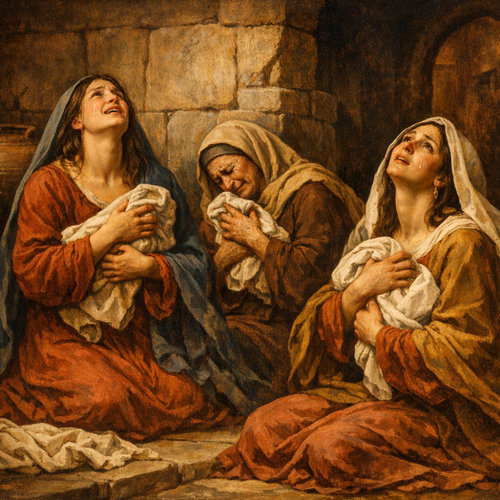
Matthew connects this tragedy to another ancient prophecy: "Then was fulfilled that which was spoken by Jeremy the prophet, saying, In Rama was there a voice heard, lamentation, and weeping, and great mourning, Rachel weeping for her children, and would not be comforted, because they are not." This reference to Jeremiah 31:15 is profound. Rachel, the beloved wife of Jacob and mother of Joseph and Benjamin, represents all mothers grieving for their children. Her tomb was near Bethlehem, and now her symbolic weeping echoes through the streets as mothers mourn their slaughtered babies. But here's what we must not miss - in Jeremiah's original context, this weeping was not the end of the story. Just verses later, God promises: "Refrain thy voice from weeping, and thine eyes from tears: for thy work shall be rewarded, saith the Lord; and they shall come again from the land of the enemy. And there is hope in thine end, saith the Lord, that thy children shall come again to their own border." God doesn't ignore suffering. He doesn't minimize grief. The Scripture acknowledges that Rachel "would not be comforted" - some sorrows run too deep for easy consolation. But God enters into that suffering and promises that it will not have the final word. This is crucial for us to understand. God's protection doesn't mean the absence of suffering. It means His presence in suffering and His promise that suffering will not defeat His purposes. The mothers of Bethlehem wept real tears over real loss, but their children's deaths were not meaningless - they were connected to the greatest story of redemption ever told.
Hope Preserved Through Protection
While tragedy struck Bethlehem, hope was preserved in Egypt. The Christ child lived because God's protection was effective. This is the central truth we must grasp - God's protection of Jesus ensured that Christmas hope would survive even the darkest persecution. Think about what was at stake. If Herod had succeeded, if Jesus had perished with the other children, there would be no salvation, no redemption, no hope for any of us. The entire plan of God hung on the protection of one small child. And God's protection proved sufficient. This teaches us that God's protection is always purposeful and always effective for His ultimate plans. He may not protect us from every hardship - indeed, many of those innocent children were not spared. But He will always protect what is necessary for His redemptive purposes to be fulfilled. The preservation of Jesus meant the preservation of hope for all humanity. Every promise of God, every prophecy of redemption, every hope for eternal life - all depended on this child reaching maturity and fulfilling His mission. God's protection made it possible. This gives us confidence in our own dark times. We may not understand why some are spared and others suffer, but we can trust that God's protective purposes are always at work. He is preserving what matters most - His plan of salvation and His people's ultimate good.
Living as Protected People
So how do we live in light of this passage? How do we apply these truths to our own lives as we face persecution, tragedy, and dark times?
First, we must cultivate Joseph's spirit of immediate obedience. When God speaks through His Word, through prayer, through godly counsel, we must be ready to act quickly and faithfully. God's protection often requires our cooperation.
Second, we must trust God's sovereignty even when His protection doesn't look like what we expected. Sometimes God leads us into Egypt - into unexpected places of refuge that don't match our preferences. We must trust that He knows what He's doing.
Third, we must acknowledge that following Christ may bring suffering. The world's hatred of our Savior will sometimes spill over onto us. But we can face this knowing that our suffering is connected to His greater purposes.
Fourth, we must not minimize real grief and loss. God doesn't call us to pretend that tragedy doesn't hurt. Like Rachel, we may weep and struggle to be comforted. That's human and acceptable to God.
Finally, we must hold fast to hope. Even in our darkest hours, God is preserving what matters most. His plan of redemption continues, His love endures, and His protection is sufficient for His purposes.
Let us remember that the Christmas story includes both the manger and the massacre, both divine protection and human suffering, both joy and sorrow. But through it all, God's love and protection ensure that hope survives and His purposes prevail. The Christ child who was protected in Egypt grew up to die on a cross - but that death became our salvation. God's protection of Jesus wasn't ultimately about preserving His earthly life, but about ensuring He could give that life for us. That's the hope that survives every dark hour - the hope of Christmas that no Herod can destroy. -F.D.