

Strangers and Pilgrims: Suffering Well in a World Not Our Own
St. Thomas More on the Scaffold
Picture this. It is the sixth of July, in the year fifteen thirty-five. The summer sun is already climbing over London. A man is being led through the streets toward Tower Hill, where a wooden scaffold has been built for his execution. He has spent the last fourteen months in the Tower of London — separated from his family, stripped of his property, denied his freedom — all because he refused to swear an oath that violated his conscience before God.
His name is Thomas More. He was once the Lord Chancellor of England, one of the most powerful men in the entire realm. And now he is about to die.
What strikes the people who were there — and what strikes us even now, nearly five centuries later — is not his fear. It is his peace. As he climbed the steps of the scaffold, which were a bit shaky that morning, he turned to the Lieutenant of the Tower and said with a smile, "See me safe up. For my coming down, I can shift for myself." A joke. The man is about to be beheaded, and he makes a joke. Then he knelt, prayed the fifty-first Psalm, told the executioner he forgave him, and died with these words on his lips — that he died the king's good servant, but God's first.
Now I want you to sit with that image for just a moment. How does a man do that? How does a man climb those scaffold steps with that kind of calm, that kind of steady peace, that kind of even a touch of humor?
I will tell you how. Thomas More knew something that the crowd around him had largely forgotten. He knew he was an exile here. He knew this world was not his home. He knew the scaffold was not the end of the story — it was barely even the beginning of it. And because he held this world loosely, this world had no ultimate grip on him.
That is the message of First Peter, chapter two, verses eleven through nineteen. And I believe it is one of the most needed messages for God's people in any age, including right now, including today. Listen carefully as I read from First Peter, chapter two, beginning at verse eleven.
"Beloved, I urge you as sojourners and exiles to abstain from the passions of the flesh, which wage war against your soul. Keep your conduct among the Gentiles honourable, so that when they speak against you as evildoers, they may see your good deeds and glorify God on the day of visitation. Be subject for the Lord's sake to every human institution, whether it be to the emperor as supreme, or to governors as sent by him to punish those who do evil and to praise those who do good. For this is the will of God, that by doing good you should put to silence the ignorance of foolish people. Live as people who are free, not using your freedom as a cover-up for evil, but living as servants of God. Honour everyone. Love the brotherhood. Fear God. Honour the emperor. Servants, be subject to your masters with all respect, not only to the good and gentle but also to the unjust. For this is a gracious thing, when, mindful of God, one endures sorrows while suffering unjustly."
Sojourners and exiles. That is what Peter calls us. And I want to unpack what that means for how we suffer, how we live, and how we hold — or how we let go of — this world.
Beloved Exiles — Establishing the Pilgrim Identity
I want you to notice how Peter opens this section. He does not start with a command. He starts with affection. He starts with love. "Beloved, I urge you." There is something tender in the way Peter addresses these suffering people before he challenges them. He is not scolding them. He is not barking orders at them. He is speaking as a shepherd to people he genuinely loves, people who are genuinely struggling. And then out of that tenderness he speaks hard truth.
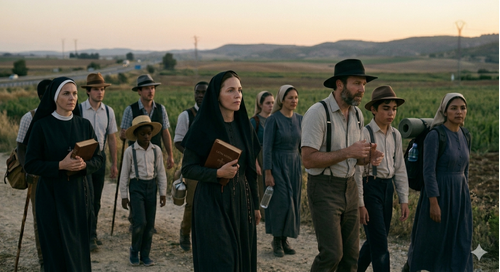
And what does he call them? He calls them sojourners and exiles. Now in the Greek, Peter uses two words here. The first is paroikous — a resident alien, someone living in a place where they do not fully belong, someone without the full rights of citizenship. The second is parepidemos — someone who is passing through, a sojourner, a traveler moving toward a destination that is still ahead. Put those two together and you get a picture of someone who lives in a place but does not ultimately belong there — who is moving through a land that is not their final home.
Now let me ask you plainly. Does that describe you? Because if you have been born again by the Spirit of God, if you have put your trust in Jesus Christ, then this world is no longer your final address. You are an exile. You are a sojourner. You are passing through.
The Catechism of the Council of Trent, reflecting on this very truth, describes the Christian life as a pilgrimage — a journey through the present age toward the age to come. And that pilgrim identity is not something peripheral or optional. It is absolutely central. It shapes everything about how we live — how we make decisions, how we hold our possessions, how we endure hardship, how we make sense of our suffering.
Think about what a sojourner does and does not do. A sojourner does not buy a house in the town he is merely passing through. A sojourner does not plant deep roots in a field that is not his inheritance. A sojourner travels light. A sojourner keeps his eyes on where he is going, not just on where he currently is. A sojourner can endure difficult roads and uncomfortable nights because he knows what is waiting at the end of the journey.
This is the life Peter is calling us to. And friends, this cuts directly against the grain of everything the world around us keeps telling us. The world is constantly saying — plant your roots here, find your happiness here, protect yourself here, build your kingdom here, hold on tight to what you have here. And Scripture quietly and firmly says — you are an exile. You are a sojourner. You are passing through.
St. Catherine of Siena — that remarkable young woman who lived in fourteenth-century Italy and who suffered enormously throughout her short life of thirty-three years — understood this at a profound level. She wrote these words, and I want you to hear them slowly: "All the way to heaven is heaven, because He said, I am the Way." Read that again. The journey itself, even when it is painful, is already filled with the presence of the One who is our destination. We are not waiting until we arrive to encounter God. God is with us on the road. But the road is still a road. And sojourners and exiles do not make the road their permanent dwelling.
That is the foundation Peter lays. Now let us see where he builds on it.
A Little While — The Mystery of Temporary Sorrow
Peter's readers were suffering. We need to understand that clearly. These were not people sitting in comfortable circumstances wondering in some abstract way whether Christianity was worth it. These were people experiencing real grief, real persecution, real loss. They had been scattered. They were being spoken against. They were being called evildoers by the very communities they were trying to live among. And Peter's letter is written to people who need to know that this suffering, as genuine and heavy as it is, is not the final word.
Hear now these words from the Gospel of John, chapter sixteen. Jesus is speaking to His disciples on the very night before His crucifixion — the night before His own supreme suffering — and He says this, beginning at verse twenty: "Truly, truly, I say to you, you will weep and lament, but the world will rejoice. You will be sorrowful, but your sorrow will turn into joy. When a woman is giving birth, she has sorrow because her hour has come, but when she has delivered the baby, she no longer remembers the anguish, for joy that a human being has been born into the world. So also you have sorrow now, but I will see you again, and your hearts will rejoice, and no one will take your joy from you."
A little while. Jesus uses that phrase several times in this conversation with His disciples. Your sorrow is real. Your weeping is real. But it is for a little while. And then — joy that no one can take from you.
Now I want to be honest with you here, because I think the text deserves honesty. When you are in the middle of deep suffering, the phrase a little while can feel almost mocking. When the grief is heavy, when the trial stretches on month after month, when the injustice keeps going and there is no relief in sight — a little while can feel like anything but a comfort. It can even feel dismissive.
But here is what Jesus is actually doing in that moment. He is not minimizing the pain. He is not pretending the sorrow is small. He is reframing it. He is placing it inside a larger story — a story that does not end with tears. He is saying, I see your sorrow. I am with you in it. But I am telling you that this sorrow is not the final chapter. There is a joy coming that will make this sorrow look, by comparison, like — well, like a little while.
Catherine of Siena, who experienced profound mystical gifts alongside deep physical suffering, intense spiritual darkness, and enormous opposition in her life and work, wrote about this truth with a clarity that could only come from someone who had actually lived it. She described the soul's journey to God as a river that must pass through narrow and rocky places before it reaches the wide, open sea of God's love. The rocky places are real. The narrow passages are real. The current is sometimes swift and frightening. But the sea is also real. And the sea is where you are headed.
She also wrote — and this is a remarkable thing for a woman in the middle of great suffering to say — "Eternal God, eternal Trinity, you have made the blood of Christ so precious through his sharing in your divine nature. You are a mystery as deep as the sea; the more I search, the more I find, and the more I find, the more I search for you." Catherine was not minimizing her sorrow by those words. She was plunging it into something immeasurably bigger than the sorrow itself.
Friends, your sorrow is real. Your trial is real. But God is deeper than your sorrow. And the joy He promises on the other side of it is more permanent than any grief you have ever experienced. A little while — and then joy that no man can take from you.
The Labor Pains of Eternity — Suffering as Birth Pang
Now I want to come back to that image Jesus uses in John sixteen, because there is more in it than we might catch on a first reading. He says a woman in labor has sorrow because her hour has come. But as soon as the child is born, she no longer remembers the anguish — for joy that a man is born into the world.
This is a very specific analogy, and the specificity matters. Jesus is not just saying that good things follow hard things in a general sort of way. He is saying something far more precise than that. He is saying that your suffering is productive. It is purposeful. It is like labor — it is not random pain, it is pain that is bringing forth life. There is something being born in the middle of your hardship that you may not yet be able to see from where you are standing.
Now I know that when you are in the middle of a trial that seems to go on and on, this can be difficult to believe. When you are suffering unjustly — when, as Peter will say in verse nineteen, you are enduring grief for conscience toward God — it can be very hard to see any purpose in it at all. It can look like nothing but loss.
But I want to bring two more voices into the room here, because I think they have something important to say to us.
St. Teresa of Ávila — that remarkable sixteenth-century woman who spent her life reforming religious houses across Spain while battling poor health, fierce opposition from within the church, enormous administrative burdens, and long seasons of spiritual dryness — wrote these words that have carried God's people through centuries of suffering: "Let nothing disturb you, let nothing frighten you. All things are passing. God never changes. Patience obtains all things. Whoever has God lacks nothing. God alone suffices."
"All things are passing." All things. Including this pain. Including this hard season. Including this unjust situation that feels like it will never change. It is passing. It is moving toward something. And in the moving, God is at work.
St. Gregory the Great — that pastoral and deeply compassionate bishop of Rome in the sixth century who wrote his massive commentary on the book of Job, that great biblical meditation on suffering — taught that suffering, when received with faith and patience, does something in the soul that no comfortable season could ever accomplish. Gregory saw in Job's trial not random cruelty, but the purposeful hand of a God who was shaping His servant for a depth of knowing and a quality of character that the easy years simply could not produce. The suffering had direction. It had a destination. It was going somewhere.
And is that not exactly what Jesus is showing us in John sixteen? The labor pain is not meaningless. The woman in labor is not suffering without purpose. The pain has a direction. A child is coming. New life is coming. Something is being born that could not have been born any other way.
Now I want to be clear — this is not a call to pretend that suffering does not hurt. Teresa of Ávila knew suffering was real. She wrestled with it for decades. Gregory the Great knew suffering was real — he watched the world crumbling around him and served through plague and invasion and heartbreak. Catherine of Siena knew suffering was real — she died at thirty-three years old, worn out by her labors and her illnesses. These are not people telling us that pain is an illusion or that we should simply smile and push through. They are people who looked suffering in the face — and then looked past it, toward the One who holds both the suffering and the joy in His hands.
That is the difference that changes everything. Not that the pain is small. But that the God on the other side of it is great.
Suffering Well — The Call to Patient Endurance
Now let us come back to First Peter, chapter two, and get very practical. Because Peter does not stop at telling us we are sojourners and exiles and leaving it there as a nice spiritual idea. He tells us how sojourners and exiles are actually supposed to live — specifically and concretely in the middle of suffering and injustice and accusation.
Look at verse twelve. "Keep your conduct among the Gentiles honourable, so that when they speak against you as evildoers, they may see your good deeds and glorify God on the day of visitation."
Live honestly. Live with integrity. Even when people are slandering you, even when people are speaking against you without cause, your response is not to fight back with the same weapons they are using. Your response is to live so consistently, so honorably, so genuinely well that your life itself becomes a testimony their accusations cannot permanently silence. Your good works become the argument. Your character becomes the evidence.
Then look at verses thirteen through sixteen. Peter calls his readers to submit to human authority — to kings and to governors — not because those authorities are always right or always just, but for the Lord's sake. He says they are to live as free people — and they are free, genuinely free, children of God — but they are not to use that freedom as a cover for doing evil. They are to live as servants of God in the middle of a world that does not fully understand them.
Now this would have been a very challenging word for Peter's original readers to receive. They were suffering under Roman authority. They were being mistreated. And Peter says — honor the king. Live as witnesses in the world. This is not a call to passive acceptance of every wrong that is done to you. It is a call to something harder than simple rebellion. It is a call to patient, principled, conscience-driven endurance that refuses to become what it is fighting against.
The Catechism of the Council of Trent, reflecting on passages like this, speaks of the Christian's calling to live as a witness in the midst of the world — not to withdraw completely from it, but to inhabit it as an exile who nonetheless serves the common good, bearing testimony through the quality of their daily life to the Kingdom to which they truly and finally belong. You pass through the land, but you leave it better than you found it. That is a sojourner's calling.
And then we come to verse nineteen, and I want you to hear this carefully, because I think this is the heartbeat of the whole passage. "For this is a gracious thing, when, mindful of God, one endures sorrows while suffering unjustly."
For conscience toward God. That phrase carries tremendous weight. Peter is not talking about suffering in general. He is not talking about suffering that comes as a result of our own mistakes or our own poor choices. He is talking specifically about suffering that comes because you are doing what is right — what your conscience before God demands of you — and the world punishes you for it anyway.
And he says that kind of suffering is thankworthy. The Greek word there is charis — grace, favor. There is a divine grace, a heavenly favor, resting on the person who suffers wrongfully for the sake of conscience toward God. God sees that suffering. God honors that endurance. It is not wasted. It is not invisible. It is not forgotten by the One who numbers the hairs on your head.
Thomas More endured exactly this kind of suffering. He was not suffering because he had done something wrong. He was suffering precisely because he would not do something wrong. He would not swear an oath that violated his conscience before God, no matter what the earthly cost. And he endured that suffering with patience and dignity and a kind of quiet, settled joy — because he knew he was suffering for conscience toward God. And he trusted that God saw him.
Friends, when you are tempted to compromise — when the cost of faithfulness looks very high and the price of going along seems very reasonable — remember that there is a grace, a charis, resting on those who suffer wrongfully for conscience toward God. You are not alone in that place. God sees you there. And what you are enduring in faithfulness is not wasted, not for a single moment.
Hold Loosely — A Call to Detachment and Eternal Hope
We come back at the end to where we started. Thomas More on a scaffold on a summer morning in fifteen thirty-five.
I want you to think about what made that kind of death possible. What kind of life do you have to have lived to die like that? What kind of relationship with this world — or rather, what kind of relationship with the next world — do you have to have cultivated to be able to stand on those shaky steps and make a small joke, and then bow your head and forgive the man who is about to end your life here?
You have to have held this world loosely. You have to have already decided — somewhere in the ordinary days long before the crisis ever came — that this world is not your home, that your life here is not the whole story, that the things this world can give you and the things this world can take from you are not ultimate. You have to have already made your peace with being an exile. The scaffold was not where Thomas More decided what he believed. That had been decided long before, in the quiet and the ordinary. The scaffold was only where it was revealed.
And that is the life Peter is calling each of us to today. Not a life of misery. Not a life that refuses to engage the world or love the people around us. But a life that holds the world's goods — its comforts, its securities, its honors, its threats — with an open hand. A pilgrim's hand.
Catherine of Siena, asked how she endured such remarkable suffering with such consistent peace, essentially answered that she had made her home in the knowledge of God rather than in the circumstances of her life. Her circumstances were often terrible. Her home was unshakeable. The circumstances changed constantly. The home never did.
Teresa of Ávila, in the middle of all the opposition she faced and all the physical suffering she bore year after year, kept returning to that same anchor: God alone suffices. Not comfort. Not health. Not the resolution of her difficulties. Not the approval of others. Not the success of her work, even her good and godly work. God alone suffices. When you have said that and truly meant it, you are holding the world with an open hand.
Gregory the Great, writing to people who were watching the great civilization around them crumbling and did not know what to make of it, said something that speaks directly across the centuries to us: do not be surprised that the world is passing away. You were always exiles in it. It was never going to be permanent. It was never meant to be your final home. Grieve what is passing, yes. But do not be undone by it. You belong somewhere else.
And Thomas More — Thomas More simply lived what he believed all the way to the end. He had spent his life as a lawyer, a statesman, a husband, a father — a man fully engaged in the world, not hiding from it. But underneath all of that engagement, he had always held the world with an open hand. And when the moment finally came — when the king demanded that he close his fist around a lie — he simply opened his hand and let it go. And walked up those scaffold steps with a steady heart and a gentle joke, because the things that truly mattered to him could not be taken by any executioner.
That is the invitation before every one of us today. You may not face a scaffold. Most of us will not. But every one of us will face moments when the world asks us to hold it tighter than we hold our Lord. Every one of us will face moments when the cost of faithfulness looks very high and the price of compromise looks very manageable. Every one of us will walk through seasons of suffering that feel purposeless and far too long, where a little while seems to stretch out without any visible end.
And in those moments, First Peter chapter two reaches across all the centuries between Peter's world and ours and says — dearly beloved. Dearly beloved, you are sojourners and exiles. This is not your home. Suffer well. Live honestly. Endure grief for conscience toward God. Hold loosely. Fix your eyes on what is coming.
There is a joy ahead of you that no man can take away. There is a destination at the end of this pilgrimage that makes every hard and weary mile worth walking. A little while — and then joy that is permanent, joy that is unshakeable, joy that no scaffold and no injustice and no earthly power has any authority over.
Dearly beloved — hold loosely. And keep walking.-F.D.