

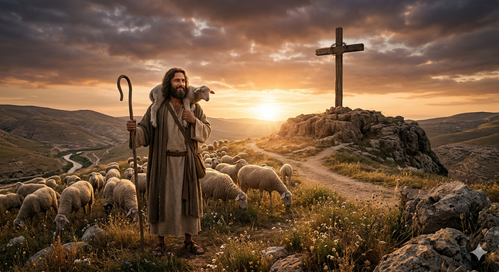
The Good Shepherd: Known, Saved, and Kept
The Shepherd Who Knows You
There is a single declaration from the mouth of Jesus — just a few words — that I want us to hold before everything else this morning.
In John chapter 10, verse 14, Jesus says: "I am the good shepherd. I know my own and my own know me, just as the Father knows me and I know the Father."
I know my own.
Sit with that for a moment. Not as a piece of abstract theology. Not as something written for someone else in some other century. Hear it as something spoken directly to you — today, in this place. The Son of God, the eternal Word made flesh, looks at you and says: I know you.
This is not the casual knowing of an acquaintance. This is not the knowing of someone who has merely reviewed the facts of your life from a distance. The word Jesus uses here carries the full weight of intimate, covenantal relationship — the same kind of knowing that exists between the Father and the Son. Infinite. Personal. Unbreakable. When Jesus says "I know my own," he is saying something far deeper than a recognition of your name on a list. He is describing a relationship that goes to the very core of who you are.
Saint Augustine, who knew something about the deep longing of the human heart — who spent years wandering before he found his rest — wrote in his Confessions: "Thou madest us for Thyself, and our heart is restless, until it repose in Thee." That restlessness Augustine describes — that quiet ache we carry through ordinary life — exists precisely because we were made to be known by this Shepherd. We were created for this relationship, and nothing else will fully satisfy us until we have it.
And notice something important: Jesus does not say "my sheep find their way to me, and then I get to know them." He says, I know my own. The knowing comes first, from his side. Before your search for God began, there was already a Shepherd who knew your name.
That is the ground on which everything else we say this morning will stand.
A Love That Cost Everything
But knowing was not enough for this Shepherd. Love always moves toward sacrifice.
In John 10:11, Jesus says: "I am the good shepherd. The good shepherd lays down his life for the sheep." And Saint Peter, years after he had witnessed that very sacrifice with his own eyes, writes with striking precision in his first letter: "He himself bore our sins in his body on the tree, that we might die to sin and live to righteousness. By his wounds you have been healed." (1 Peter 2:24)
What I want us to see clearly is this: Christ does not merely happen to die. He is not overwhelmed by forces outside of his control. The Catechism of the Council of Trent is unambiguous on this point — Christ suffered willingly and freely for us. He was no victim of circumstance. He was the Good Shepherd who, seeing the wolf coming, did not turn and run — but stood firm in the breach and laid down his life for the sheep.
Saint Leo the Great, in his sermons on the Passion of Christ, insisted that the cross was not the defeat of the Shepherd, but the very instrument of his triumph — the means by which he accomplished what no power in heaven or earth could have forced from him. He gave himself. Freely. Deliberately. Out of love.
There is something deeply significant in the voluntary nature of this sacrifice. If Christ had been somehow compelled to die, we might receive it with gratitude, as we receive a gift from a generous stranger. But because he chose it — because the Good Shepherd walked freely toward the cross with full knowledge of what awaited him — this sacrifice becomes something more than heroism. It becomes the most personal declaration of love ever made in human history. He chose this. For you.
And the result? "By his wounds you have been healed."
We say those words in our liturgy, and sometimes familiar words can quietly lose their weight. Let us recover it today. It is not your spiritual effort that heals you. It is not your religious performance. It is his wounds — real wounds, received on a real cross — that are the source of your healing. That is the foundation of everything else we will say this morning.
We Were the Straying Sheep
Now here is the honest part of the Gospel. Saint Peter writes: "For you were straying like sheep, but have now returned to the Shepherd and Overseer of your souls." (1 Peter 2:25)
You were straying.
That is not condemnation — it is a diagnosis. And a diagnosis, as every good physician knows, is the beginning of healing. Notice that Peter is not writing to hardened pagans. He is writing to the baptized — to people who know the faith, who have received the sacraments, who belong to the fold. And he still says: you were straying. Because there is something in every human heart — the legacy of original sin that the Catechism of Trent describes with such clear-eyed realism — that bends us toward wandering. Toward going our own way. Toward the slow, quiet drift away from the fold.
Perhaps you know what that drift feels like. Not always dramatic rebellion. Sometimes just a gradual cooling in prayer. A growing distance from the confessional. A part of your life quietly held back from the Lord.
But here is what the Good Shepherd says in response to all of that. In John 10:16, speaking of scattered sheep — sheep far from the fold, sheep who have wandered far — Jesus says: "I must bring them also, and they will listen to my voice. So there will be one flock, one shepherd."
I must bring them. Not I hope to. Not I will try to. I must. There is a holy compulsion in the heart of the Good Shepherd. He cannot leave his sheep scattered. The Roman Catechism makes plain that the redemption Christ accomplished is not narrow or restricted — it reaches every soul, in every age, in every condition of wandering. He came to gather what was lost.
For any heart that has strayed, that word from Jesus is not a word of judgment. It is the sound of a Shepherd already on his way.
Follow the Shepherd, Not the Hired Hand
Now we come to the most searching part of this morning's Gospel.
The Good Shepherd does not only call us to receive his love. He calls us to imitate it.
In John 10:12-13, Jesus draws a sharp contrast: "He who is a hired hand and not a shepherd, who does not own the sheep, sees the wolf coming and leaves the sheep and flees, and the wolf snatches them and scatters them. He flees because he is a hired hand and cares nothing for the sheep."
The hired hand is not necessarily wicked. He may even be, in some respects, a religious man. But when the cost of genuine love becomes high — when real sacrifice is required, when standing firm will cost something — he protects himself. He steps back. He flees.
And then Peter says this: "For to this you have been called, because Christ also suffered for you, leaving you an example, so that you might follow in his steps." (1 Peter 2:21)
The word Peter uses for example is the Greek hupogrammos — a writing pattern placed beneath parchment so that a student could trace it, letter by letter, until the shape of the letters became second nature. Christ's life — his selfless, courageous, suffering love — is the pattern we are called to trace.
Saint Gregory the Great, reflecting on this very passage in his Homilies on the Gospels, wrote that true love is known by exactly this: it does not flee when the cost becomes real. It stays. It suffers alongside those it loves. And Gregory is clear that this calling does not belong to the ordained alone — it belongs to every Christian who has been claimed by the Good Shepherd and sealed in Baptism.
So what does it look like for you? It may be the faithfulness of a parent who sacrifices their own comfort for the spiritual wellbeing of their children. It may be the courage to speak a true and loving word to someone drifting from the faith, when silence would be far easier. Or it may simply be the daily dying to self that Christian life demands — choosing the other person over yourself, choosing the harder right over the easier wrong.
The hired hand runs when things get hard. The Good Shepherd stays.
That is the question the Gospel puts before each of us this morning. Not as condemnation — but as an invitation. Which pattern are you tracing?
Safe in the Overseer of Your Soul
And here is where we rest.
After everything Peter has said — about sin and wandering and the suffering example of Christ — he closes with a title for Jesus that I want you to carry home with you today. He calls him "the Shepherd and Overseer of your souls." (1 Peter 2:25)
Overseer. The Greek word is episkopos — the same root from which we derive the word bishop. It means one who watches over, who guards, who stands on watch. And Peter gives this title not to any earthly authority, but to Christ himself. Jesus is the Bishop of your soul — the eternal Guardian who watches over you with a care that never sleeps and a love that never fails.
This is not passive or distant watching. A true shepherd counts his sheep. He notices the one that is missing. He goes out after the one who has wandered. And when the flock is gathered, he keeps watch through the night.
Saint Augustine wrote that God is more inward than our most inward part — closer to us than we are to ourselves. The Good Shepherd who bore our sins on the tree, who rose from the dead, who now reigns at the right hand of the Father — this same Shepherd is, at this very moment, the Overseer of your soul. Watching. Interceding. Knowing you by name.
And perhaps the most striking thing of all is this: the wounds by which he purchased your redemption are the very marks of what your salvation cost him. He bears them still, in his glorified body, as the eternal testament to the depth of his love for you.
So whatever you are carrying into this coming week — whatever weight came through those doors with you this morning — hear the word of the Shepherd.
He knows you. He laid down his life for you. He comes for you when you stray. He calls you to follow him in courageous, selfless love. And he stands watch as the eternal Overseer of your soul.
That is the Gospel. And it is more than enough.