

The Mind of Christ: Humility, Obedience, and the Way of the Cross
The Crowd's Hosanna and Our Own Hearts
There is something deeply familiar about the Palm Sunday crowd. They were not bad people. They were hopeful people. They had heard what Jesus had done — the blind receiving their sight, the lame walking, the dead raised. And when He rode into Jerusalem on a donkey, and its colt, they could not contain themselves. They threw their cloaks on the road. They waved branches. They shouted "Hosanna!" — which means, in its most basic sense, "Save us now!" It was a spontaneous, joyful outpouring of real hope. These were people who had been waiting a long time for someone to come and make things right.
And yet, within the same week, many of those same voices would be crying something very different. "Crucify him. Crucify him." The crowd had not changed much. Their longing had simply collided with a Savior who refused to save in the way they had imagined. They wanted a king who would raise an army, throw off Roman rule, restore the throne of David by force. What they got was a man who washed feet, who healed the ear of the soldier who came to arrest Him, who stood silent before His accusers, and who walked willingly to the cross.
That gap — between the king they wanted and the King He is — is the heart of Holy Week.
And this is not just their story. If we are honest, it is ours too. Each of us carries something of that Palm Sunday crowd inside us. We welcome Jesus gladly when He brings comfort, peace, healing, answered prayer. But when He calls us to follow Him into the harder places — into surrender, into suffering, into losing what we thought we needed — something in us pulls back. Something in us still wants a different kind of king.
That is exactly why this week matters. Holy Week is not simply a remembrance of ancient events. It is an invitation — a pressing, personal invitation — to see who Jesus really is, and to ask ourselves whether we are willing to follow Him all the way.
The Apostle Paul, writing to the church at Philippi, gives us the lens through which we are meant to see all of it. And this morning, I want us to hold that lens up together and look through it at the whole sweep of Christ's Passion.
Have This Mind Among Yourselves
Paul writes in Philippians 2:5, "Have this mind among yourselves, which is yours in Christ Jesus."
That phrase — "have this mind" — is not a suggestion. It is an invitation into a whole way of being. Paul is saying: the way Jesus thought, the way He oriented His will, the way He moved through the world — this is what should shape you. This is what should shape us.
And what is that mind? The verses that follow describe it in terms that should stop us cold. Christ Jesus, Paul says, though He was in the form of God, did not count equality with God a thing to be grasped. He emptied Himself, taking the form of a servant, being born in the likeness of men. He set aside the glory that was rightfully His. He came down. He came all the way down.
And then, in verse 8 — the verse we will keep returning to all morning — Paul captures it in one sentence: "And being found in human form, he humbled himself by becoming obedient to the point of death, even death on a cross."
The mind of Christ is a mind of humility. A mind of obedience. A mind willing to let go — of honor, of comfort, of life itself — out of love for the Father and love for us.
Now, we need to be careful here. This is not weakness. This is not passivity. Jesus was not swept along by forces He could not control. He made a choice. At every point in the Passion, He could have stepped away. He had the power. He even said as much — that He could call twelve legions of angels if He chose. But He did not. He chose the downward path. He chose the cross. He chose it deliberately, eyes wide open, out of obedience.
And Paul says: have that mind. Let that same orientation of heart be in you.
St. Augustine, reflecting on what the Incarnation reveals about God, wrote that pride was the wound that brought our race to ruin, and that God's answer to that wound was not power — it was humility. He taught that God became lowly precisely so that man could be lifted up. The remedy for our pride, Augustine said, is the humble obedience of the Son of God. God did not send a message from a safe distance. He entered our condition, took on our weakness, and walked the road we could not walk — all the way to the end.
That is what Palm Sunday puts before us. Not just a historical event, but a remedy — and an invitation.
"Have this mind among yourselves, which is yours in Christ Jesus." That mind is ours because it belongs to Him, and He has given us His Spirit. We do not manufacture this humility on our own. But we are called to receive it, to practice it, to let it shape us. And the Passion narrative shows us, in flesh and blood, exactly what that mind looks like.
He Humbled Himself
Let us walk into the Passion now, carrying Philippians 2:8 with us: "He humbled himself by becoming obedient to the point of death."
Follow Jesus into the Garden of Gethsemane on that Thursday night. The disciples are falling asleep around Him, unable to stay awake even for an hour. The air is heavy. And Jesus, fully knowing what is coming — the betrayal, the arrest, the mockery, the nails, the cross — falls with His face to the ground and prays. "My Father, if it be possible, let this cup pass from me. Nevertheless, not as I will, but as you will."
There it is. Right there in the dirt of the garden. That is Philippians 2:8 in lived form.
This moment is important, because sometimes we can hear about Christ's obedience in a way that makes it sound easy — as though it cost Him nothing, as though He sailed through the Passion untouched. Gethsemane will not allow us that comfortable misreading. His distress was real. His sorrow was real. He prayed the same prayer three times. He sweated as it were drops of blood. He did not want the cup. He asked if there was another way.
And yet He chose obedience. He chose the Father's will over His own desire. "Not as I will, but as you will."
This is the mind of Christ — not the absence of struggle, but the willing surrender of His own will in the middle of the struggle. That is what makes it so astonishing. And that is what makes it so relevant to us, because most of us will never be asked to face something easy in obedience to God. Real obedience always costs something.
Then Judas arrives — one of His own, someone He had walked with for three years, eaten with, loved. He comes with soldiers, torches, and a kiss. A kiss that is a betrayal. And Jesus does not run. He does not call down judgment. He says to Judas, "Friend, do what you came to do." He receives the betrayal in silence. He allows it.
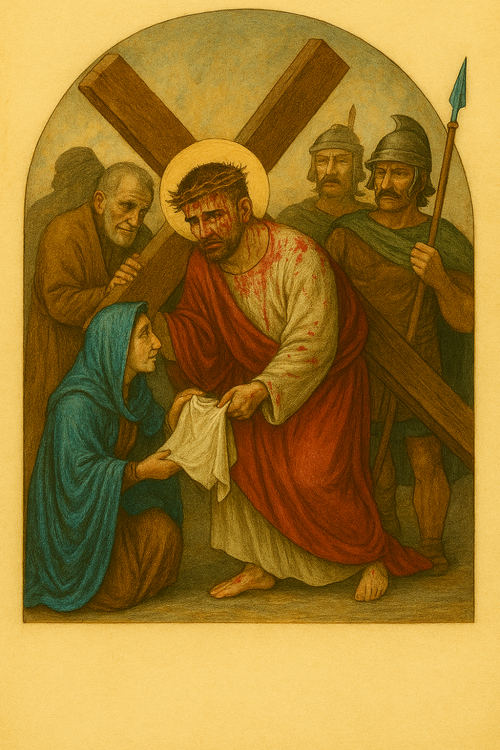
Then come the trials. Before Annas. Before Caiaphas. Before Pilate. He stands largely silent before His accusers. He who had spoken the world into existence, who had calmed storms with a word, now stands quietly before men who do not understand what they are looking at. They blindfold Him and strike Him and say, "Prophesy! Who hit you?" They dress Him in purple and press thorns onto His head as a crude mockery of a crown. Pilate, wanting to release Him but afraid of the crowd, caves to the pressure and hands Him over.
Every step of the way, Jesus is being pushed lower. Humiliated. Diminished. The crowd that had cried "Hosanna!" a few days before now screams for His death.
But here is what we must not miss. They thought they were humiliating Him. They did not understand that He had already chosen this humiliation. He had already bowed down in the garden before they ever laid a hand on Him. What they were doing to Him, He had already accepted in His heart.
"He humbled himself by becoming obedient to the point of death."
He walked into this. He did not stumble. And that willingness — that deliberate, humble, obedient surrender — is the most profound expression of love the world has ever witnessed.
Obedient Unto Death
Paul does not stop at "obedient to the point of death." He adds three more words that we need to sit with: "even death on a cross."
In the ancient world, crucifixion was the most degrading death that could be imagined. It was not simply painful — it was deliberately designed to strip a person of every last shred of dignity. You were exposed. You were lifted up in public view. You were meant to be a warning, a spectacle, an example of what Rome did to those who stepped out of line. It was reserved for the lowest of the low — for slaves, for rebels, for criminals. No Roman citizen could be legally crucified. It was considered beneath the dignity of the law itself.
And yet this is what Paul says the eternal Son of God chose. Not just death — but that death. Not a quiet, dignified passing surrounded by friends. A shameful, public, agonizing death on a cross, between two criminals, while the crowd jeered and soldiers divided up His clothing.
The Catechism of the Council of Trent is clear and deliberate on this point. It teaches that Christ's suffering was not something forced upon Him against His will. He was not simply a victim of circumstances or of human cruelty. Rather, He freely and willingly offered Himself as a sacrifice for our sins. He was not overcome by His enemies — He chose to be, out of love. He bore the full weight of sin and death deliberately, because no other price would do, and because He was willing to pay it. The Catechism calls us to see in the Passion not a tragedy that spiraled out of control, but the purposeful, loving act of a God who would stop at nothing to bring us home.
Augustine captured this beautifully when he wrote that He who had no need to die chose to die for those who could not save themselves. The One who owed nothing paid everything. He entered the full depth of human suffering and death so that no human being could ever stand before God and say: You do not know what this is like. You do not know how far down I have fallen.
He went all the way down. And He did it freely.
And then there is the burial. The stone rolled across the tomb. The silence of that Saturday — what we now call Holy Saturday. For the disciples, it must have felt like the end of everything. The One they had given up their lives to follow was sealed behind stone, and hope seemed to be buried with Him.
But that burial, too, is part of the obedience. He did not stop at the edge of death and wait at a safe remove. He entered death fully, on our behalf. He went into the earth. He bore the complete consequence of our sin — not partially, not symbolically, but entirely.
"He humbled himself by becoming obedient to the point of death, even death on a cross."
That is the lowest point. That is how far the mind of Christ — the humility of Christ, the obedience of Christ — was willing to go for us.
A King Who Chose the Cross
Down through the centuries, the mind of Christ — that same humility, that same obedience — has shaped lives in ways both dramatic and quiet. Two witnesses in particular speak to us this morning.
Consider St. Thomas More. In the early sixteenth century, he stood at the very pinnacle of English life. Lord Chancellor of England. The most respected legal mind of his age. A man of genuine faith, remarkable learning, and deep personal integrity. King Henry VIII called him a close friend. If you had seen Thomas More in his robes of office, surrounded by the prestige of his position, you might have thought: here is a man who has arrived. A man who has everything.
But Henry wanted more than More's service. He wanted his agreement — his public endorsement of the king's divorce from Catherine of Aragon, and of the king's claim to be the supreme head of the Church in England. And Thomas More, in good conscience before God, could not give it. He did not attack the king. He did not launch a campaign against him. He simply remained silent, and that silence was enough to condemn him.
He was stripped of his offices, imprisoned in the Tower of London, separated from his beloved family, and eventually sentenced to death as a traitor. The man who had been celebrated and honored by the whole of England was now led to the scaffold like a common criminal.
And yet on the day of his execution, by every account, he was at peace. His final words are among the most famous in Christian history: "I die the king's good servant — but God's first."
That is Philippians 2:5 written in a life. "Have this mind among yourselves, which is yours in Christ Jesus." Thomas More had the mind of Christ. He chose obedience to God over the preservation of his own comfort, his own reputation, his own life. He chose to go down, trusting that God would be faithful.
What makes his witness even more striking is this: in the months before his arrest, while he was still free, Thomas More had written a profound meditation on Christ's agony in the garden. He called it The Sadness of Christ. In it, he reflected on how the Lord in Gethsemane faced the full weight of human fear and still chose the Father's will. He was, it seems, writing his own story into the story of Jesus — being shaped, even before he knew it, by the very Scripture he was studying.
Then there is St. Thérèse of Lisieux, who died in 1897 at only twenty-four years old, from tuberculosis, in a small Carmelite convent in Normandy. She never held a position of power. She never gave a great speech. She never performed miracles that drew crowds. By the world's measure, she was entirely unremarkable.
But Thérèse had discovered something the world consistently undervalues. She wrote in her autobiography, Story of a Soul: "Jesus does not demand great actions from us but simply surrender and gratitude." Her little way, as she called it, was the way of humble, daily, childlike trust — doing small things with great love, surrendering every moment to God, never grasping for recognition or reward. She bore her suffering in those final years with a joy that those around her found difficult to understand. She was not pretending it did not hurt. She simply trusted that the God who suffered on the cross was close to her in hers.
Thomas More on the scaffold. Thérèse in her convent cell. One dramatic, one quiet. But both shaped by the same truth that Paul declares in Philippians 2:8 — that the path of humility and obedience is not a detour around the life of God. It is the life of God. It is the very shape of Christ's love poured out into human lives across the centuries.
And the question that both of their lives put to us is simply this: what would it look like for us to have that mind?
The Name Above Every Name
But Paul does not end with the cross. And neither does the story.
Listen to what comes next in Philippians 2:9-11: "Therefore God has highly exalted him and bestowed on him the name that is above every name, so that at the name of Jesus every knee should bow, in heaven and on earth and under the earth, and every tongue confess that Jesus Christ is Lord, to the glory of God the Father."
Therefore. Because He humbled Himself. Because He was obedient to the point of death. Because He went all the way down — God raised Him all the way up. The One who was mocked as a false king now holds a name above every name. The One who was stripped of His clothing and nailed to wood now receives the worship of heaven and earth and everything beneath the earth. Every knee will bow — not to Caesar, not to any power that thought it had the last word — to Jesus.
This is the great reversal at the center of the gospel. This is the pattern woven into the very structure of reality. The way down is the way up. The path through death is the path to life. Humility is not the end of the story — it is the way into the fullness of the story.
And here is the most important thing: Paul places this entire passage — both the humility of verse 5 and the obedience of verse 8 — not just as a description of what Christ did, but as an invitation to what we should do. "Have this mind among yourselves." He is calling us into this same pattern. Not perfectly — the garden reminds us that struggle is part of the journey — but genuinely. Willingly. Trustingly.
That will look different for each person in this room.
For some of us, it means surrendering a conflict we have been nursing — choosing to humble ourselves before someone who has wronged us, because Christ humbled Himself before those who wronged Him. For others, it means releasing our grip on a plan we have made for our lives, and trusting that the Father's will, even when it is painful or confusing, is better than our own. For still others, it looks like what Thérèse practiced — choosing, in the small and mostly unnoticed moments of everyday life, to love without demanding recognition. To serve without keeping score.
For all of us, there is a garden somewhere ahead this week. A moment where our will and the Father's will are not the same thing. And in that moment, we will be invited — as Jesus was — to pray "not my will, but yours." That prayer is not easy. But it is the prayer that opens us up to resurrection.
Because the story does not end at the cross. And it does not end at the tomb. It ends at the exaltation. It ends with every tongue confessing that Jesus Christ is Lord. And those who have walked in His humility — who have taken up their own crosses and followed Him — will share in that glory.
Thomas More knew this. He climbed the scaffold with peace on his face because he trusted that death was not the last word. Thérèse knew this. She endured her suffering with a quiet joy because she believed that surrender to God leads not to loss but to life. And the saints of every age have known it — that the mind of Christ, the way of humble obedience, is not the way of defeat. It is the way of resurrection.
This Holy Week, as we follow Jesus through the Passion — through the garden, through the trials, through the cross, through the silence of the tomb — let us do so not merely as observers watching from a safe distance. Let us do so as people being called to something. Called to let His mind become our mind. Called to let His humility reshape our choices, our relationships, our whole orientation toward God.
"He humbled himself by becoming obedient to the point of death, even death on a cross. Therefore God has highly exalted him."
That is the gospel. That is the hope of Holy Week. And that is the invitation before each one of us today. May we have the courage — and the grace — to receive it.