

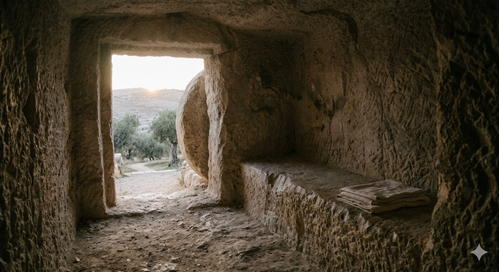
The Empty Tomb Demands a Response
He Is Risen — Introduction
Easter Sunday. Of all the days on the Christian calendar — all the feasts and seasons and holy days that mark the year — this is the one. This is the day the entire Christian faith stands or falls on.
And I want to begin by asking us to slow down just a moment before we rush into the celebration. Because I think it is very easy on a day like today, with the flowers and the music and the packed pews, to let the beauty of the occasion become a kind of cushion between us and the raw, staggering reality of what we are actually here to proclaim.
This is not a story. This is not a symbol. This is not a beautiful religious idea that has inspired great art and architecture across twenty centuries.
This actually happened.
On a specific Sunday morning, in a specific garden, outside the city of Jerusalem, a man named Jesus of Nazareth walked out of a sealed tomb alive. Witnesses saw Him. Touched Him. Ate with Him. And the world has never been the same since.
Saint Augustine put it simply: "We are an Easter people, and Alleluia is our song." But I want to gently press on that. Because that song — that Alleluia — it is not merely a feeling. It is a declaration of fact. And if it is a declaration of fact, then it carries with it not just comfort and joy, but a demand. A call. A challenge to every one of us who gathers under its weight.
The empty tomb is not merely good news to be believed. It is a summons to be answered with a changed life.
The Empty Tomb — The Resurrection as Objective Fact
Let us go to the tomb. Not metaphorically — let us actually walk there with the women in Mark's Gospel. Listen to what Mark records, beginning in chapter 16 at verse 1:
"When the Sabbath was past, Mary Magdalene, Mary the mother of James, and Salome bought spices, so that they might go and anoint him. And very early on the first day of the week, when the sun had risen, they went to the tomb. And they were saying to one another, 'Who will roll away the stone for us from the entrance of the tomb?' And looking up, they saw that the stone had been rolled back — it was very large. And entering the tomb, they saw a young man sitting on the right side, dressed in a white robe, and they were alarmed. And he said to them, 'Do not be alarmed. You seek Jesus of Nazareth, who was crucified. He has risen; he is not here. See the place where they laid him. But go, tell his disciples and Peter that he is going before you to Galilee. There you will see him, just as he told you.'"
I want you to notice a few things here that are easy to rush past.
These women were not coming to a resurrection. They were coming to a corpse. They had purchased burial spices. This was the errand of grief — practical, sorrowful, dutiful grief. They were not hoping for a miracle. They were not whispering to each other that maybe He had risen. Their only concern was entirely practical: who is going to move this very large stone so we can properly honor our very dead Lord?
And then Mark gives us a small, quiet detail that carries enormous weight: "when the sun had risen." He is being precise. This is not the language of legend or myth. This is the language of a man recording what happened on a specific morning to specific people at a specific place.
The stone is rolled back. Not cracked. Not partially shifted. Rolled back. And inside — no body. Just a young man in white, calm, seated, with a message that must have struck those women like a wave: "He has risen; he is not here."
Not: he lives on in spirit. Not: his memory endures in you. He is not here. Come and see the place where they laid Him.
And then the command: go and tell.
That is where it all begins. The tomb is empty. The Lord is risen. And because those two things are true — really, historically, factually true — nothing is the same. Everything that follows in the history of the world flows from that one empty tomb on that one Sunday morning.
Point 3: The World Turned Upside Down — Early Church History Illustration
I want to take you forward in history now — about one hundred years from that first Easter morning, to the heart of the Roman Empire.
Rome in the second century is the most powerful civilization the world has ever seen. Its emperors are worshipped as divine. Its legions have conquered nations. Its philosophers debate in marble halls. And its prisons are filling up with a strange new sect — people who call themselves followers of a crucified Jew from a backwater province, who insist that He rose from the dead and that He is Lord above all lords, including Caesar himself.
The Roman authorities could not understand it. And here is what truly baffled them: they offered these Christians a way out. A simple, painless way out. Offer a pinch of incense to the emperor's image. Say the words "Caesar is Lord." That is all. Walk free. Go home to your families. Live your life.
And thousands upon thousands of them refused.
Men, women, children. Educated and uneducated. Rich and poor. Old and young. They walked into arenas and faced wild beasts. They were burned alive. They were thrown into prisons and left to rot. And they went singing.
Why? What in the world would make ordinary people do that?
Listen to the words of Ignatius of Antioch, Bishop of Antioch, writing around the year 107 AD as he was being transported to Rome to face the beasts in the arena. In his letter to the Roman church, he wrote: "I am the wheat of God, and I am ground by the teeth of wild beasts that I may be found the pure bread of Christ."
This is not a man clinging to a comforting idea. This is a man who has been so completely remade by the Risen Christ that his own death had become, in his eyes, an offering.
And Polycarp, the beloved Bishop of Smyrna, when the Roman authorities gave him one final opportunity to save his life — just renounce Christ, they said, and you can go free — replied with words that have echoed down through the centuries: "Eighty-six years I have served Him, and He has done me no wrong. How can I blaspheme my King who saved me?"
Tertullian, watching the church multiply in the face of every effort to crush it, made this stunning observation: "The blood of the martyrs is the seed of the Church."
Here is what I want you to see. These men and women were not dying for a doctrine on paper. They were not dying because they had read a convincing theological argument and decided to take a principled stand. They were dying because the resurrection of Jesus Christ had invaded their lives so completely, had remade them so thoroughly from the inside out, that they were simply and genuinely new people. The old life was gone. Something new had taken hold of them, and they could not go back to who they had been before — even to save their own lives.
The resurrection of Jesus Christ does not just prove that He is alive. It proves that the old life is over and the new life has begun. And those who truly encounter the Risen Lord are never the same again.
The Feast of the New Leaven — Paul's Call to Change
Which brings us to Saint Paul. And to a metaphor that every Jewish person in his audience would have recognized immediately and completely.
In First Corinthians, chapter 5, verses 7 and 8, Paul writes this:
"Cleanse out the old leaven that you may be a new lump, as you really are unleavened. For Christ, our Passover lamb, has been sacrificed. Let us therefore celebrate the festival, not with the old leaven, the leaven of malice and evil, but with the unleavened bread of sincerity and truth."
Paul is reaching back into the Passover tradition here. Every Jewish household knew exactly what this meant. Before the Feast of Unleavened Bread, the entire family would search the house — every shelf, every storage jar, every dark corner — to find and remove every last trace of old leaven. It was thorough. It was deliberate. It was complete. Nothing was overlooked. Nothing was excused. The old was cleared out entirely before the new feast could begin.
And Paul says: this is what the resurrection of Christ now demands of you.
He calls Jesus our Passover Lamb. That is not casual language. The Passover lamb was slain so that death would pass over the households of Israel in Egypt. Christ was slain — and raised to life — so that death would pass over our souls. The slavery is over. Egypt is behind you. You are free people now. A new life has begun.
But here is Paul's challenge, and it cuts deep: free people can still choose to carry the old life with them. You can pack the old leaven into your bags and drag it right into the new life. You can walk out of Egypt and still live like you never left. And Paul says — do not. Search the house. Find it. Remove it. All of it.
The leaven of malice. The leaven of evil. Every settled pattern of sin. Every hardened habit of the heart. Every grudge, every bitterness, every comfortable self-deception. Paul says none of it belongs in the house of an Easter people.
The Baltimore Catechism reminds us that the Christian life is not merely the avoidance of mortal sin — it is the active pursuit of holiness, the ongoing work of becoming in daily practice what we already are in Christ by grace. Easter is not a finish line. Easter is a starting line.
You are, Paul says, "really unleavened." That is what you are in Christ. But you must become in the practice of your daily life what you already are by grace and by covenant. The truth of who you are must shape and govern how you live. The old leaven has no business in a new creation.
Put Away the Old Life — The Practical Call to HolinessLet me be direct with you for a moment, because I believe this day calls for it.
We have gathered in our Easter clothes. We have sung the alleluias. The church is filled with lilies, and the bells have rung, and all of that is beautiful and right and fitting. But when you walk out those doors today, the question that is being pressed upon every one of us — by the empty tomb, by the Risen Lord, by the witness of Ignatius and Polycarp and the thousands of nameless martyrs, by the words of Saint Paul — is not: did you enjoy the celebration?
The question is: what are you going to leave behind?
Because Paul is telling us something we need to hear plainly. You cannot celebrate the resurrection and carry the old life with you unchanged. You cannot sing alleluia on Sunday and harbor malice in your heart through the week. You cannot proclaim that Christ has conquered death and still be conquered by bitterness, by pride, by dishonesty, by impurity, by unforgiveness. Those things do not belong in the same house.
Now, I am not going to stand here and catalog your particular sins for you. You know your own heart far better than I do. And the Lord knows it better than any of us. But I want to ask you — honestly ask you — is there old leaven in the house?
Is there a relationship that has been poisoned by unforgiveness that you have been avoiding for months, or maybe years? Is there a sin you have been carrying so long that you have almost made peace with it — almost stopped calling it what it is? Is there a corner of your heart where pride has taken up permanent residence, where you have quietly decided that God's way is simply not practical in your particular situation? Is there a bitterness toward God Himself — a wound you have been nursing, a prayer that was not answered the way you hoped, a loss that you have held against Him?
Whatever form your old leaven takes — and it is different for each of us — Easter Sunday is the day the Risen Christ says to you: it is time. Search the house. Clean it out.
Pope Leo the Great, preaching to his flock in Rome in the fifth century, urged them in this way: let us not merely proclaim the resurrection with our lips and our festival songs — let us manifest it in the ordering of our hearts and the conduct of our lives. Let the resurrection be visible in you.
That is the call. Not simply to believe the resurrection in your mind. Not simply to celebrate it once a year with flowers and bells. But to manifest it — to make it visible, real, and credible — in the way you live your ordinary Monday-through-Saturday life from this day forward.
The Challenge of the Risen Christ — Strong Closing Call to Action
Let me close with this.
The women came to that tomb expecting to find a body. They left as witnesses to the Living Lord — moving quickly, hearts pounding, carrying a message they could not contain and could not keep to themselves. Something happened to them in that garden that changed the direction of their feet and the content of the rest of their lives. They walked in as mourners and walked out as messengers.
The early church martyrs — Ignatius and Polycarp and thousands of others whose names we will never know this side of eternity — walked into arenas and prisons and execution grounds not because they were reckless or naive or had simply decided to be brave. They went because the Risen Christ had remade them so completely, from the inside out, that they were genuinely and irreversibly new people. The old life had no more claim on them. It had lost its grip.
And Paul — who had spent the early years of his adult life hunting down Christians, dragging them from their homes, and standing by while they were killed — was so completely undone by his encounter with the Risen Christ on the road to Damascus that he spent the rest of his days in chains, in beatings, in shipwrecks, pouring himself out without reserve. And he kept returning to the same truth in every letter he wrote: the old is gone. The new has come. Cleanse out the old leaven. Live the new life.
That is the Easter message, brothers and sisters. Not only that He is risen — though He is, and that is the most glorious and certain fact in all of human history. But that His rising demands our rising. His new life calls forth a new life from us. His victory over the grave is meant to become our victory over every old pattern, every entrenched habit, every long-carried sin that has been holding us down and holding us back.
So here is my challenge to you as you leave this place today. Do not let this be the Easter that changed nothing. Do not let the alleluias fade into another ordinary week with the same old habits, the same old grudges, the same old leaven quietly working away beneath the surface of a life that looks Christian on Sunday and runs on the old fuel the rest of the week.
The Risen Christ is not standing at a distance, waiting for you to sort yourself out on your own. He is offering you His grace. His mercy. His strength. Everything you need to actually live the life He is calling you to. But He is asking you — He is asking you now — to say yes. To make a decision here and now. To put down something real. To leave something behind that you have been dragging along far too long.
What does your old leaven look like? What is it that the Lord has been quietly, persistently pressing you about — perhaps through a homily, perhaps through a sleepless night, perhaps through the gentle and inconvenient conviction of the Holy Spirit — that you have been carrying past one Easter Sunday and then another and then another?
Leave it here today. At the foot of the empty tomb. Not next week when it feels more manageable. Not when the conditions are better or when you feel more spiritually ready. Today. This Easter Sunday. Walk out of this place differently than you walked in.
He is risen. He is risen indeed.
And because He is, we must not — we simply cannot — remain the same.-F.D.