

The Hidden Glory: Entering the Mystery of Passiontide
Before Abraham Was, I AM
Some moments in the Gospels, if you slow down long enough to really hear them, will take your breath away. This morning's Gospel is one of those moments.
The scene is the Temple in Jerusalem. Jesus is surrounded by men who are questioning His identity, His authority, His sanity. They have called Him a Samaritan. They have accused Him of having a demon. And then, in the midst of that rising hostility, He says something that silences every other question in the room.
"Truly, truly, I say to you, before Abraham was, I am."
Read those words slowly. Before Abraham was — before the father of nations drew his first breath, before the covenant of circumcision was made, before the first star was hung in the sky over the plains of Canaan — I am. Not "I was." Not "I existed." I am. Present tense. Eternal tense. The tense that belongs to God alone.
The men in that Temple immediately understood what He was claiming. That is why they reached for stones. They were not confused. They were furious — because they had just heard a man from Nazareth claim to be the eternal God, and they were not willing to believe it.
But what about us? We are gathered here today in these final weeks before Easter, and the question this text puts to each of us is not primarily a historical one. The question is whether we truly believe what those words mean — whether the One who goes to the Cross in a matter of days is the eternal I AM, the living God, taking on human flesh to accomplish what no earthly priest and no animal sacrifice could ever accomplish.
That is the question Passion Sunday is asking us. And it is one of the most important questions we will ever answer.
The Glory Hidden in Plain Sight
Notice what happens immediately after Jesus speaks those words. The crowd takes up stones. And then the Gospel tells us simply: Jesus hid himself and went out of the temple.
He hid himself.
That phrase is worth pausing over, because it is doing something more than describing a physical withdrawal. Throughout the Gospel of John there is a steady movement of concealment and revelation — the eternal Word wrapped in human flesh, the divine glory dwelling in a body of clay. And here, at this crucial moment, rather than calling down fire from heaven, He simply hides Himself and walks away.
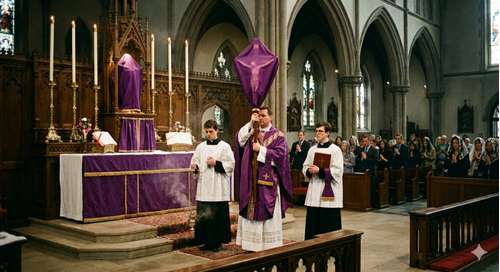
Now, if you look around this sanctuary today, you may notice something is different from what you see on ordinary Sundays. The images and the cross are veiled in purple. This is the ancient custom of Passiontide — these final two weeks before Easter — and for those of you who may not be familiar with this practice, let me say just a brief word about what it means.
The veiling is not merely a decoration, and it is not an absence. It is a theological statement made in fabric and shadow. It is the Church saying, in the language of sacred art: something is being hidden, and that hiddenness is itself a mystery we are invited to enter.
St. Augustine, reflecting on this movement of concealment throughout Christ's earthly ministry, observed that our Lord did not hide His glory from weakness, nor from fear, but from a divine purposefulness. He was not running away — He was drawing us forward. The veil does not signal the absence of glory. It signals that glory is present, closer than we can see, and that we must be prepared to receive it.
That is precisely what these two weeks are for. The veiling of the images around us is an invitation to veil our own distractions, to quiet the noise of ordinary life, and to follow the hidden Christ toward the altar of the Cross. The sanctuary is asking something of us. And the question is whether we are willing to give it.
The Crowd That Could Not See
But let us return to that Temple courtyard, because there is something deeply instructive — and if we are honest, something quietly convicting — in the crowd's inability to recognize who was standing before them.
Go back a few verses in this same chapter. Jesus says to them: "Which one of you convicts me of sin? If I tell the truth, why do you not believe me? Whoever is of God hears the words of God. The reason why you do not hear them is that you are not of God."
That is a devastating diagnosis. These were not irreligious men. These were religious leaders, students of the Scripture, guardians of the covenant of their fathers. And yet, standing face to face with the eternal Word made flesh, they could not see Him. They heard the words and could not receive them. They watched the works and explained them away.
St. John Chrysostom, that great preacher of Antioch and Constantinople, wrote with pastoral grief about this spiritual blindness. He observed that the tragedy of those who rejected Christ was not primarily intellectual — it was moral and spiritual. They had so conformed their hearts to the religion they had constructed, so organized their understanding of God around their own expectations, that when God Himself stood before them, they could not recognize Him. Spiritual blindness, Chrysostom says, is not merely the inability to see. It is the refusal to look.
And yet — and this is the astonishing grace of this passage — what Jesus claims in the face of that blindness only becomes more luminous. "Before Abraham was, I am." Those words are not chosen carelessly. When God appeared to Moses in the burning bush and Moses asked His name, the answer came back across the centuries: "I AM WHO I AM." That is the divine Name. That is the Name Jesus is now claiming as His own, standing in the very Temple that bore that Name.
The God who spoke to Moses from the fire, the God who parted the sea and gave the Law on Sinai, the God whose glory filled the Tabernacle so completely that Moses could not enter — that God is now standing in a body of flesh, looking His creatures in the eye, and they are picking up stones.
This is the hidden glory. This is what Passiontide is about. And the question it asks us — the question it asks me — is whether we are any different from that crowd. Do we truly see Him? Do our hearts bow before the weight of who He is? Or have we grown so accustomed to the familiar forms of faith that the living God has become merely background to our ordinary lives? That is a question worth carrying into the silence of this week.
A Greater Tabernacle, A Better Blood
Now the letter to the Hebrews helps us understand why the eternal identity of Christ matters so enormously — not merely as a theological proposition, but as the very foundation of our salvation.
The writer of Hebrews places before us two sanctuaries, two covenants, two kinds of blood.
The first is the earthly sanctuary — the Tabernacle, and later the Temple. Year after year, the high priest would enter the Holy of Holies with the blood of goats and calves, sprinkling and purifying, making atonement for the sins of the people. It was a solemn and beautiful ritual. It was ordained by God Himself. And yet the letter to the Hebrews tells us plainly: it was never enough.
The Catechism of the Council of Trent, that great treasury of Catholic teaching compiled in the sixteenth century, is clear and careful on this point. The blood of animals, it teaches, could purify the flesh in a ceremonial sense — removing legal uncleanness, restoring the worshipper to participation in the community of Israel. But it could not touch the conscience. It could not reach that deep interior place where guilt actually lives, where the weight of sin presses down on the human soul. For that, something immeasurably greater was required.
And here is what Christ brings: through the greater and more perfect tent, not made with hands, that is, not of this creation, he entered once for all into the holy places, not by means of the blood of goats and calves but by means of his own blood, thus securing an eternal redemption.
One sacrifice. Once for all. An eternal redemption.
But why is this sacrifice sufficient when every prior sacrifice was not? Why does this blood accomplish what centuries of priestly ministry could only gesture toward? The answer brings us all the way back to that declaration in the Temple courtyard. It is sufficient because the One who offers it is not merely a man, however holy. He is the eternal I AM, the One before whom Abraham rejoiced, the One who spoke from the burning bush, the One in whom all the fullness of God dwells in bodily form. His sacrifice carries an infinite weight precisely because He Himself is infinite.
The Mediator Only Eternity Could Provide
This is where the text reaches its great theological climax, and I want you to hear it carefully, because it is one of the most beautiful sentences in all of Scripture.
"How much more will the blood of Christ, who through the eternal Spirit offered himself without blemish to God, purify our conscience from dead works to serve the living God. Therefore he is the mediator of a new covenant, so that those who are called may receive the promised eternal inheritance, since a death has occurred that redeems them from the transgressions committed under the first covenant."
Pope Leo the Great, who was Bishop of Rome in the fifth century and who preached with extraordinary theological precision on the mystery of the Incarnation, taught that the suffering of Christ derived its infinite value not from the mere fact of physical pain — for many innocent men have suffered greatly — but from the dignity of the Person who suffered. Because the Son of God, the Second Person of the eternal Trinity, truly took human nature into Himself, His one act of self-offering on the Cross became of infinite and eternal worth. Leo teaches that what was mortal in Christ served as the instrument of what was divine, and the divine nature gave to that mortal suffering a redemptive power that no merely human sacrifice could ever possess.
This is why He alone is the Mediator. This is why no other name under heaven could secure what His Name secures. This is why the old covenant, beautiful and divinely ordained as it was, had to give way to something incomparably greater. It required an eternal Priest making an eternal offering to obtain an eternal redemption.
And notice the texture of what Hebrews says here. He offered Himself through the eternal Spirit. This is not a transaction performed from the outside. The entire Trinity is present in this act of self-giving — the Son offering, the Spirit sustaining, the Father receiving. The Cross is not merely a historical event. It is an eternal act, performed in time, for those who will live in all times.
The I AM who walked out of that Temple in Jerusalem, hiding Himself from the fury of the crowd, was walking toward a cross. And that Cross would become the altar on which the eternal High Priest offered Himself, once, for all, for you. That is not a familiar phrase to be passed over quickly. That is the center of everything. For you.
Consciences Cleansed, Lives Reoriented
But now the text turns pastoral in the most profound way, and I want us to sit with this for a moment.
The blood of Christ, Hebrews says, will purify our conscience from dead works to serve the living God.
Notice that the purpose of this cleansing is not merely relief from guilt — though thank God, it does bring that, and it is no small gift. The purpose is freedom for something. Freedom to serve the living God.
St. Thomas Aquinas, in his reflection on the nature of worship and the interior life, drew a careful distinction between what might be called dead works — actions performed out of fear, habit, or self-interest, without any living orientation toward God — and the kind of genuine worship that flows from a conscience that has been truly cleansed and set free. Dead works, Aquinas observed, have the outward form of religion without the animating interior reality. They are the religious life performed from the outside in, rather than from the inside out. They go through the motions without any living movement of the soul toward its Creator.
What the blood of Christ accomplishes is something that no ritual purification could ever do. It reaches the conscience — that deepest interior faculty of moral awareness — and cleanses it. Not merely of guilt, but of the deadness that guilt produces over time. It restores a living relationship between the soul and its Creator, making genuine worship possible in a way it was not possible before.
This is not a small thing. This is not a footnote in the history of religion. This is the restoration of what we were made for.
But here is the pastoral question this text places before us with great gentleness: are we living as people whose consciences have been cleansed? Are we genuinely serving the living God — with alert and attentive souls, with hearts that are truly engaged — or have we allowed our worship to settle into something closer to what Aquinas described as dead works? Familiar, habitual, outwardly present, but not fully alive?
I do not ask that to condemn anyone. I ask it because I believe this is exactly the kind of question Passiontide is designed to help us face. These final weeks before Easter are a gift of time — time to let the blood of Christ do its deep work again, to come to the sacraments with renewed hunger, to allow the mystery of what He is about to accomplish to reach us somewhere below the surface of our ordinary religious routine.
Enter the Veil With Him
We have two weeks, brothers and sisters. Two weeks before the Church stands at the empty tomb and proclaims with a single voice that death has been defeated and the eternal I AM has risen. And these two weeks — Passiontide — are a gift that the ancient wisdom of the Church has given us precisely because we need them. Because we are human, and we need time to prepare our hearts for what is coming.
The veiled images in this sanctuary are not hiding anything from you. They are inviting you in. They are saying: there is a mystery here that cannot be taken in at a glance, a glory that asks something of you before it fully reveals itself. Come. Follow the hidden Christ. Walk with Him through these final days toward the altar of His sacrifice.
Holy Week is not primarily a series of liturgical events to be attended and marked off. It is a journey to be made. And it asks something of us — that we lay down, even for these two weeks, some of the noise and distraction that keeps us living at the surface of our own spiritual lives, and that we descend with Christ into the depth of what He is about to do.
What holds you through that descent is not a feeling or a passing experience. What holds you is the eternal I AM — the One who was before Abraham, who walked out of that Temple veiled in human flesh, who entered the greater and more perfect sanctuary with His own blood, who is the Mediator of a covenant that cannot be broken, who secured not a temporary reprieve but an eternal redemption.
So let these two weeks be different. Come to confession, and mean it. Read slowly from the Passion narratives in the evenings. Kneel a little longer before the veiled cross in your own prayer, and let the hiddenness itself speak to you — let it remind you that glory is always closer than it appears, and that it asks for a prepared heart.
And when Holy Week arrives, walk through it — really walk through it — with the full awareness that you are following the eternal Son of God to the altar where He offered Himself, once, for all, for you. Not as a distant observer. As someone who has been purchased by that blood. As someone whose conscience has been cleansed. As someone who has been set free to serve the living God.
Before Abraham was, He is. And He is yours. The veil is before you. Enter it with Him.-F.D.