

Talk Is Cheap, Fruit Is Real
I want to read just one verse to start us off, and I want you to sit with it for a minute before we go any further. Matthew 7:21:
"Not everyone who says to me, 'Lord, Lord,' will enter the kingdom of heaven, but the one who does the will of my Father who is in heaven."
Let that sink in a moment. Our Lord is not talking to the Pharisees here. He's not talking to the tax collectors or the public sinners or the outright pagans. He is talking, in this very passage, to people who call Him "Lord." People who pray in His name. People who, later in this same chapter, say things like, "Lord, Lord, did we not prophesy in your name, and cast out demons in your name, and do many mighty works in your name?" These are church people. These are religious people. These are people who look, sound, and act like they belong.
And Our Lord says some of them don't.
That ought to put a little holy fear in us this morning. Because I imagine if you're here today, you've said "Lord, Lord" plenty of times. I have too. I've prayed the Rosary, decade after decade. I've gone to Mass, not just on Sundays, but on holy days of obligation. I've knelt in the confessional and heard the priest speak absolution over me. I've made my First Communion, been confirmed, worn the scapular, lit a candle before Our Lady's statue, and asked the saints to pray for me. And I believe with all my heart that many of us in this room have a real, living faith in Jesus Christ, nourished by the sacraments He gave His Church.
But Our Lord is warning us that saying the right words, even praying the right prayers, is not the same as having the real thing. The Council of Trent, in its teaching on justification, reminds us that faith, unless hope and charity are joined to it, "neither unites a man perfectly with Christ, nor makes him a living member of His body." In other words, belief alone, without love poured out in action, is not yet the fruit God is looking for. Talk is cheap. Fruit is real.
The Baltimore Catechism puts the same truth to children in the simplest possible words: faith and hope, by themselves, are not enough for salvation; we must also have charity and good works, for as Scripture teaches us, "faith without works is dead." But hear me carefully here, because this is where so many stumble — these are not our works, offered up to God as though we had produced them out of our own strength, as some kind of independent contribution alongside what Christ has done. No. Saint Paul tells us plainly in Philippians 2:12-13, from the English Standard Version, Catholic Edition: "Work out your own salvation with fear and trembling, for it is God who works in you, both to will and to work for his good pleasure." Do you see the order there? It is God working in us — first the willing, then the doing — and our part is simply to yield to Him, to not resist or quench what He is producing. The charity, the good works, the fruit — it is Christ's own life in us, flowing out through us as we surrender to Him, the way sap rises unseen from the root and shows itself in the branch. As Our Lord said in John 15, "apart from me you can do nothing." So when the Catechism says we must have charity and good works, it is not adding a burden of self-effort onto grace. It is describing what grace itself produces when we stop resisting it. Our Lord is not asking whether we know the right answers on a test. He's asking whether we have yielded enough to Him that His own life shows through ours.
That's our theme this morning, straight out of two passages — Matthew 7 and Romans 6 — that together form a kind of spiritual examination of conscience. Like a farmer walking his orchard in September, checking not what the tree promised in the springtime blossoms, but what it actually produced. Not everyone who says "Lord, Lord" is the real deal, Our Lord tells us. So the question this morning isn't "do I say the right things, do I know my prayers?" The question is, "where do I actually stand before God?"
I want us to look past outward observance today, brothers and sisters, and get down to the root of true discipleship. Because Our Lord isn't interested in shaking hands with our vocabulary, or even our attendance record. He's after our hearts. And He tells us plainly — you will know the difference by the fruit.
So let's walk through this together. We're going to spend some time in Matthew 7, and then we're going to move into Romans 6, and along the way I'm going to ask you some hard questions — not to condemn you, but because I love you, and because Saint Augustine once said that God, who created us without us, will not save us without us. Grace does the work, but grace expects our cooperation — our fruit.
Wolves in Sheep's Clothing
In Matthew 7:15, Our Lord says:
"Beware of false prophets, who come to you in sheep's clothing but inwardly are ravenous wolves."
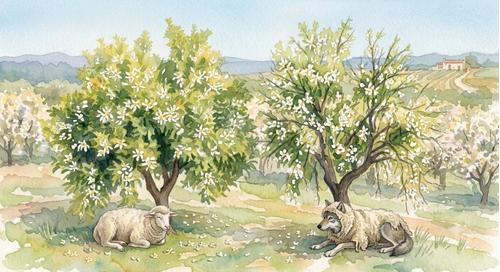
Now think about that picture for a second. A wolf doesn't walk into the sheep pen looking like a wolf. If he did, the whole flock would scatter and the shepherd would grab his staff. No — the wolf comes disguised. He's got the wool on. He bleats like a sheep. He walks with the flock, eats the same grass, maybe even leads a few of the other sheep around for a while. But underneath that fleece, he's still a wolf. And sooner or later, sheep start disappearing.
This is exactly what Our Lord is warning about. Not people who show up looking dangerous. People who show up looking exactly like us. Same pew. Same vocabulary. Same rosary in the pocket. Same "God bless you" on the way out the church doors. The danger was never that false teachers would look obviously false. The danger is that they look exactly right — right up until you look at what they're actually producing in people's lives.
The Fathers and Doctors of the Church understood this danger well. St. Ignatius of Antioch, writing to the churches way back in the early second century, warned believers plainly — he said, in essence, that some men carry the name of Christ on their lips like a badge while their actual conduct denies Him completely, and that we ought to know people not by their title but by their deeds. St. Jerome, that great scholar who translated Scripture into Latin, said something just as blunt — he warned that many wear the cloak of religion the way an actor wears a costume, and that a robe and a title have never yet saved a single soul. And centuries later, Pope St. Pius X, in warning against a hollow, merely external religiosity in his own day, insisted that holiness could never be reduced to correct formulas or outward observance alone — it had to reach, and change, the will. Three men from three different centuries, all seeing the same danger Our Lord described — the wolf doesn't announce himself. He blends in.
Now here's what I want you to notice. Our Lord doesn't tell us the solution is to become suspicious of everybody, always hunting for hidden wolves in the pews around us. That's not it at all. The solution He gives is much simpler, and much more personal. He says, "You will recognize them by their fruits." Not by their words. Not by their title. Not by how devoutly they can pray in public. By their fruit.
And here's the uncomfortable part, church. This test doesn't just apply to false prophets out there somewhere. It applies to me. It applies to you. Because we can all wear the wool pretty convincingly at Mass on Sunday morning. The real question isn't just "can I spot a wolf out there" — it's "what does my fruit look like when nobody's checking?"
So let me ask you something this morning, and I want you to actually sit with this, not just nod along. How do you treat your family when the front door is closed?
See, out here, in this room, we can all put on the wool pretty easy. We shake hands, we smile, we say "God bless." But what happens at home? What's your tone with your spouse when supper's late and you're tired? What do the kids hear from you when they've made a mess of something? Is the man who leads the family Rosary the same man who loses his temper the moment the car door shuts after Mass? Is the woman who sings so sweetly in the choir the same woman who gossips about her neighbor over coffee on Tuesday?
Brothers and sisters, the home is where the wool comes off. That's where the real fruit shows. Not because your family is harder to please than the parish — but because it's harder to fake it there. They see you when you're tired, when you're frustrated, when nobody's watching to see if you act like a good Catholic. If the fruit is sweet there, in the hidden places, you can trust it's real. If it's sour there, we've got some things to bring to Confession.
That's the first mark of the examination, church. Not what we say on Sunday, but what grows behind our own front door.
By Their Fruit You Shall Know Them
Let's keep reading. Matthew 7:16-18:
"You will recognize them by their fruits. Are grapes gathered from thornbushes, or figs from thistles? So, every healthy tree bears good fruit, but the diseased tree bears bad fruit. A healthy tree cannot bear bad fruit, nor can a diseased tree bear good fruit."
I grew up not too far from some orange groves, and I want to paint you a picture, because I think it'll stick with you.
In the springtime, every tree in that grove looks glorious. Every single one. White blossoms everywhere, bees humming, the whole grove smelling like heaven itself. And if you walked through in April and tried to judge which trees were going to produce good fruit that year, you couldn't do it. They all look the same. They're all blooming. They're all putting on a show.
But you don't judge a grove in April. You judge it in September.
I remember our neighbor, who was the citrus grove manager, taking me through his grove one fall, and there was this one tree — biggest tree in the whole row, prettiest blossoms every spring, everybody always commented on it. And that September, we walked up to it, and the oranges were small, hard, dried out — some had just rotted right on the branch. Meanwhile, over in the corner, there was a scrawny little tree nobody paid much attention to in springtime. Nothing special about its blossoms. But come harvest time, that tree was loaded with the sweetest, juiciest oranges in the whole grove. Our neighbor picked one, handed it to me, and said, "Todd, (thats my birth name), don't ever judge a tree by its flowers. Judge it by its fruit."
St. Francis de Sales taught this very same lesson to souls under his care: a tree, he said, is known by its fruit and not by its leaves. Leaves are lovely, they rustle nicely in the wind, but nobody ever ate a meal off a leaf. What feeds people — what actually nourishes a soul — is the fruit, not the foliage.
That's exactly what Our Lord is telling us here. Fruit isn't the flashy stuff. Fruit isn't spiritual gifts, prophecies, or miracles that He mentions later in this chapter. Fruit is character formed by grace. Fruit is patience when you're wronged. Fruit is kindness when nobody's clapping for you. Fruit is honesty when a lie would be easier. St. Paul tells us in Galatians 5 what this fruit actually looks like — love, joy, peace, patience, kindness, goodness, faithfulness, gentleness, self-control. That's the fruit. Not the blossoms. Not the show. The actual oranges on the branch come September.
And here's the sobering part of this passage — a tree can't fake its nature on its own. Our Lord says a diseased tree cannot bear good fruit. You can't get grapes off a thornbush no matter how hard you shake it or how much you pray over it or how nice the thornbush looks in the sunlight. What's inside eventually shows up outside. Every single time. That's why the Church has always insisted that good works, to be truly good and meritorious, must flow from a soul in the state of grace — from a tree that has actually been made healthy at the root, not merely tidied up on the outside.
So let me ask you this morning — and again, I want you to actually answer this in your heart, not just brush past it — what do you watch, what do you scroll through, when nobody else is in the room?
Because that's harvest time too, brothers and sissters. That's September for your soul. What fills your mind in private — late at night, alone with your phone, alone with the television — that's not neutral. That's not "just relaxing." That's soil. And whatever you're feeding your soul in secret is going to show up in your fruit eventually, whether you intend it to or not. You cannot marinate your mind in bitterness, in lust, in gossip, in cynicism, and expect sweet fruit to show up at the harvest. It doesn't work that way. It never has.
The good news, and I promise we're getting to good news this morning, is that fruit isn't produced by trying harder to look like a good tree. It's produced by what kind of tree you actually are, rooted in what kind of soil, nourished by what kind of grace. Hang onto that thought, because we're going to come back to it when we get to Romans.
But for now, let this settle in. You will recognize them by their fruits. Not the flowers. Not the show. What actually grows on the branch when the applause has died down and it's just you, alone, in September.
Cut Down and Cast Into the Fire — Even Saints Once Faltered
Now Our Lord doesn't stop with the grove picture. He goes on to say something that ought to make every one of us sit up straight. Matthew 7:19-21:
"Every tree that does not bear good fruit is cut down and thrown into the fire. Thus you will recognize them by their fruits. Not everyone who says to me, 'Lord, Lord,' will enter the kingdom of heaven, but the one who does the will of my Father who is in heaven."
There it is again — that same verse we started with. Our Lord brackets this whole teaching with it, like He wants to make sure we don't miss it. A fruitless tree, no matter how tall it grew, no matter how nice it looked in the grove, gets cut down. And the "Lord, Lord" crowd — the ones with all the right words — some of them are not known by Him at all.
I want to tell you a story this morning about a man the whole Church has looked to for over sixteen hundred years, but maybe not this particular chapter of his life.
Before Augustine became a bishop, a Doctor of the Church, before his name got attached to religious orders, universities, and a whole school of theology — he was a brilliant, restless young teacher of rhetoric in the Roman Empire, wandering from one philosophy to another, searching for truth. And I mean genuinely searching. This was not a lazy man. He read voraciously. He debated the finest minds of his day. His own mother, Monica — whom the Church now honors as a saint — wept and prayed for him for years, following him from city to city, begging God for his conversion. If anybody looked like he was on his way toward God, in his own restless, searching way, it was Augustine.
But privately? Augustine was, in his own words, in chains. He tells us in his Confessions that his mind had already come to believe the truth of the Catholic faith. Intellectually, he was persuaded. He knew Christ was Lord. But his will was still enslaved to old habits he couldn't let go of. He famously admitted that his prayer at the time was, "Grant me chastity and continence, but not yet." He had the words. He even had the right beliefs. What he didn't have was a will surrendered to God. He had the "Lord, Lord." He didn't yet have the fruit that comes from actually being rooted in Christ.
Now here's where the story turns, and I want you to hold onto this because we're about to walk right into it. One afternoon in a garden in Milan, in the year 386, Augustine was in such agony over his own divided will that he threw himself down under a fig tree, weeping bitterly. And then he heard, from over the wall, what sounded like a child's voice, chanting over and over, "Tolle lege, tolle lege" (TOH-leh LEH-jeh, TOH-leh LEH-jeh) — "Take up and read, take up and read." He didn't know of any children's game with those words, so he took it as a command from God. He went back to where he'd left a copy of St. Paul's epistles, picked it up, opened it at random, and his eyes fell on Romans chapter 13: "not in reveling and drunkenness, not in debauchery and licentiousness... but put on the Lord Jesus Christ, and make no provision for the flesh, to gratify its desires." Augustine himself wrote what happened next: "No further would I read, nor did I need to; instantly, at the end of this sentence, a light of confidence flooded my heart, and all the darkness of doubt vanished away."
That's the moment his private life finally caught up to what his mind had already believed. That's the moment the tree got a new root.
Before we move to the Epistle reading, I want to ask you two more questions, because this is where the examination of conscience gets real personal.
Do you give and spend honestly when nobody's auditing you? When it's just you and the checkbook, you and the tax form, you and the collection basket passing by — is your integrity the same in private as it is when people are watching?
And what do you say about others when they're not in the room? Because that conversation in the car after Mass, that comment over the fence, that little bit of gossip dressed up as a "prayer intention" — that's fruit too. That's the harvest showing up whether we meant it to or not.
Augustine discovered that all his brilliance, all his searching, even his mother's tears — as powerful as her prayer was — could not substitute for a will actually surrendered to Christ. And brothers and sisters, neither can ours. But don't leave discouraged this morning. Augustine's story doesn't end weeping under a fig tree, in chains to himself. It ends with a will surrendered and a life transformed into one of the greatest saints and teachers the Church has ever known. And the very passage that broke him open that day — St. Paul's letter to the Romans — is the passage we're turning to now.
From Slaves of Sin to Slaves of Righteousness
Romans chapter 6 is the very letter, remember, that God used to break through to Augustine in that garden in Milan. Staring with verse 20 and reading through verse 23:
"For when you were slaves of sin, you were free in regard to righteousness. But what fruit were you getting at that time from the things of which you are now ashamed? For the end of those things is death. But now that you have been set free from sin and have become slaves of God, the fruit you get leads to sanctification and its end, eternal life. For the wages of sin is death, but the free gift of God is eternal life in Christ Jesus our Lord."
Do you see it? St. Paul is using the exact same word Our Lord used in Matthew 7 — fruit. But now Paul tells us where the fruit actually comes from. Not from trying harder to produce good apples while our roots are still tangled up in sin. Not from decorating a corrupt tree with nicer-looking branches. Fruit comes from a change of ownership. A change of root system entirely.
Paul says, look back at what fruit sin actually produced in your life. Not much, was there? Just things you're now ashamed of. That's the wages of sin — and Paul is blunt about it — the end of all that is death. Not just physical death someday, but a kind of deadness right now, the deadness Augustine felt weeping under that fig tree, brilliant and searching yet still in chains.
But then that word — "but." "But now that you have been set free from sin and have become slaves of God, the fruit you get leads to sanctification." Something changed. Not the leaves got polished. The root got replaced. The Council of Trent teaches that justification is not merely being declared righteous on paper, but a real, interior renewal — an infusion of grace and charity that actually makes us, in truth, sons and daughters of God, not merely reputed as righteous, but truly made righteous. You were transferred from one master to another — from slavery to sin, to servanthood under God. And once that transfer happens, fruit doesn't have to be forced. It grows, because that's what a tree planted by the right root, in the right soil, naturally does.
This is exactly what happened to Augustine in that garden. He didn't try harder that afternoon. He didn't resolve to read more philosophy or win one more debate. He simply surrendered — really surrendered — to Christ, and something in him finally gave way. And from that root, real fruit began to grow in his life for the next four decades: as a priest, a bishop, a shepherd of souls, and a teacher whose writings still form the Church today. The same man who once prayed "not yet" became one of the great Doctors of the Church. Not because he became a better tree-decorator. Because his root finally changed.
That's the whole message this morning, boiled down to one truth. You cannot manufacture fruit by tightening up your behavior while your root is still tangled in sin, in pride, in self-reliance. That's just wax fruit — looks good from a distance, doesn't feed anybody, and doesn't survive the harvest inspection.
But when Christ becomes your root — when sanctifying grace actually lives in your soul, when you become, as Paul says, enslaved to God instead of a slave of sin — the fruit isn't forced anymore. It grows. Naturally. Sometimes slowly. Sometimes through seasons that don't look like much. But it grows, because that's what happens when the sap running through you is the very life of Christ Himself, given to us first in Baptism and renewed every time we come honestly to Confession and to the Eucharist.
So here's my closing question this morning, and it ties all the others together. What do you say about others, what fruit comes out of your mouth, when it's just you and them and nobody's grading your Christianity? Because that too — that's the harvest showing whether the root has really changed.
Here's my invitation to you this morning. Don't leave here just resolving to "try harder to produce better fruit." That's exactly the trap that kept Augustine in chains for years, brilliant and searching yet still bound. Instead, I want you to do what he finally did in that garden in Milan. Bring your actual, hidden, private life honestly before God this week — in a good examination of conscience, and in the confessional if it's been a while — the temper at home, the things you watch alone, the money in your wallet, the words about your neighbor — bring it all honestly to Him, not to perform for Him, but to let Him replace the root.
Trust His mercy. Trust that the wages of sin is death, but the free gift of God — unearned, undeserved — is eternal life in Christ Jesus our Lord. Let Him be your root this week. And watch what grows.
Talk is cheap, folks. Fruit is real. Let's not leave this building today with more talk. Let's leave with our hearts open before God, asking Him to do in us exactly what He did in St. Augustine in that garden in Milan — to take a mind that already believed, and turn it, once and for all, into a will that truly surrenders.-F.D.