

Buried, Fed, and Sent: Trusting the God Who Provides
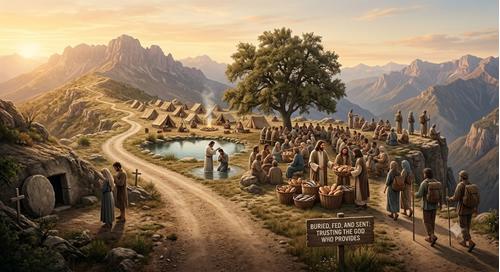
A Crowd in the Wilderness
You just heard the Gospel proclaimed, so I won't read it again — but I want you to sit with that scene for a moment, because I want you to really see it.
Four thousand people. Three days out in the wilderness — no Dillon Super Market, no Caseys convenience store, nothing but rock and dust and the hot sun. And Mark tells us plainly: "they have nothing to eat."
I want you to notice something before we go any further. Jesus doesn't wait for the disciples to come to Him with the problem. He sees it Himself. "I have compassion," He says. He sees their exhaustion. He sees the mothers who are worried, the children who are weak, the old men who might not make the journey home. He sees it all before anyone asks Him for help.
I remember, growing up, my own father used to say, "Son, don't wait until you're desperate to trust the Lord — He already sees what you need before you even open your mouth." That's exactly what's happening here. Before the disciples panic, before the crowd complains, the Lord already has compassion.
This is the first thing I want us to hold onto this morning: God sees our helplessness before He ever acts. He's not waiting on us to figure it all out. He's not waiting for us to have just the right words in prayer. He sees the wilderness we're standing in, and His heart is already moved toward us.
But here's the strange detail Mark gives us — three days. Three days they'd been with Him, three days without food. Now, in the Scriptures, three days is never just a number. It shows up again and again — Jonah in the belly of the fish three days, Christ in the tomb three days. And I promise you, that number is not an accident here either. Because this Gospel reading isn't only about bread. It's about something far deeper — something that Saint Paul is going to open up for us in the Epistle. So let's look at that now.
Buried With Him: The Meaning of Baptism
In Romans chapter 6. Saint Paul writes:
"Do you not know that all of us who have been baptized into Christ Jesus were baptized into his death? We were buried therefore with him by baptism into death, in order that, just as Christ was raised from the dead by the glory of the Father, we too might walk in newness of life." (Romans 6:3-4, ESV-CE)
Did you catch that word — buried? Not just washed. Not just sprinkled. Buried. That's a strong word. That's a tomb word.
Now think back to our crowd in the wilderness — three days without help, three days that seemed like death, and then the Lord provides abundantly. Paul is telling us that in baptism, we go through our own three days, so to speak. We go down into the water as into a grave, and we come up out of it alive — raised, just as Christ was raised.
The early Church Fathers loved to meditate on this. Saint Ambrose, writing to the newly baptized in Milan back in the fourth century, called the baptismal font nothing less than a tomb — but a tomb that gives life rather than takes it. He said that when you go down into that water, you are following Christ into the grave, and when you come up, you are following Him out of it into the resurrection.
And Saint John Chrysostom — the great preacher of Constantinople, whose sermons are still read today — he put it even more beautifully. He called the baptismal font both a tomb and a womb at the very same time. Isn't that remarkable? A tomb, because the old self, the old life of sin, is buried there and dies. But a womb, because a new life, a new child of God, is born from those same waters.
Brothers and sisters, that is exactly what happened to every one of you who has been baptized. You went down into death with Christ. And you came up newly born, walking — as Paul says — "in newness of life."
So here is our second point this morning: baptism is not merely a symbol we perform. It is a real death and a real rising. Just as those four thousand people passed through three desperate days before the Lord provided abundantly, we pass through the waters of death before the Lord raises us to new life in Him. The wilderness always comes before the feast. The tomb always comes before the resurrection.
Dead to Sin, Yet Still Wounded
Now Paul doesn't stop there. Listen to what comes next, Romans 6, verses 5 through 7 and verse 11:
"For if we have been united with him in a death like his, we shall certainly be united with him in a resurrection like his. We know that our old self was crucified with him in order that the body of sin might be brought to nothing, so that we would no longer be enslaved to sin. For one who has died has been set free from sin... So you also must consider yourselves dead to sin and alive to God in Christ Jesus." (Romans 6:5-7, 11, ESV-CE)
Saint Augustine spent a great deal of time meditating on that little word Paul uses — "consider," or as some translations put it, "reckon" yourselves dead to sin. Augustine said this reckoning isn't wishful thinking. It's not pretending. It is a settled confidence, based on what Christ has truly accomplished, that sin's mastery over us has been broken at the root.
Now here's where I want to be honest with you, because our faith has always been honest about this. If sin's power is broken in baptism, why do we still struggle? Why do good people, faithful people, baptized people, still feel the pull toward anger, toward lust, toward pride, toward every old temptation?
The Church has always taught something very careful here, and I think the old Baltimore Catechism says it in the simplest way possible. It teaches that even after baptism washes away original sin and all our personal sins, there remains in us what is called concupiscence — that is, an inclination or a leaning toward sin that stays with us as a kind of wound, even after the guilt itself is gone.
The Council of Trent taught this very clearly, in plain terms — that baptism truly takes away sin, root and guilt, but it does not remove every trace of our fallen nature. The old wound of Adam still aches in us, even though the master that once enslaved us has lost his grip entirely.
Think of it this way. Imagine a man who was once a prisoner, chained up for years. One day he is truly set free — the chains are gone, the prison door is open, he walks out a free man. But his legs are still weak from all those years in chains. He may still stumble sometimes when he walks. That stumbling doesn't mean he's still a prisoner. It means he's a free man who is healing.
That's us, brothers and sisters. Baptism breaks the chains completely. Sin no longer owns us. But we still walk with a limp sometimes. That's why Trent, and the Catechism, and the whole tradition of the Church point us toward the ongoing medicine of grace — prayer, the sacraments, and above all, as we're about to see, the Eucharist — to keep healing that limp, day by day, until we walk without stumbling in the life to come.
So here is our third point: baptism truly sets us free from sin's mastery, but the wound of our fallen nature remains, and it is healed slowly, through the ongoing grace God gives us — especially at this altar.
Seven Loaves, Seven Baskets: God's Sustaining Provision
Now let's go back to our wilderness crowd. Remember them? Three days without food, and then Jesus asks a simple question: "How many loaves do you have?" Seven. Just seven loaves and a few small fish, for four thousand people. It's nothing. It's laughably small.
But notice what Jesus does. He doesn't wait for more. He takes what little they have, gives thanks, breaks it, and gives it to the disciples to distribute. And everyone eats. Everyone is satisfied. And they gather up seven baskets of leftovers — more abundance at the end than they even started with.
I want to share with you something that has stuck with me for years, ever since I first heard it from an older priest when I was young in the faith. He called it "The Bread in the Baptistery."
In the early centuries of the Church, when adult converts were baptized — usually at the Easter Vigil, in the dead of night — they would come up out of that baptismal water, dripping, newly reborn, having just died and risen with Christ. And do you know what the Church did for them, right there, often before they even had time to change into dry clothes? They gave them milk and honey to taste, symbolizing the Promised Land, and then they led them straight into the assembly for their very first Eucharist. Their first meal as Christians, fresh out of the watery tomb, was the Body and Blood of the Lord Himself.
Think about that. The Church, from the very earliest days, understood that a person who has just died and risen with Christ needs to be fed immediately. You don't leave someone hungry after they've just come up out of the grave. The same God who saw the wilderness crowd's need before they asked, the same God who provided seven loaves for four thousand people, is the same God who has always provided His own Body as the Bread for those who have died and risen with Him in baptism.
That is precisely what happens on this altar, every single Mass. We bring so little — a bit of bread, a bit of wine, nothing more than that widow's small loaves. And the Lord takes it, blesses it, breaks it, and gives us back nothing less than Himself — enough not just to satisfy four thousand, but enough for every soul in every age who comes hungry to His table.
So here is our fourth point: the same God who multiplied seven loaves in the wilderness feeds us still, abundantly, at this altar — especially those of us who, like the newly baptized of old, have died and risen with Christ and come to Him hungry.
Trust and Table: Living the Provision Today
So let's bring all of this together, because I think you can see now how beautifully these two readings speak to each other.
A crowd in the wilderness, three days without food, and Christ sees their need before they even ask, and provides abundantly. A Christian in the waters of baptism, three days mirrored in that tomb-like descent, buried with Christ, and raised to newness of life — set free from sin's mastery, though still carrying the wound of our fallen nature, a wound that needs ongoing healing. And that healing, that ongoing grace, comes to us chiefly here, at this table, where the Lord takes our little offering and multiplies it into more than enough — His very Body and Blood.
Brothers and sisters, whatever wilderness you're walking through this week — whatever three days of struggle you're facing, whether it's sickness, or grief, or a temptation you thought you'd already buried, or just the ordinary exhaustion of daily life — I want you to remember: God sees you before you even ask. And He has already made provision for you. Not just seven loaves. Not just enough to survive. He has given you Himself.
In a few moments, we're going to come forward to this altar, and I want to invite each one of you who is properly disposed to receive Him — to come, like that wilderness crowd, hungry and empty-handed, and to be satisfied, truly satisfied, by the Bread that does not run out. Come to this table the way those newly baptized Christians came, still dripping from the font of grace, trusting that the same God who buried you with Christ and raised you to new life will not let you go hungry now.
And when you leave this church today, don't leave that trust behind at the door. Carry it into your week. When you face your own wilderness — your own three days of waiting, of weariness, of wondering if God even sees you — remember: He already does. He already has compassion. And He has already prepared the bread.
So this week, I'm asking you simply this: bring Him your seven loaves, however small they seem — your little bit of prayer, your little bit of patience, your little bit of faith — and trust Him to multiply it. He always has. He always will.
Let us now stand and profess together the faith into which we were baptized, buried, and raised — the faith that leads us, hungry and trusting, to this altar of abundant provision. F.D.