

Frayed Wires: A Warning Before the Spark
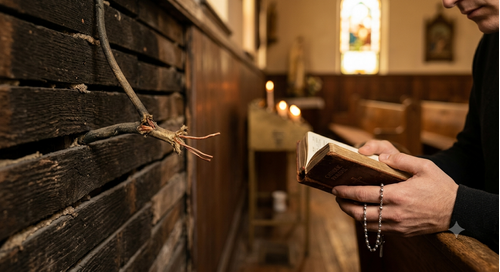
Frayed Wires — The Danger We Don't See
Brothers and sisters, I want to tell you about a house.
From the outside, it looked just fine. Fresh paint, tidy yard, lights coming on every evening right on schedule. Nothing to worry about. But behind the walls, in a place nobody ever looked, there was a wire that had frayed. Just a little. Just enough. It had been that way for years — through birthdays, through holidays, through every ordinary evening — and nothing happened. The lights still came on. The house still felt safe.
Until one night, it didn't.
That's the trouble with frayed wires. They don't announce themselves. They don't blink a warning light. The power still flows, the house still looks fine, right up until the moment it doesn't — and then it's too late to go back and fix what should have been tended to all along.
I share that image with you because I believe Paul is describing something very much like it in 1 Corinthians chapter 10. You heard it read a moment ago, so I won't read the whole thing again, but let me remind you what Paul is doing there. He's talking to the church at Corinth — good church people, baptized people, people who received the Holy Eucharist, people who had every spiritual privilege you could ask for — and he reaches all the way back to the Israelites in the wilderness to make his point.
Listen to how he describes them. All of them were under the cloud. All of them passed through the sea. All of them ate the same spiritual food and drank the same spiritual drink. Paul is stacking up privilege after privilege after privilege. These weren't outsiders. These were God's own covenant people, marked by His presence, fed by His hand, led by His cloud of fire.
And then verse 5 hits like a hammer: "But with many of them God was not well pleased: for they were overthrown in the wilderness."
All of them had the privilege. Most of them still fell.
That's the wire fraying behind the wall. The power was still on. The blessings were still real. And yet something underneath was coming apart, unnoticed, unattended, until the day it finally sparked — and an entire generation, the very generation God rescued out of Egypt with His own mighty hand, never made it into the promised land.
So here's the question I want us to sit with, old and young, whether you've been coming to church since before you could walk or whether you slipped in the back door for the first time: is it possible to have all the right religious privileges — baptism, the Holy Eucharist, regular Confession, a good Catholic upbringing, a devout family name — and still have a frayed wire nobody's checking?
Paul says yes. And he says it not to scare us for the sake of scaring us, but to love us enough to tell us the truth before the spark, not after.
That's what we're going to walk through together — five short stops along the way, showing us where those wires tend to fray, and where God, in His mercy, has already given us everything we need to check them, tend them, and walk safely home.
When Privilege Isn't Protection
Paul doesn't leave it vague. He gets specific in verses 6 through 10. He says these things happened as examples for us — idolatry, sexual immorality, testing Christ, grumbling against God. Four different ways that same wilderness generation let the wire fray until it sparked.
Now here's what strikes me. These weren't pagans who never knew God. These were people who had walked through the Red Sea on dry ground. Paul actually calls what happened to them a kind of baptism — "baptized unto Moses in the cloud and in the sea." They had spiritual food, spiritual drink, Christ Himself present with them in the wilderness, Paul says. In other words, they had something that looked an awful lot like sacrament. Shadow and type, yes — pointing forward to what we now have fully in Christ — but real privilege all the same.
And it wasn't enough to keep most of them from falling.
Now, brothers and sisters, the Church has always taught that the sacraments are not bare symbols. Baptism actually washes. The Eucharist actually feeds us with Christ Himself. These are real channels of real grace, not just gestures we perform to remember something that happened long ago. But hear me carefully — that is exactly why Paul's warning cuts so deep. The old Catechism of the Council of Trent said it plainly, and I'll put it in our own everyday words: the sacraments are not vending machines. God's grace poured out in baptism, in communion, doesn't work automatically on a soul that isn't turning toward Him. Grace is real, grace is powerful, grace is a gift — but grace given still has to be received with a heart that keeps saying yes, over and over, day after day. The Baltimore Catechism used to teach children that grace helps us to know, love, and serve God — but it's still something we have to cooperate with, not something we can just collect and set on a shelf.
That's the wire underneath the wall. You can have the power running to the house — real power, God's own power — and still let the insulation wear thin if nobody's checking on it. Going forward with a form of godliness isn't the same as a heart that's actually following hard after God.
I think of St. Thérèse of Lisieux, who used to say that what mattered wasn't doing great and extraordinary things for God, but doing the small, hidden things with great love, every single day. That's tending the wire. That's the daily, unglamorous work of actually letting the grace you've been given do something in you — not just assuming it's doing its work while you go on about your business.
So let's ask ourselves honestly: have I received the sacraments but let the wire underneath go untended? Am I in a state of grace, or have I been receiving Communion out of habit while my conscience has gone unexamined for months? Is my faith a living, daily communion with God, or is it something I received once at the font and now just assume is still holding?
Because Israel assumed the same thing. And the wilderness swallowed most of them anyway.
"Take Heed Lest He Fall" — The Sin of Presumption
Which brings us to the verse I really want us to sit with — verse 12. Paul writes: "Wherefore let him that thinketh he standeth take heed lest he fall."
Notice who Paul is warning. Not the person who knows they're struggling. Not the person who's aware they're weak. He's warning the person who thinks he's standing just fine. The confident one. The comfortable one. The one who assumes the wire is fine because the lights still come on every night.
Let me tell you about a man — I'll call him Ray, though that's not his real name — who had a good fire insurance policy on his house for almost thirty years. Paid it faithfully every month. Never missed a payment. And because he had that policy, he never once had an electrician out to look at his wiring. Why would he? He had it covered. That's what the policy was for, right?
Except insurance doesn't keep a fire from starting. It just tells you what happens after it burns down.
Brothers and sisters, that's exactly the sin Paul is naming here — presumption. Not doubt, not despair, but presumption. The quiet, comfortable assumption that says, "I go to Mass. I was baptized as a baby. I made my First Communion. I come from a good Catholic family. I'll be fine." It's trusting the policy instead of tending the wire.
This is why the Church has always urged us toward an examination of conscience — not as some morbid exercise in guilt, but as the electrician walking through the house before there's ever a spark. Before you come to the Lord's table, take just a moment — quiet, honest, unhurried — and ask: where have I let this wire fray? Where have I been coasting on privilege instead of walking in grace?
And here's the beautiful thing — this isn't meant to leave us anxious. It's meant to lead us to humility instead of presumption. St. Thérèse again is such a gift to us here. She didn't examine her conscience so she could impress God with her effort. She called it her "little way" — the way of a child who runs to her Father not because she's earned the right to stand confidently on her own, but because she trusts Him utterly, even in her smallness, even in her failures. That's the opposite of presumption. Presumption says, "I've got this covered." The little way says, "I have nothing, Father, but I trust You completely, and so I keep coming back to You, again and again."
So here's the application, plain and simple: before you come forward, before you take communion next time you gather at the table, take thirty seconds. Not to work up guilt, but to ask honestly — Lord, is there a wire I've let go? And then bring it to Him, not as a debt you're trying to pay, but as a child running to a Father who is glad to have you home.
A House of Prayer, Not a Business
Now I want to pull one more thread in, because Paul's warning about presumption in worship connects directly to something Jesus does in Luke chapter 19. You heard that passage too — Jesus coming over the ridge, seeing Jerusalem spread out below Him, and weeping. Actually weeping over the city. And then walking straight into the Temple and driving out the moneychangers, saying, "My house is the house of prayer: but ye have made it a den of thieves."
Now why does Jesus weep first, and then cleanse the Temple? I think it's because the same thing was happening in Jerusalem that Paul later warns the Corinthians about. The Temple was still standing. The sacrifices were still being offered. Everything looked religious, looked functional, looked fine from the outside. But the wire had frayed. What was meant to be a house of prayer — a place where people came to actually meet with the living God — had become a place of transaction. Business. Routine. Something you did on your way to somewhere else.
Jesus doesn't weep over empty pews. He weeps over full ones that have lost their reverence.
And brothers and sisters, I have to ask us — old and young alike — has anything like that crept into our worship? Not moneychangers in the literal sense, but the same spirit: hurry, distraction, checking the time, going through the motions because it's Sunday and that's just what we do. A house of prayer can quietly, slowly become a house of habit, and nobody notices the wire fraying because the building still opens its doors every week right on schedule.
Here's a simple, everyday application, and I mean simple: what if you came just ten minutes early next week — not to socialize in the foyer, but to sit in the sanctuary in silence before the service starts? Just you and the Lord, in the quiet, before anything else pulls at your attention. Let the sanctuary be sacred space again. Let it be, even for ten minutes, a house of prayer and not just a house you show up to.
Because reverence isn't about being stiff or somber. It's about remembering Who it is we've actually come to meet.
The Way of Escape and the Quiet Fidelity of St. Anne
Now, I don't want to leave you thinking the message is only warning, only fear, only "check your wires or else." Because Paul doesn't leave it there either. Look at what comes right after that sobering warning in verse 12. Verse 13: "There hath no temptation taken you but such as is common to man: but God is faithful, who will not suffer you to be tempted above that ye are able; but will with the temptation also make a way to escape, that ye may be able to bear it."
Paul warns us plainly — take heed, don't presume, tend the wire. And then in almost the same breath he says: God is faithful. He doesn't hand you a warning and walk away. He hands you a warning and stays right there beside you with a way through it.
That's not fire insurance sitting untouched in a drawer somewhere. That's a Father who walks through the house with you, wire by wire, saying, "Here, let's fix this one together. I'm not leaving you to figure it out alone."
I think of St. Anne here — Mary's mother, according to what the Church has always handed down to us. We don't have long, dramatic stories about her. No grand miracles, no famous sermons. What we have is a quiet woman who, year after ordinary year, raised her daughter in faithfulness, tended what God had given her with humble, hidden devotion, long before anyone knew what that daughter would become. She wasn't presuming on some future greatness. She was simply faithful with what was in front of her, day by day, wire by wire, tending the house God had given her to keep.
That's what God is calling every one of us to — not dramatic, not showy, just faithful. Not presuming on privilege, but walking daily with the One who provides the way of escape before the spark ever comes.
So here's what I want us to do together. I'm going to lead us in a prayer, and I want you to pray it with me in your heart if that's where you are right now. Let's bring our own frayed wires, whatever they may be, to the God who is faithful.
Let's pray together. In the name of the Father and of the Son and of the Holy Spirit:
Heavenly Father, we come to You as people who have been given so much — Your Word, Your grace, Your church family gathered around us. And we confess that privilege alone has never been enough to keep a heart faithful. We confess the places where we have presumed instead of watched; where we have coasted instead of walked; where we have let the wire fray in the dark, unnoticed corners of our lives.
Lord, we ask You now to search us. Show us where we have made Your house a house of habit instead of a house of prayer. Show us where we have trusted the policy instead of tending the wire. And Father, where we have fallen — forgive us, and lift us up.
We thank You that You are faithful — that You do not simply warn us and walk away, but that You always provide a way of escape, a way through, a way home. Teach us the little way of humble trust, the way of quiet, daily faithfulness, that we might stand not on our own confidence, but on Your grace alone.
We commit ourselves to You again — all of us, together, as one body — asking You to renew in us a reverent, watchful, faithful heart, until the day we see You face to face.
In the name of the Father, and of the Son, and of the Holy Spirit. Amen.