

Two Men, Two Prayers, One Mercy
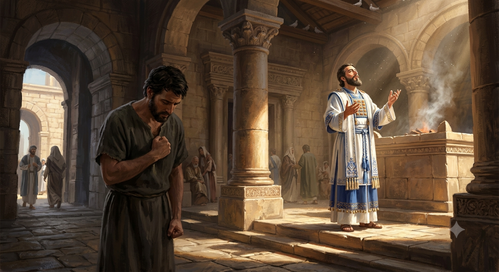
Two Men, Two Prayers
I want you to come with me into the Temple courts in Jerusalem. It's the hour of prayer. The sun is warm on the stone. Doves are cooing up in the rafters somewhere. People are filing in and out, some hurrying, some lingering, and over near the front of the court, close to where the sacrifices are offered, there's a man standing tall. His robe is clean. His shoulders are back. His chin is lifted just a little, the way a man stands when he knows people are watching him and he doesn't mind one bit. He's got his eyes open, looking up toward heaven, and his voice carries — not shouting, but pitched just loud enough that the fellow three feet away can hear every word.
Now look over there, off to the side, almost in the shadows by the gate. There's another man. He won't come any closer than he has to. His eyes are on the ground — he won't even lift them up toward heaven. His hands are folded up against his chest, and every so often he strikes himself right over the heart, the way you'd pound on a door that's been shut too long. He's not saying much. He's almost whispering. You'd have to lean in close to catch what he's saying at all.
Two men. Same Temple. Same hour of prayer. Same God they're both approaching. And yet look at the distance between them — not just the few yards of stone between where they're standing, but something much deeper. One of them is comfortable. One of them is undone.
Now, friends, you already know who these two men are, because you've heard this parable before — maybe a hundred times. Jesus tells us plainly in Luke chapter 18: one is a Pharisee, a religious man, careful about the law, faithful in his observance. The other is a publican — a tax collector, and not just any tax collector, but the kind hired by Rome to squeeze money out of his own Jewish neighbors, a man everybody in that town would've crossed the street to avoid.
If you'd asked anybody standing in that Temple court that day which of those two men God was pleased with, I don't think there'd have been much debate. The Pharisee kept the law. He fasted twice a week — that's more than what was required. He tithed on everything he had, not just the big stuff, but everything. By every outward measure, he was the model of righteousness, and the tax collector was the model of everything wrong with the nation.
But Jesus doesn't tell us this story to confirm what everybody already thought. He tells us this story to turn it upside down. Because the man who walked home right with God that day wasn't the one standing tall near the altar. It was the one who couldn't even lift his eyes.
I want us to sit in that gap for a while this morning — the gap between how a man looks on the outside and where he actually stands before God. Because that gap is where every one of us lives, if we're honest. We've all got a little bit of the Pharisee in us, and thank God, we've all got the chance to become like the tax collector too. Let's walk through this together.
The Danger of "Praying With Himself"
Let's listen again to what the Pharisee actually prays. Luke records it for us — verse 11: "The Pharisee, standing by himself, prayed thus: 'God, I thank you that I am not like other men, extortioners, unjust, adulterers, or even like this tax collector. I fast twice a week; I give tithes of all that I get.'"
Now here's something I want you to catch, because it's easy to read right past it. Luke doesn't just say the Pharisee prayed. He says the Pharisee "prayed thus with himself." Now, that's a curious little phrase, isn't it? You'd expect it to say he prayed to God. But Luke says he prayed with himself.
There was an old preacher from the early Church, St. John Chrysostom — his name means "golden mouth," because he had a gift for saying plain things in a way that stuck with you — and he noticed this same detail centuries ago. He said that the Pharisee's prayer never actually made it up to heaven. It went up a little ways and then folded back down, because the whole time, he wasn't really talking to God. He was talking to himself, about himself, admiring himself, and God just happened to be standing there listening in.
Think about that for a second. Here's a man in the Temple — the one place on earth built specifically for meeting God — and he manages to spend the whole prayer without actually reaching Him. He's not asking for anything. He's not confessing anything. He's just giving God a little report card on how well he's doing, and grading himself an A.
Now here's what makes this so dangerous, friends — and I want you to really hear this part. Everything the Pharisee says is true. He probably did fast twice a week. He probably did tithe faithfully. These aren't small things. Fasting is hard. Tithing is hard. If you've ever tried to give away a tenth of what you earn, you know it costs you something. This man was disciplined. He was sacrificial. By any honest measure, he was doing more than most of us do.
But here's the trouble. Good works, when they're used to build yourself up instead of to serve God and love your neighbor, don't stay good works for long. They turn into something else. They turn into credentials. And credentials, when you're standing before God, aren't worth the paper — or in this case, the pride — they're printed on.
Let me give you a picture of what I mean. You ever go through airport security? You know how it works — you've got your carry-on, and before you go through, you've got to take everything out. Your laptop, your liquids, your belt, your shoes, anything metal in your pockets. You strip it all down to basically nothing, because the whole point of that checkpoint is not to see how much you're carrying — it's to see if there's anything dangerous hidden underneath it all.
Now imagine a fellow walks up to that checkpoint, and instead of emptying his pockets, he starts pulling things out to show the security agent how impressive he is. "Look here, I've got my pilot's license. Look, here's my frequent flyer card, top tier. Here's a letter of recommendation from my boss." The agent doesn't care about any of that. He's not there to be impressed. He's there to let you through — but you've got to come to the checkpoint the way the checkpoint requires, empty-handed, ready to be searched, not loaded down with your own credentials.
That's exactly the picture of the Pharisee standing in the Temple. He walks up to God with his hands full — full of his own righteousness, his own fasting, his own tithing — and he's showing it all off like it's going to get him special treatment at the gate. But God doesn't need to see your credentials. God already knows everything about you. What He's looking for isn't a résumé. It's a heart that knows it needs Him.
And here's the sting in the tail of this prayer — did you catch the last line? "I thank you that I am not like other men... or even like this tax collector." He doesn't just praise himself. He uses the other man, the one standing off in the shadows, as a measuring stick to make himself look taller. Friends, that is one of the oldest tricks pride plays on us — we don't just compare ourselves to God's holiness, which would humble anybody. We compare ourselves to the fellow next to us, and if we can find somebody who looks worse off than we do, we feel pretty good about ourselves.
I've caught myself doing this. Maybe you have too. You hear about somebody's struggles — with drink, with their marriage, with their temper — and there's this little quiet voice that whispers, "Well, at least I'm not like that." And just like that, without even meaning to, you've prayed the Pharisee's prayer. You've stood in the Temple with your hands full of your own credentials, comparing yourself to your neighbor instead of kneeling before your God.
The Baltimore Catechism puts it to children in the simplest terms, and I think the simplest terms are usually the truest ones: pride is loving our own excellence and wanting others to admire us for it. That's all it is. And it can hide inside good deeds just as easily as bad ones — maybe more easily, because good deeds don't feel like sin. They feel like accomplishment. But when fasting and tithing and church attendance and Bible knowledge all get quietly rerouted into feeding our own sense of superiority, we've taken something meant to draw us to God and turned it into a wall that keeps Him out.
So here's the danger, plain and simple: it's entirely possible to do all the right things and still walk out of church, out of confession, out of Sunday Mass, no closer to God than when you walked in — because the whole time, like that Pharisee, you were only praying with yourself.
The Tax Collector's Empty Hands
Now let's walk back over to that other man, the one standing off by the gate, the one who wouldn't lift his eyes. Luke tells us in verse 13: "But the tax collector, standing far off, would not even lift up his eyes to heaven, but beat his breast, saying, 'God, be merciful to me, a sinner!'"
That's it. That's the whole prayer. Just a handful of words. No résumé. No comparison to anybody else. No mention of what he's done right, because — let's be honest — a tax collector working for Rome, cheating his own people, probably didn't have a whole lot to put on that résumé anyway. He knew it. Everybody in that Temple court knew it. And instead of trying to talk his way past that fact, he just... admits it.
"God, be merciful to me, a sinner!" Not "a sinner among many" — in the original language, it's actually "the sinner," like he's the only one in the room, like for that moment, he's not comparing himself to the Pharisee or anybody else at all. He's just standing there before God with nothing to offer but the truth about himself.
Remember that airport picture? Here's a man who walks up to the checkpoint with his pockets already empty. He's got nothing to show, no credentials, no frequent flyer card, nothing impressive to pull out and set on the little tray. He just puts his empty hands up and says, "Here I am. Search me. I know what's underneath — have mercy." And what happens? He walks right through. Jesus says so plainly in verse 14: "I tell you, this man went down to his house justified, rather than the other."
Justified. That's a word we use a lot in church, and sometimes we let it get complicated, but the Baltimore Catechism keeps it simple for us, the way it keeps most things simple: to be justified means to be made right with God — not just excused, not just let off the hook, but actually cleansed, actually restored, actually brought back into friendship with Him. That's what happened to this man. He walked into the Temple with nothing but honesty and walked out with everything — right standing before God Himself.
Now I want to be careful here, because somebody might hear this and think, "So it doesn't matter what I do — I can live any way I want, as long as at the end I say a quick prayer like the tax collector's." That's not what this parable is teaching, and it's not what the Church has ever taught. The tax collector's prayer wasn't a magic formula. It was the honest overflow of a heart that had actually been broken by its own sin. That's what true contrition looks like — not just words on the lips, but sorrow that reaches the heart, sorrow that turns a man away from his old path.
This is exactly what the Church means when she talks about the Sacrament of Confession. You come to that confessional, before God, in humility and honesty — not with a list of your good deeds to balance out the bad, but with empty hands, admitting what's true, and trusting entirely in God's mercy to do what you cannot do for yourself. The old Catechism of Trent describes contrition as a sorrow of the soul and a hatred of sin committed, joined with the resolution not to sin again. That's not complicated theology. That's just what happened in that tax collector's heart, right there by the Temple gate. He was sorry — truly sorry — and God met him in that sorrow with mercy that made him new.
There's a story told about St. Padre Pio, who spent so many hours of his life sitting in the confessional listening to people's sins, that people used to say he could see right into a person's soul before they even opened their mouth. One time a man came to him absolutely convinced that his sins were too many, too dark, too repeated for God to forgive him one more time. And Padre Pio just looked at him and said something like, "Son, God is not tired of forgiving you nearly as much as you are tired of asking." That's the heart of this whole parable, isn't it? We think God's mercy runs out before it does. We think there's a limit to how many times He'll listen to "God, be merciful to me, a sinner!" But He never gets tired of that prayer. He built the whole Temple, the whole system of sacrifice, the whole plan of salvation, around exactly that prayer being answered.
So here's what I want you to notice about the publican's posture, because it's not just his words, it's his whole body. He stands far off — he doesn't presume he belongs close to the altar. He won't lift his eyes — he's not trying to catch God's attention with a performance. He beats his breast — there's real sorrow moving through him, not just polite regret. Everything about him says: I have nothing to offer here except the truth, and I am trusting entirely in mercy.
That, friends, is what true humility looks like in prayer. Not groveling, not despair, not pretending you're worse than you are for show — just plain honesty before a God who already knows everything anyway, and who has never once turned away a heart that comes to Him with empty hands.
Every Gift Is Grace, Not a Trophy
Now, I want to take what we've learned in that Temple courtyard and carry it somewhere else for a few minutes — into 1 Corinthians chapter 12, where Paul is writing to a church that had a whole different kind of pride problem going on.
See, the church at Corinth was blessed. God had poured out all kinds of gifts among them — some could teach with real power, some had gifts of healing, some spoke with wisdom, some served quietly behind the scenes. But instead of using those gifts to build each other up, they'd started ranking themselves. "My gift is better than your gift." "I'm more spiritual because I can do this." It was the Pharisee's prayer all over again, just wearing different clothes — church clothes, this time.
So Paul writes to straighten them out, and he starts with this simple but powerful truth in verse 4: "Now there are varieties of gifts, but the same Spirit; and there are varieties of service, but the same Lord; and there are varieties of activities, but it is the same God who empowers them all in everyone." Did you catch what he's doing? Every single gift, no matter how different it looks on the outside, comes from the very same source. Nobody earned their gift. Nobody worked hard enough to deserve it more than the next person. It's given — that's the whole point of the word "gift." You don't achieve a gift. You receive one.
Paul goes even further down in verse 11: "All these are empowered by one and the same Spirit, who apportions to each one individually as he wills." Notice who's doing the choosing there. Not us. The Spirit "apportions... as he wills" — according to His own wisdom, His own purposes, not according to our merit or our seniority or how long we've been coming to church.
There was a bishop back in the fourth century, St. Cyril of Jerusalem, who used a picture I've always loved for explaining this. He said, think about rain falling from the sky. It's the same rain, falling the same way, everywhere it lands. But when it falls on a rose bush, it comes up as a rose. When it falls on a lily, it comes up as a lily. Same rain, but the flower that comes up is different depending on the soil and the seed that receives it. And Cyril said that's exactly how the Holy Spirit works in the Church. The same Spirit falls on all of us, but in one person that Spirit brings up the gift of teaching, in another the gift of hospitality, in another music, in another a quiet, faithful gift of just showing up and serving where nobody's watching.
Think about your own parish family for a minute. Think about the person who always seems to know exactly what to say to a grieving family, or who shows up with a casserole before you even had to ask. Think about the one who can teach a CCD class of squirming children and somehow make the Gospel stick in their hearts. Think about the folks who serve at the altar, who arrange the flowers before Mass, who quietly keep the parish books, who visit the shut-ins every single week without fail and without fanfare. None of those people got their gift because they were more righteous than the rest of us. They got it because the same Spirit, the same rain, fell on them, and something beautiful came up out of the soil God gave them to work with.
Here's why this matters so much alongside our Temple story. It would be very easy — especially for those of us who've been given a visible gift, a gift people notice and praise — to slip right back into the Pharisee's prayer. "Lord, I thank you that I'm not like those other church members who can't teach, who can't sing, who just sit quietly in the back." The moment we start ranking gifts, comparing ourselves to the person next to us instead of receiving our gift as pure grace, we've walked right back to that spot near the altar, standing tall, forgetting that every single thing we have to offer was handed to us, not earned by us.
Paul actually spends the rest of that chapter — you can read it later — comparing the Church to a body, where the eye can't say to the hand, "I have no need of you," and the parts that seem weaker are actually treated with the most care and honor. That's not how the world usually works, but it's exactly how grace works. In God's economy, the gift you were given is not a trophy for you to hold up. It's rain that fell so something could grow — not just for your own garden, but for the whole field, the whole parish, the whole body of Christ around you.
So if God has given you a gift — and He has given every single one of you something, whether it's loud and visible or quiet and hidden — receive it the way the tax collector received mercy: with open, empty hands, not a puffed-up chest. Not, "look what I've done with what I was given," but "look what the Spirit has done, using someone as unworthy as me."
Coming Home Justified
So let's bring these two pictures together now, because I don't think they're really two separate lessons at all. I think they're one lesson, told twice, in two different rooms.
In the Temple, we saw two men — one who came with his hands full of his own righteousness, comparing himself to his neighbor, and one who came with nothing but honest sorrow and a plea for mercy. And Jesus tells us plainly that only one of them went home justified — right with God — and it wasn't the one who looked more impressive walking in.
In Corinth, we saw a whole church full of gifted people who started ranking those gifts against each other, forgetting that every single gift — however great, however small, however visible or hidden — came from the very same Spirit as pure, unearned grace, like rain falling from heaven and bringing up whatever flower the soil was made to grow.
What connects these two stories, friends, is this: humility is the doorway. It's the doorway grace walks through to reach us, and it's the doorway our gifts walk through to reach each other. The Pharisee's problem and the proud Corinthian's problem were really the same problem — both of them forgot that what they had, whether it was righteousness or spiritual gifts, wasn't theirs to boast about. It was theirs to receive, and then to give away.
I think about St. Thérèse of Lisieux sometimes when I read this parable — that young nun who never did anything the world would call impressive. She didn't found a great order, didn't perform miracles that made headlines, didn't preach to thousands. She called her path the "Little Way" — she said she wanted to find an elevator to heaven instead of climbing the stairs, because she was too small to climb, and the elevator, she said, was Jesus' own arms, lifting her up because she couldn't lift herself. That's the tax collector's prayer, dressed up in a nineteenth-century French convent. That's a whole spiritual life built on empty hands and complete trust.
So here's my question for you this morning, and I want you to actually sit with it, not just let it float by: which man are you standing closer to today? Are you the one at the front, hands full of your own credentials, quietly grateful you're not as bad as so-and-so down the pew? Or are you the one at the gate, willing to admit — really admit, not just recite — "God, be merciful to me, a sinner"?
Here's the good news, and I want to leave you with this before we go any further: it doesn't matter which one you've been up until this moment. It only matters which one you're willing to be right now. The Pharisee could have prayed the very same words as the tax collector. Nothing was stopping him except his own pride. And any one of us, no matter how long we've been coming to church, no matter how many good deeds we've piled up, no matter how impressive our credentials look — we can set all of that down right now, walk up to that gate with empty hands, and say that same simple prayer, and Jesus promises us the very same thing He promised that tax collector: we will go home justified.
I want to invite you this week — really invite you, not just suggest it — to come to Confession, honestly and without pretense, the way the tax collector came before God. Leave the credentials at the door. Don't bring your fasting record or your tithing record or your church attendance record to show off at the gate. Just bring the truth about yourself, and let mercy do what only mercy can do.
And when you come to the Communion rail this week, come the same way — hands open, not clenched around your own righteousness, but open to receive what you could never earn. That's what that Sacrament has always been for: empty hands reaching out for a mercy that's been freely given.
I don't know exactly what the Spirit wants to do in your heart this week. I don't need to know. That's not my job. My job was just to walk you into that Temple courtyard this morning, and show you those two men, and let you decide, right there in your own heart, which prayer you're going to pray on the way home today.
God be merciful to us, sinners, every one. In the name of the Father and of thee Son and of the Holy Spirit, amen.-F.D.