

Life in the Ditch, Life in the Spirit
Letter Perfect, Spirit Deficient?
I want to read verses 25 through 29 from the Gospel of Luke again.
"And behold, a lawyer stood up to put him to the test, saying, 'Teacher, what shall I do to inherit eternal life?' He said to him, 'What is written in the Law? How do you read it?' And he answered, 'You shall love the Lord your God with all your heart and with all your soul and with all your strength and with all your mind, and your neighbor as yourself.' And he said to him, 'You have answered correctly; do this, and you will live.' But he, desiring to justify himself, said to Jesus, 'And who is my neighbor?'"
Now, folks, I love this lawyer. Not because he's a good example — he's actually a warning to us. But I love him because he is so relatable. This man knew his Bible. He could quote Deuteronomy 6 and Leviticus 19 without even opening a scroll. If you gave him a Bible trivia quiz, he'd have won every round.
But look at what Jesus does. Jesus doesn't argue theology with him. He simply says, "You have answered correctly; do this, and you will live." Notice that word — do. Not "believe correctly," not "recite correctly" — do.
And here's where it gets interesting. Verse 29 says the lawyer, "desiring to justify himself," asks, "And who is my neighbor?" Friends, that question isn't sincere curiosity. That's a lawyer looking for a loophole. He wants Jesus to draw him a nice, tidy circle — "your neighbor is this person, but not that person" — so he can keep his conscience clean without actually loving anybody inconvenient.
This is what I call being "letter perfect, but Spirit deficient." You can know every verse, sing every hymn, say every prayer by heart — and still be looking for a loophole to avoid loving your neighbor. The Pharisees were experts in the letter of the Law. But knowing the Law and living the Law are two very different things.
Paul writes later that "the letter kills, but the Spirit gives life" (2 Corinthians 3:6, ESV-CE). That's not Paul saying Scripture is bad — heaven forbid! It's Paul saying that knowledge alone, without the Holy Spirit changing our hearts, leaves us exactly where this lawyer stood: correct in our answers, but cold in our love. So here's my first challenge to you this morning: don't just be a "Bible answer man" or "Bible answer woman." Ask yourself — am I looking for loopholes in my own life? Am I asking "who is my neighbor?" instead of simply going out and being one?
Road to Nowhere
Before Jesus answers the lawyer's question directly, He tells a story — and it starts with a man on a road. Let's set the scene, because geography matters here. The road from Jerusalem to Jericho was notorious. It drops nearly 3,300 feet in about 17 miles. Rocky, winding, full of hiding places for bandits. The old-timers used to call a stretch of it "The Bloody Way" because so many travelers were ambushed there.
Luke 10:30 tells us, from the ESV-CE: "Jesus replied, 'A man was going down from Jerusalem to Jericho, and he fell among robbers, who stripped him and beat him and departed, leaving him half dead.'"
Now picture this man. He's not just inconvenienced. He's not just lost his wallet. He is stripped naked, beaten half to death, and lying in a ditch on the side of a dangerous road. He cannot get up. He cannot flag anyone down. He cannot fix his own situation. He is utterly, completely helpless.
Friends, that is a picture of every single one of us before the grace of God got a hold of us. That is what sin does. It doesn't just inconvenience us — it strips us, it beats us, and it leaves us half-dead on the road, unable to save ourselves.
Now listen to 2 Corinthians 3:5 in the ESV-CE: "Not that we are sufficient in ourselves to claim anything as coming from us, but our sufficiency is from God."
Paul is saying plainly — we don't have what it takes on our own. Not to save ourselves, not to fix ourselves, not to pull ourselves up out of that ditch by our own bootstraps. Our sufficiency, our adequacy, comes from God alone.
I think of my own life, and maybe you can think of yours — a time when you were absolutely stuck. Maybe it wasn't a physical ditch. Maybe it was a broken marriage, or an addiction, or grief so heavy you couldn't get out of bed. I remember a fellow I knew years back — a good, hardworking man — who lost his farm in a bad season, and then lost his wife to illness the same year. He told me, "Father, I felt like I was lying in a ditch and the whole world was just driving by." That's the picture. That's the road to nowhere.
And here's the hard truth: no amount of self-help, no amount of gritting our teeth and trying harder, gets us up out of that ditch. We need someone to stop. We need someone with the power — and the compassion — to lift us out.
When Religion Passes By
Now here's where the story gets uncomfortable. Luke 10:31-32, from the ESV-CE: "Now by chance a priest was going down that road, and when he saw him he passed by on the other side. So likewise a Levite, when he came to the place and saw him, passed by on the other side."
Two religious men. A priest — someone who served in the Temple, who handled holy things. A Levite — someone from the tribe set apart for God's service. These weren't strangers to Scripture. They knew the Law better than most. And both of them saw the wounded man clearly. Luke makes sure we know that — "when he saw him." This wasn't a case of missing him in the dark. They saw, and they crossed to the other side of the road.
Now, we can guess their reasons. Maybe they were worried about ceremonial defilement — touching a possibly dead body would make them unclean for Temple service. Maybe they were in a hurry, on important religious business. Maybe they told themselves, "Someone else will come along and help him."
I want to tell you a little story — and some of you have heard versions of this before, because it happens more than we'd like to admit. A man was driving to church one Sunday morning, running a little late because his kids couldn't find their shoes. On the way, he passed a car pulled over on the shoulder, hood up, steam rising, a woman standing beside it looking helpless. He thought, "I really should stop." But then he thought, "I'll be late for church. Someone else will stop." He kept driving. He made it to the service in plenty of time — sang the hymns, said the responses, even took good notes on the sermon about the Good Samaritan. Funny thing is, on the way home, that same car was still there. Nobody had stopped.
Friends, that man wasn't a villain. He wasn't cruel. He was just like us — busy, distracted, telling himself someone else would handle it. But that's exactly the danger Jesus is warning about. Religion — real, sincere, church-attending religion — can become so focused on the "right way to get to church" that it drives right past the person lying in the ditch.
So let me ask you honestly this morning: what's your "other side of the road"? Is it busyness? Is it the fear of getting involved in someone else's mess? Is it simply that we've trained ourselves not to see? The priest and the Levite saw the man clearly — and still passed by. Seeing isn't enough. We need something more than sight. We need a changed heart.
Stopped, Not Stumped
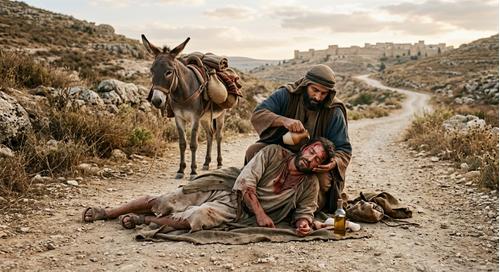
Now we come to the heart of the story. Luke 10:33-34, from the ESV-CE: "But a Samaritan, as he journeyed, came to where he was, and when he saw him, he had compassion. He went to him and bound up his wounds, pouring on oil and wine. Then he set him on his own animal and brought him to an inn and took care of him."
Remember — a Samaritan was a despised outsider to the Jews. Half-breed, heretic, unclean by their standards. The very last person the crowd listening to Jesus would expect to be the hero of the story. And yet this outcast is the one who stops. He sees the same wounded man the priest and Levite saw — but where they felt inconvenience, he "had compassion."
He doesn't just feel sorry for the man from a safe distance. He gets down in the dirt with him. He pours out his own oil and wine — valuable supplies he was carrying for his own journey — to clean and disinfect the wounds. He sets the man on his own animal, meaning he now walks while the wounded man rides. He takes him to an inn and pays for his care out of his own pocket.
Church, this is Jesus. Jesus is the true Good Samaritan. We were the ones stripped, beaten, and left for dead by sin — outsiders to God, unable to help ourselves. And Christ, who had every reason to pass by on the other side, stopped. He didn't just feel sorry for us from heaven. He came down. He got into the dirt of our human condition. He poured out — not oil and wine, but His own blood — to bind up our wounds.
Now listen to what Paul has to say in 2 Corinthians 3, verses 6, 8, and 9 in the ESV-CE:
"who has made us sufficient to be ministers of a new covenant, not of the letter but of the Spirit. For the letter kills, but the Spirit gives life... will not the ministry of the Spirit have even more glory? For if there was glory in the ministry of condemnation, the ministry of righteousness must far exceed it in glory."
Paul is drawing a straight line here. The old covenant — the letter, the Law — could tell us what love looks like, but it couldn't give us the power to actually love. It could diagnose the wound, but it couldn't heal it. That's the "ministry of condemnation." But the new covenant, the ministry of the Spirit, doesn't just tell us to get up out of the ditch — it reaches down, lifts us up, and pours new life into us.
That's the difference between the priest and the Samaritan. The priest had the letter. The Samaritan had compassion in action. And Christ, our Good Samaritan, gives us both — the truth of His Word and the living power of His Spirit to actually walk in it.
So when you feel like you're still lying wounded — maybe from an old sin, maybe from grief, maybe from a wound somebody else caused you — hear this: you are not stumped. You are not stuck forever in that ditch. Someone has stopped for you. Someone has already paid the bill at the inn. His name is Jesus, and He is not finished healing you yet.
Neighbor-Hood Watch
Let's finish the story. Luke 10:36-37 in the ESV-CE: "Which of these three, do you think, proved to be a neighbor to the man who fell among the robbers?' He said, 'The one who showed him mercy.' And Jesus said to him, 'You go, and do likewise.'"
Notice what Jesus does here. The lawyer's original question was "Who is my neighbor?" — trying to draw a small circle to limit his responsibility. But Jesus flips the question entirely. He doesn't ask, "Who counts as your neighbor?" He asks, "Who acted like a neighbor?" The question isn't about drawing lines around who deserves your love. The question is about whether you will get up and be a neighbor to whoever God places in front of you.
And then comes the command that echoes down through every generation of Christians since: "You go, and do likewise." Not "go and believe the same." Not "go and admire the same." Go and do.
This is where the Gospel and our daily lives meet. We've talked about how we were the wounded man, and Christ is the Good Samaritan who stopped for us. But once we've been healed, once we've received His mercy, we don't just stay lying at the inn forever. We get up, and we go out looking for the next person in the ditch.
So here's my challenge for you this week — and I mean this literally, not just as a metaphor. This week, you are going to drive past your own broken-down car on the side of the road. Maybe it's a coworker going through a divorce. Maybe it's a neighbor who just lost a job. Maybe it's a stranger in the checkout line who looks worn down and forgotten. The question isn't whether you know the right theological answer, like our lawyer friend did. The question is: will you stop?
Christ didn't pass you by when you were wounded and half-dead in your sin. He stopped. He bound up your wounds. He paid your debt in full at the inn, out of His own pocket, with His own blood. So don't leave here today having simply heard a good sermon and filed it away with all the other good sermons. Go, and do likewise.
Let's pray together. Lord Jesus, thank You for stopping for us when we were broken and unable to save ourselves. Thank You for pouring Your Spirit into our wounds and giving us life we could never earn on our own. Give us eyes to see the hurting people You place in our path this week, and give us the courage to stop, to love, and to act — not out of duty, but out of the mercy we've already received. In the name of the Father and of the Son and of the Holy Spirit, AMEN-F.F.D