

Grace Received, Gratitude Returned
Opening: Two Scriptures, One Story
Our Epistle and Gospel readings today are Galatians 3:16–22 and Luke 17:11–19.
At first, these may seem like two very different passages. Galatians is a careful argument from St. Paul about Abraham, the promise, and the Law. Luke gives us a moving story about ten lepers crying out to Jesus on the road. One passage sounds theological; the other sounds very personal. But together they tell one Gospel story.
Galatians tells us what the Law does. The Law shows us our sin. It tells the truth about us. It exposes the sickness of the human heart. But the Law cannot heal us. It cannot make us righteous by our own efforts.
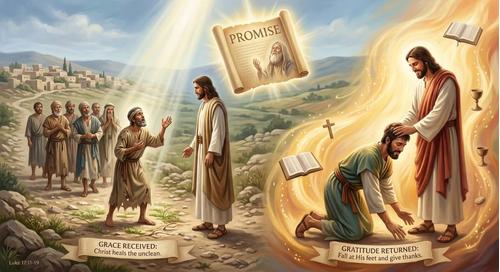
Then Luke shows us what grace does. Jesus meets people who know they are unclean, needy, and helpless. He heals them. And one man, a Samaritan, returns to Jesus, falls at His feet, and gives thanks.
That is the shape of the Christian life. First, we come to see our need. Then we receive mercy from Christ. And then, by grace, we return to Him with faith, thanksgiving, worship, and obedience.
The danger for religious people is that we can get those things backwards. We may imagine that if we work hard enough, pray long enough, follow enough rules, or become disciplined enough, then God will owe us something. But St. Paul says no. God's blessing begins with His promise. Salvation begins with grace. We do not earn our way into God's family; we receive His mercy through faith in Jesus Christ.
And the danger after receiving grace is that we become like the nine lepers. We are happy to receive the gift, but we do not return to the Giver. We enjoy forgiveness, health, family, food, work, another day of life, and the graces of the Church, yet we can forget to fall at the feet of Jesus and say, "Thank You."
So these readings ask us two important questions. First: Am I trying to save myself, or am I trusting in the promise of God fulfilled in Christ? Second: Having received so much mercy, have I returned to Jesus with thanksgiving?
The Promise That Cannot Be Broken
Let us begin with Galatians 3:16–18. St. Paul says, “Now the promises were made to Abraham and to his offspring.” He then points us to the true fulfillment of that promise: Christ.
God made a covenant with Abraham long before the Law was given through Moses. God promised Abraham that through his offspring all nations would be blessed. That promise was not based on Abraham earning it. Abraham certainly was called to obey God, but the covenant began with God’s gracious initiative. God spoke. God promised. God bound Himself by His word.
St. Paul uses a simple example. Once a human covenant, a legal agreement, or a will is ratified, no one simply comes along afterward and cancels it or adds conditions to it. How much more, then, can we trust the covenant promise of almighty God?
The Law came 430 years later. The Law is holy. The Law is good. The Law comes from God. But the Law did not erase the promise. It did not change salvation from a gift into wages. It did not say, “God has now changed His mind. You may save yourselves by perfect rule-keeping.”
No. The inheritance comes by promise.
This is very important for us as Catholics. We believe deeply in obedience. We believe the commandments matter. We believe faith bears fruit in love. We believe the sacraments are not empty symbols but real gifts of Christ to His Church. But none of that means we can put God in our debt.
The Catechism of the Council of Trent teaches, in modern words, that our justification begins with the mercy of God and the grace won for us by Jesus Christ. We do not first make ourselves holy and then come to God. God comes to us in Christ, forgives us, renews us, and enables us to live as His children.
The Baltimore Catechism asks, “Why did God make you?” The answer is: “God made me to know Him, to love Him, and to serve Him in this world, and to be happy with Him forever in heaven.” Notice that this is our purpose. It is not a ladder by which we climb to God apart from His help. We know Him because He reveals Himself. We love Him because He first loves us. We serve Him because His grace strengthens us.
This should give us great comfort. Our hope does not rest on the strength of our grip on God. It rests on the strength of God’s promise to us in Christ.
Some days, we may feel spiritually strong. Other days, we may feel weak, distracted, ashamed, or weary. But the promise of God does not rise and fall with our moods. Christ died for sinners. Christ rose from the dead. Christ gives His grace to His Church. Christ invites the repentant sinner home.
If you belong to Christ through faith and baptism, your hope is not that you have performed well enough. Your hope is that God is faithful. He has made a promise, and He will not break it.
The Law as Schoolmaster, Not Savior
Then St. Paul asks the natural question in Galatians 3:19: “Why then the law?” If the promise is central, why did God give the Law at all?
Paul answers that the Law “was added because of transgressions.” The Law reveals sin. It draws a clear line. It tells us what holiness looks like and shows us where we have failed.
Think of a mirror. A mirror is useful. It can show you that your face is dirty. But no one takes the mirror off the wall and tries to wash his face with it. The mirror reveals the problem; it does not cleanse it.
Or think of a doctor’s scan. A scan may reveal a broken bone, an infection, or a dangerous growth. We are thankful for the scan because it tells the truth. But the scan itself is not the treatment.
That is what the Law does. It tells the truth. It says, “Love God with all your heart.” It says, “Love your neighbor as yourself.” It says, “Do not lie. Do not steal. Do not commit adultery. Do not covet. Honor your father and mother.” And when we honestly look at ourselves, we have to admit that we have not loved as we should.
The Law does not create the disease of sin. It reveals the disease already in us.
Paul says that “the Scripture imprisoned everything under sin, so that the promise by faith in Jesus Christ might be given to those who believe.” That language may sound severe, but it is mercy. God shuts the door on our false confidence so that we will stop pretending to be our own saviors.
Many of us have tried to bargain with God. “Lord, I know I have sinned, but I have done some good things too.” “Lord, I know I have been impatient, but I work hard.” “Lord, I know I have not prayed much, but at least I am not as bad as somebody else.”
But the Law will not let us hide behind comparisons. It brings us to the truth: we need a Savior.
St. Peter of Alcantara helps us here. He was a Spanish Franciscan priest known for a life of severe penance, fasting, simplicity, and prayer. His self-denial was extraordinary. Yet the lesson of St. Peter is not that we must all try to copy every detail of his austerity. The lesson is that even a holy man of deep discipline knew that human effort cannot replace grace.
St. Peter’s penances did not make him proud before God. They taught him his dependence on God. His prayer and self-denial were not an attempt to purchase salvation. They were the response of a man who knew how much he needed Christ.
That is the right place for discipline in the Christian life. Fasting is good. Prayer is good. Giving alms is good. Keeping the commandments is good. Going to Mass is good. Receiving the sacraments is good. But these are not ways to boast. They are ways by which we humble ourselves, receive grace, and cooperate with the grace God gives.
The Law is like a schoolmaster leading us to Christ. It says, “You cannot heal your own heart. Go to Jesus.” It says, “You cannot erase your own sins. Go to Jesus.” It says, “You cannot make yourself clean by your own strength. Go to Jesus.”
And when we come to Jesus, we do not find a Savior who despises us for being sick. We find One who receives sinners, heals the broken, forgives the guilty, and gives the Holy Spirit to make us new.
Ten Healed, One Saved
Now we turn to Luke 17. Jesus is traveling toward Jerusalem, toward the cross. As He enters a village, ten lepers stand at a distance. In their day, leprosy was not only a physical suffering. It brought isolation. It separated people from their families, their worshiping community, and ordinary life.
These men know they cannot fix themselves. They stand far off and cry, “Jesus, Master, have mercy on us.”
That is one of the greatest prayers we can pray: “Jesus, Master, have mercy on us.” It is honest. It is humble. It is the prayer of a person who knows his need.
Jesus sees them, and He tells them, “Go and show yourselves to the priests.” This was according to the Law, because the priest would examine a person who had been cleansed and declare him able to return to the community.
Notice what happens next: “And as they went they were cleansed.” They obey before they see the full result. They walk in faith. And as they go, Christ heals them.
There is a sacramental lesson here. Christ is the One who heals. Yet He sends them to the priests. St. Ambrose saw in this a fitting sign of how Christ works through the ministry He gives His Church. The priest does not replace Jesus. The priest serves Christ. The grace is Christ’s grace. The forgiveness is Christ’s forgiveness. But Christ chooses to send His people through the ministry He has established.
That matters especially when we think about Confession. When we go to Confession, we are not merely talking to a man. We are answering Christ’s invitation to bring our uncleanness into the light. We confess our sins honestly. We hear the words of absolution. We receive the mercy Christ purchased by His blood.
All ten lepers were cleansed. That is already a tremendous miracle. But only one turns back. And he is a Samaritan, someone considered an outsider by many Jews. He returns, praising God with a loud voice. He falls on his face at Jesus’ feet. And he gives Him thanks.
Jesus asks, “Were not ten cleansed? Where are the nine?” Then He says to the man, “Rise and go your way; your faith has made you well.”
There is a difference here between being healed and returning to the Healer. All ten received bodily cleansing. But this one man received something deeper. He recognized who Jesus is. He worshiped. He gave thanks. He came back.
St. Gregory the Great warned that we should not be like those who receive God’s gifts and then forget the Giver. Gratitude is not a small decoration added to faith. Gratitude is the voice of faith that recognizes mercy.
This is why the Church calls the central act of worship the Eucharist. Eucharist means thanksgiving. At Mass, we do not come to congratulate ourselves. We come to give thanks. We come because Christ has loved us, died for us, risen for us, and feeds us with Himself.
The Samaritan leper teaches us how to live after mercy: return to Jesus, fall at His feet, glorify God, and give thanks.
Perhaps we have been cleansed from sins in Confession. Perhaps we have received help in a time of illness. Perhaps God has rescued a marriage, provided work, protected a child, carried us through grief, or given us peace when we had no earthly reason for peace. Have we returned to give thanks?
The nine were healed, but they were in a hurry to get on with life. We can be the same way. We pray urgently when we are in trouble. Then the trouble passes, and prayer becomes less urgent. Let us be the one who comes back.
From Gratitude to Confession: A Call to Return
St. Elizabeth of Hungary gives us a beautiful picture of grateful love. She was born into wealth and became a queen, but she did not treat her position as something merely for herself. She loved Christ and saw Christ in the poor, the sick, and the hungry. She used what she had to serve others with generosity and joy.
Her acts of charity were not a way of earning God’s love. They flowed from having received God’s love. She had been given much, and so she gave thanks by giving herself.
That is the Christian response to grace. Grace does not make us passive. Grace makes us grateful. And grateful people begin to love, serve, forgive, pray, and give.
So here is a simple practice for this week: begin a weekly gratitude examen. Set aside ten or fifteen minutes, perhaps on Sunday evening. Quiet your heart before God and look back over the week.
Ask yourself: Where did I receive God’s goodness this week? What gifts did I overlook? When did God protect me, provide for me, correct me, comfort me, or give me strength? Who was a blessing to me? What should I thank Him for?
Then ask a second question: Where did I resist grace? Where did I sin? Where did I fail to love God or my neighbor? Where did I speak harshly, hold a grudge, give in to impurity, neglect prayer, become selfish, or fail to do the good I knew I should do?
This is not meant to make us despair. It is meant to bring us back to Jesus.
The Law tells us the truth about our leprosy. It shows us the sin we may prefer to hide. But the promise tells us that Christ is merciful. And the Samaritan shows us what to do: return to the feet of Jesus.
I want to encourage each one of us: go to Confession this week if you are able, especially if you have been away for some time or if you are conscious of serious sin. Do not wait until you feel worthy. The lepers did not come because they were clean. They came because they were unclean. They cried, “Jesus, Master, have mercy on us.”
Come honestly. Name your sins. Receive the absolution of Christ. Let Him cleanse what you cannot cleanse yourself.
And then do not be like the nine. Return. Give thanks. Come to Mass with a Eucharistic heart. Thank Him for forgiveness. Thank Him for His Church. Thank Him for the cross. Thank Him for every ordinary mercy that fills your days.
God’s promise cannot be broken. The Law leads us to see our need. Christ gives the grace we cannot earn. And the right response is a life that returns again and again to the feet of Jesus.
This week, take up the gratitude examen. And this week, bring your need to Confession. Let us be the one who returns, glorifies God, falls before Christ, and says from the heart: “Jesus, Master, thank You for Your mercy.”