

Go First: What God Wants Before Your Worship
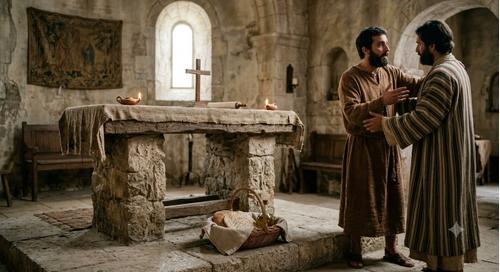
Listen to what Jesus says in Matthew chapter five, verses twenty-three and twenty-four:
"So if you are offering your gift at the altar and there remember that your brother has something against you, leave your gift there before the altar and go. First be reconciled to your brother, and then come and offer your gift."
I want you to just sit with that image for a second.
A man walks up to the altar. He's done everything right. His offering is prepared. His prayers are ready. He's shown up. And then — right there, in the holiest moment of his week — a face flashes across his mind. A name. Someone he's been avoiding. A friendship that quietly fell apart. A silence between him and another person that has gone on way too long.
And Jesus — the very One this man is trying to worship — says: Stop. Put it down. Go.
That's a startling thing to hear. And honestly? It's been startling people for two thousand years. Because we recognize ourselves in that man, don't we? We've all been there — physically present at Mass, going through the motions, standing at the Gospel, kneeling at the consecration — while somewhere underneath all of that, a broken relationship quietly sits there like a stone in our shoe.
We're in the pew. But we're not fully at peace.
And Jesus won't let us paper over that with good liturgical attendance. He doesn't say, "Don't worry about it — your devotion makes up for it." He says: leave the gift. Go first.
It's worth noting that today is June the twenty-eighth — the feast of Saint Irenaeus of Lyon. A bishop who spent his entire ministry choosing the peace of the Church over the satisfaction of being right. The Church's own calendar seems to be underlining the message this morning.
So let's walk through the Scriptures together and see why Jesus takes this so seriously.
The Blueprint of a Reconciled Heart — Expository Reading of 1 Peter 3:8–15
Before we go back to Matthew chapter five, I want to spend some time in 1 Peter chapter three, because Peter gives us a really clear picture of what a reconciled heart actually looks like from the inside.
Here's what he writes: "Finally, all of you, have unity of mind, sympathy, brotherly love, a tender heart, and a humble mind. Do not repay evil for evil or reviling for reviling, but on the contrary, bless, for to this you were called, that you may obtain a blessing." — 1 Peter 3:8-9, ESV-CE
Notice how he starts: "Finally, all of you." Not "finally, the especially holy among you." Not "finally, those of you who have it together." All of you. That means the person who's been coming to this parish for forty years and the person who walked through the door for the first time last Easter. It means people who prefer one form of the Mass and people who prefer another. Peter is not letting anyone off the hook here.
"Have unity of mind." Now, I want to be clear about what that does and doesn't mean. It doesn't mean everyone in this parish has to agree on every devotional preference or every liturgical custom. The Baltimore Catechism is helpful here — it teaches us that we are bound to love our neighbor as ourselves for the love of God, and that this love isn't just a warm feeling. It's an obligation rooted in our common Baptism into the one Body of Christ. Unity of mind is more like a family resemblance. You can tell when people belong to the same household, even when they're different from each other.
Then Peter layers on: sympathy, brotherly love, a tender heart. He's moving from the inside out — from what's happening in your heart to what shows up in how you treat people day to day. Sympathy means you can actually be moved by what your brother is going through. Brotherly love — philadelphia in the Greek — is the specific warmth that belongs to family. A tender heart is one that hasn't been hardened by years of grievance.
Here's where I want to bring in the Fifth Commandment, because I think we often think of it too narrowly. We hear "Thou shalt not kill" and we think — well, I haven't done that, so I'm fine. But the Baltimore Catechism is clear that the Fifth Commandment doesn't just forbid taking a life. It commands us to actively preserve and promote the well-being of our neighbor — their peace, their dignity, their honor. And the teaching of the Church goes further: to harbor contempt, to nurse a cold indifference, to let a quarrel fester for years and call it a matter of principle — these aren't just failures of charity. They are violations of the Fifth Commandment itself.
That's a serious claim. But it's the Church's claim, not mine.
Peter continues: "Do not repay evil for evil or reviling for reviling, but on the contrary, bless." And this is where it gets genuinely hard. To bless the person who has spoken badly about you in this very parish. To return warmth after years of coldness. Nobody does that naturally. That's not where the wounded human heart goes on its own. And that's exactly why Peter frames it as a calling — "for to this you were called." You weren't called to just avoid the worst. You were called to the highest. You were called to bless.
He lands the whole passage in verse fifteen: "but in your hearts honor Christ the Lord as holy." That's the key to everything. A reconciled heart isn't just the result of a successful conversation or a negotiated truce. It starts with Christ genuinely on the throne of your interior life — because a heart that has truly enthroned Him can't simultaneously maintain a private altar of resentment in the corner.
The Catechism puts it simply: charity is never passive. It moves. It pursues. It goes first.
The Higher Righteousness — Expository Reading of Matthew 5:20–24
Now let's go back to the mountain — back to Matthew chapter five — because this is where Jesus really turns up the heat.
In verse twenty He says: "For I tell you, unless your righteousness exceeds that of the scribes and Pharisees, you will never enter the kingdom of heaven."
If you were a first-century Jew hearing that, your jaw would drop. The scribes and Pharisees were the gold standard of religious observance. They tithed their garden herbs. They fasted twice a week. They had the Law memorized. These were the most visibly righteous people in Israel. And Jesus looks at all of that and says: not enough.
He's not throwing out the Law. He's driving it deeper. He's going after the root, not just the fruit.
Then He gets specific: "You have heard that it was said to those of old, 'You shall not murder; and whoever murders will be liable to judgment.' But I say to you that everyone who is angry with his brother will be liable to judgment; whoever insults his brother will be liable to the council; and whoever says, 'You fool!' will be liable to the hell of fire." — Matthew 5:21-22, ESV-CE
Look at what He's doing. He starts with murder — the most extreme external act — and then traces it all the way back to its beginning. Anger. Then contemptuous insult. Then the dismissive word that says to another person: you don't matter. You're nothing. He's showing us the family tree of violence. Murder doesn't just appear out of nowhere. It grows from a seed — a flash of contempt, a nursed anger, a habit of looking at someone and deciding they're beneath your regard.
Jesus is the New Lawgiver. And He's going somewhere the scribes and Pharisees refused to go — inside.
The Baltimore Catechism backs this up plainly. The Fifth Commandment forbids not just murder, but fighting, quarreling, and injuring our neighbor. It commands us to live in peace and union with one another. And the teaching of the Council of Trent extends this even further — sins against the Fifth Commandment include the interior movements of unjust anger, hatred, and contempt. The commandment doesn't stop at your hands. It reaches into your chest.
So here's the uncomfortable question this raises. Is it possible to have never physically harmed anyone in your life — and still be in violation of the Fifth Commandment? According to the Church, yes. If you've allowed contempt to take up permanent residence in your heart. If you've learned, Sunday after Sunday, to look past a certain person in this parish with a practiced, comfortable coldness. If you've quietly convinced yourself that your liturgical fidelity or your doctrinal seriousness somehow exempts you from the basic obligation of brotherly love.
Pope Leo XIII put it plainly: charity is not one virtue among others for the follower of Christ. It is the very soul of Christian witness. When charity is missing, the external forms of religion become — in his words — a beautiful shell surrounding a hollow interior. The prayers get said. The rubrics get followed. But something essential is absent. And the Lord of the altar notices.
That's why He interrupts the offering. That's why He says: stop. Leave the gift. Go first.
He's not saying it to punish us. He's saying it because He knows that worship offered from a heart at war with its brother can't reach its destination. He wants the gift. He just wants the giver to be whole first.
The Witnesses Who Chose Unity Over Being Right — Three Illustrations
Now, I want to introduce you to three people this morning. Three witnesses who actually lived this out — who chose reconciliation when it cost them something real.
The first one is the saint we're celebrating today.
Most of you probably know Saint Irenaeus as a theologian — the great second-century bishop of Lyon, the man who wrote Against Heresies, a direct disciple of Polycarp who had himself sat at the feet of the Apostle John. He's a towering figure in the early Church.
But what I want to tell you about this morning isn't his theology. It's a trip he took.
In the late second century, a serious controversy broke out between the churches of Asia Minor and the church of Rome over the date of Easter — the Quartodeciman (kwawr-toh-des-uh-muhn) controversy. The Asian churches celebrated Easter on the fourteenth of Nisan, no matter what day of the week it fell on. Rome celebrated on the Sunday following. Pope Victor got fed up with the disagreement and threatened to excommunicate the Asian churches entirely. This could have been catastrophic — a rupture in the still-young Body of Christ over a question of liturgical calendar.
Irenaeus stepped in. He traveled to Rome — at his own expense, at considerable effort — and he stood before the Pope not to pick a side, but to make a case: that preserving communion matters more than enforcing liturgical uniformity on secondary questions. He reminded Victor that their predecessors had maintained unity across this very same difference for generations.
He wrote: "The disagreement in fasting confirms the agreement in faith." Different practices. One body. One Lord.
He chose the hard, humble work of peacemaking over the clean satisfaction of being right. And the Church has never forgotten it. It's not a coincidence that we're reading this text on his feast day.
The second witness stands in the snow.
January, 1077. Henry IV — the Holy Roman Emperor, the most powerful man in the Western world — is standing barefoot outside the castle of Canossa in northern Italy. He's been excommunicated by Pope Gregory VII over a dispute about who gets to appoint bishops. And for three days, in the bitter cold of a northern winter, he waits. Not in his imperial robes. In rough penitential wool. Like a common sinner. Asking to be received back into communion with the Church.
Think about that image for a moment. The most powerful man in Europe, stripped of every pretension, standing in the snow for three days.
Now, historians have debated whether Henry's repentance was entirely sincere. That's a fair question. But here's what's not debatable: he understood that no amount of earthly power, no claim to being wronged, no institutional pride was worth the cost of a severed communion with the Body of Christ. Whatever his motives, he went first.
The third witness is the most personal of the three.
Saint John of the Cross — the sixteenth-century Spanish mystic, co-founder of the Discalced Carmelite Reform with Saint Teresa of Avila — was unjustly imprisoned by fellow Carmelite friars who opposed his reforms. They threw him in a dark, cold cell in Toledo. They humiliated him publicly on a regular basis. They gave him barely enough food. They left him in isolation.
And what did John of the Cross do in that cell? He wrote poetry. Poetry about the love of God. Poetry so beautiful that scholars are still writing about it four hundred years later.
When he was eventually freed and rose to a position of authority in the reformed Carmelites — a position from which he could have made his captors' lives very difficult — he blessed them. He actively sought their good. He let go of his right to be vindicated.
John of the Cross understood something that Saint Peter had written fifteen centuries before him: that blessing those who have wronged you isn't weakness. It's the most demanding form of spiritual warfare there is. It's the narrow gate that almost nobody willingly walks through.
Three men. Three very different situations. One obedience: they went first.
The Altar Waits — Interior Examination and Individual Call to Action
So let's come back to the man at the altar.
He's not a figure from ancient history. He's here this morning. Maybe he's you. Maybe he's me. He's the one who has a wound in his heart that he's been carefully not dealing with — for weeks, maybe for much longer. He's the one who has learned to walk past a certain person in the narthex with a practiced, neutral expression that took years to perfect. He's the one who has quietly told himself that his faithful Sunday attendance, his doctrinal seriousness, his love for the liturgy — surely that counts for something. Surely that compensates.
And Jesus — standing not behind this altar but in front of it, on our side, looking us in the eyes — says with infinite patience and absolute clarity: Stop. Leave the gift. Go first.
I want to ask you to do something right now. Something that takes a little courage.
In the quiet of your own heart — just between you and God — I want you to name the face. You know who it is. You may have been carefully avoiding thinking about them for the last twenty minutes. That's okay. Name them now, before God, in the silence of this moment.
Not to beat yourself up. Not to spiral into guilt. Just to be honest. To say: Lord, there is a work here that isn't finished. And it can't be finished from inside this building.
The Baltimore Catechism is direct about this: the Fifth Commandment doesn't just invite us to live in peace with our neighbor. It obligates us. And Saint Peter has already told us that peace isn't something we wait around to receive — it's something we're commanded to pursue. "Let him seek peace and pursue it." — 1 Peter 3:11, ESV-CE.
So here's what I'm asking. Not as a vague spiritual suggestion. As a concrete act of discipleship with a specific face and a specific week attached to it.
Before you come back to this altar next Sunday — before you stand here again to receive the Body and Blood of our Lord — go to that person. This week. Not someday. Not when you feel ready. Not when the timing seems right. This week.
You go first. Don't wait for them to soften. Don't wait for them to apologize. Don't wait for them to meet you halfway before you're willing to move an inch. Christ didn't wait for us to come to Him. He came to us. He descended. He went first.
Maybe they'll receive you warmly. Maybe they won't — not right away. Maybe the door stays closed for a while. That's okay. You'll have done what the Lord of this altar asked of you. You'll have left the gift, gone to your brother, and pushed open the door that pride has been holding shut.
And when you walk back through those doors next Sunday — when you stand here again as a worshipper — the gift you bring will be whole. It'll be honest. It'll be the thing He actually wants from you. Because He'll know — He always knows — that you chose His command over your comfort. His peace over your pride.
You chose to go first.
The altar will wait for you. But don't make it wait too long. And don't make your brother wait either.
Go first. And then come back and offer your gift.-F.D.