

Heirs Who Act Like Stewards
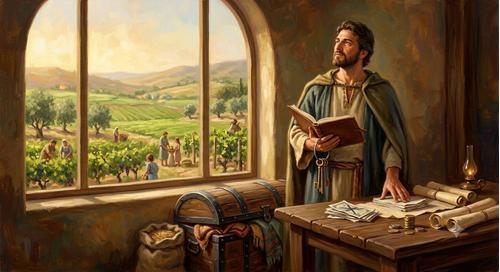
Who Owns Your Life?
I want to begin this morning by placing two readings side by side — not to complicate things, but because I believe God timed these two readings together on purpose.
Listen to this from Luke 16, verses 1 and 2: "There was a rich man who had a manager, and charges were brought to him that this man was wasting his possessions. And he called him and said to him, 'What is this that I hear about you? Turn in the account of your management, for you can no longer be manager.'"
Now hold that thought, and listen to St. Paul in Romans 8, verses 12 and 13: "So then, brothers, we are debtors, not to the flesh, to live according to the flesh. For if you live according to the flesh you will die, but if by the Spirit you put to death the deeds of the body, you will live."
Two very different scenes. One is a parable about a man on the verge of losing everything he manages. The other is Paul laying down deep theology about who we are in Christ. But I want to suggest to you this morning that these two readings are asking us the very same question, just from two different directions. And the question is this: Who owns your life?
Because there are really only two ways to live. You can live like a slave — scrambling, anxious, always trying to save yourself, always trying to secure your own future by your own cleverness. Or you can live like an heir — someone who already has security, who already belongs to a Father, and who is free to use everything in his hands for something greater than himself.
That manager in Luke 16 is scrambling. He has just learned his position is over, and he is left to reckon with how to secure what comes next. But Paul, in Romans, tells us something remarkable — you are no longer a slave. You are a son. You are a daughter. You are an heir of God.
So here is the question I want you to carry with you this morning, and honestly, this whole week: If your time was up today — if right now you were told, "Turn in the account of your management, you can no longer be steward" — what would you do with what is in your hands? Would you panic like that manager did? Or would you already know exactly what to do, because you already know exactly who you are?
That is where we are headed this morning. Let us look at it together.
You Are Not a Slave, You Are an Heir
Let's stay in Romans 8 for a minute, because before Jesus ever tells us what to do with our money, Paul wants us to understand who we are. And friends, that order matters. Doing always flows out of being. You don't act your way into sonship — God makes you a son first, and then you start acting like one.
Look at verse 14: "For all who are led by the Spirit of God are sons of God." And then verse 15: "For you did not receive the spirit of slavery to fall back into fear, but you have received the Spirit of adoption as sons, by whom we cry, 'Abba! Father!'"
Now, "Abba" — this isn't some formal, stiff word. This is the word a little Jewish child would use for their daddy. It's intimate. It's warm. It's the same word Jesus Himself used in the Garden of Gethsemane when He was crying out to the Father in His agony. And Paul says that same cry is now in our mouths too.
St. Ambrose of Milan, way back in the fourth century, put it like this — a slave lives in constant anxiety, always wondering what the master is going to do to him if he messes up. But adoption completely resets that. When a Christian cries out "Abba," he's not begging for mercy from a stranger — he's speaking as a son who already belongs, whose place at the table is already secured.
Think about that for a second. So many of us — and I include myself in this — live our whole spiritual lives like we're still trying to earn a place in the family. We pray like we're auditioning. We serve like we're trying to prove something. But that's not the gospel. The gospel says the adoption papers are already signed. You didn't earn your way in. Christ paid the debt, and the Father called you His own.
And then verse 16 — one of my favorite verses in all of Scripture: "The Spirit himself bears witness with our spirit that we are children of God." There's something the Holy Spirit does deep inside a believer's heart — a quiet, settled confidence that says, "You belong to Him." Not because you feel worthy on your best day, but because the Spirit Himself testifies it.
And then comes the kicker, verse 17: "and if children, then heirs — heirs of God and fellow heirs with Christ, provided we suffer with him in order that we may also be glorified with him."
Heirs of God. Not just forgiven — heirs. Everything that belongs to Jesus Christ, by grace, belongs to you. St. Bede the Venerable made a beautiful observation about this — he said earthly inheritances get split up and diminished the more heirs there are. You know how that goes — Dad's farm gets divided six ways and everybody gets a smaller piece. But the inheritance of God doesn't work that way. Every single one of us gets the whole thing. Full glory, fully shared, with nothing diminished.
So here's the application before we even get to the parable: Your security is not something you have to go earn through frantic effort. It's already given. Rest in that first. Before I tell you to go be shrewd with your money — and I am going to tell you that in a minute — I need you to first hear that you don't have to be anxious about your standing before God. You're not a slave sweating out your existence. You're a son. You're a daughter. The adoption is done.
Now — and this is key — once you know that, everything changes about how you handle the rest of your life. Because a slave holds tight to what he has, out of fear. But a son holds things loosely, because he knows his Father owns it all anyway, and there's more where that came from.
That's exactly the mindset Jesus is trying to build in the parable we're about to look at.
The Steward's Wake-Up Call
Alright, let's go back to Luke 16. Jesus tells this story about a manager — some translations say "steward" — who's basically the guy running the estate for a wealthy landowner. And word gets back to the owner that this manager has been careless, wasting the master's resources.
Verse 2 again: "And he called him and said to him, 'What is this that I hear about you? Turn in the account of your management, for you can no longer be manager.'"
Now picture this guy's stomach dropping. He's been coasting. Maybe he figured he had years left in this position. And in one sentence, his whole world gets turned upside down. "You're done. Give me the books."
Verse 3 shows us his internal panic: "And the manager said to himself, 'What shall I do, since my master is taking the management away from me? I am not strong enough to dig, and I am ashamed to beg.'"
St. Augustine looked at this line and said something that has stuck with me — "To dig I am not able" points to a spiritual truth: when death arrives, the time for heavy labor and earning merit has passed. And "I am ashamed to beg" — that's pride. Even in crisis, this man's pride is still working against him. He doesn't want hard labor, and he doesn't want to look weak either.
But here's what I want you to notice — this man doesn't sit around denying reality. He doesn't waste time complaining about how unfair it is. He faces the crisis head on, and fast.
Friends, here's the hard truth in this passage for us: none of us knows exactly when our own management ends. We don't get an email from God with an exact date and time telling us "your stewardship over this life concludes on such-and-such day." It comes like it did for this manager — sudden, unannounced, final.
I think about how many of us live like we've got all the time in the world. We put off reconciling with a family member. We put off giving generously. We put off getting serious about prayer, about the sacraments, about really loving the people God put in front of us — because we figure there's always tomorrow. But this parable is Jesus grabbing us by the shoulders and saying, "Don't wait for the notice. Start living with urgency now, while you still hold the keys."
Because here's the good news buried in this uncomfortable parable — unlike the manager, you and I still have time. Right now. This morning. You're not fired yet. The books haven't been called in yet. So the question isn't "will my stewardship end" — it will, someday. The question is, "what am I going to do with the time I've still got?"
That's exactly where Jesus takes this story next.
Shrewd for Eternity
So the manager has his crisis moment, and then look what he does. Verses 5 through 7: "So, summoning his master's debtors one by one, he said to the first, 'How much do you owe my master?' He said, 'A hundred measures of oil.' He said to him, 'Take your bill, and sit down quickly, and write fifty.' Then he said to another, 'And how much do you owe?' He said, 'A hundred measures of wheat.' He said to him, 'Take your bill, and write eighty.'"
This guy moves fast. No committee meetings, no long deliberation. He's cutting deals, reducing debts, using whatever authority he has left to make friends who will take care of him once he's out of a job.
And then verse 8 gives us the surprising line: "The master commended the dishonest manager for his shrewdness. For the sons of this world are more shrewd in their generation than the sons of light."
Now don't misread this. Jesus is not congratulating dishonesty. St. Irenaeus, one of the earliest Church Fathers, made this crystal clear — Christ is absolutely not commending the man's fraud. What He's commending is the man's prudence — his speed, his foresight, his willingness to act decisively when he understood what was at stake.
And here's the sting in the tail of this parable — Jesus looks at that scene and says, essentially, "The people of this world put more urgency, more creativity, and more energy into saving their earthly future than my own people put into saving their eternal one." Ouch. That one stings if you let it.
Because think about it. How many people will pull all-nighters, take out loans, hustle relentlessly to build a business or secure a retirement — and yet those same people, when it comes to prayer, or generosity, or the state of their eternal soul, can barely muster ten minutes a day?
Then comes verse 9, the actual application Jesus gives us: "And I tell you, make friends for yourselves by means of unrighteous wealth, so that when it fails they may receive you into the eternal dwellings."
Money is called "unrighteous wealth" here not because money itself is evil, but because it belongs to this passing, corrupted world system. You can't take a single dollar with you when you die. But — and this is the whole point — you can use it now, while you have it, to do eternal good. You can use it to feed someone. To help build up the Church. To rescue somebody from despair. And Jesus says when that happens, those very people become friends waiting to welcome you at the gates of heaven.
Now, I want to bring in a modern story that I think captures exactly what Jesus is talking about here. Some of you may have heard of a man named Chuck Feeney. He co-founded Duty Free Shoppers and became one of the wealthiest men in the world — a fortune worth around eight billion dollars. But here's the remarkable part — for decades, almost nobody knew that Feeney was secretly giving nearly all of it away. He funded hospitals, universities, peace efforts around the world — and he did it quietly, without putting his name on buildings. He lived modestly himself — no mansions, no private jets. He called his approach "giving while living." And near the end of his life, he deliberately closed down his own charitable foundation, making sure that every last dollar went out the door before he died. In 2024, Chuck Feeney passed away having given almost his entire fortune away, on purpose, while he still had breath to see the good it was doing.
Now, I'm not saying you have to be a billionaire to live this out. But think about the posture behind it. Feeney didn't wait for a deathbed conversion of generosity. He acted with urgency while he still held the keys — very much like that steward in Luke 16, cutting bills and making friends before his time ran out.
This is exactly the heart behind what the Church has always taught. The Baltimore Catechism reminds us that among the works of mercy God asks of us, giving alms to the poor is one of the clearest ways we lay up treasure in heaven. It's not a suggestion for the extra spiritual — it's part of the ordinary Christian life. When you give to the poor, when you use what God has entrusted to you to relieve someone else's need, you are, quite literally, doing what Jesus commends in this parable — converting temporary wealth into an eternal friendship, into treasure that never fails.
So here's the challenge tucked inside this whole passage: don't wait for the deathbed to get generous. Don't wait until the books are called in to start being shrewd with what God has given you. Start now, while you've still got the keys in your hand.
Living Like Heirs Who Act Like Stewards
So let's bring these two readings back together, because I promised you at the start they were connected, and now I hope you can see exactly how.
Romans tells you who you are — you are not a slave scrambling in fear, terrified of some cosmic debt collector. You are an adopted child of God, an heir, with the Spirit Himself testifying to your heart that you belong to the Father. That identity is settled. It's not up for negotiation, and it's not something you have to go earn through frantic religious effort.
But Luke tells you how to act like it. Because here's the beautiful truth — precisely because your security is already settled in Christ, you are now completely free to be generous, urgent, and even bold with everything else in your life. A slave grips tight to his possessions because he's terrified of loss. But an heir — an heir gives freely, because he knows his Father owns everything anyway, and there's always more where that came from.
That's the whole Christian life in a nutshell, isn't it? Rest in your identity, then act with urgency. Know you're a son, then live like a faithful steward. Don't wait for the notice that says "you can no longer be manager" to start using what God gave you — your time, your money, your relationships, your forgiveness — for something eternal.
So here's what I want to leave you with this week. It's simple, but I want you to actually do it, not just nod along.
This week, I want you to identify one thing — just one — that you can give away before it's too late. Maybe it's money you've been holding onto out of fear instead of generosity. Maybe it's time you've been hoarding for yourself instead of giving to your family or your church. Or maybe — and for some of you, this might be the hardest one — maybe it's a grudge. A debt you've been holding against somebody, refusing to write down like that steward wrote down fifty instead of a hundred. Jesus is asking you this week: what's one debt, one grudge, one hoarded thing you can release, right now, while you still have the chance?
Let's take a moment right now, in silence, and let that question sit with the Lord. I'm going to ask it once more, and then we'll just sit quietly before Him.
Lord — what would I do, if I knew my time was short?
...
Let's carry that question with us as we go from this place today. In the name of the Father and of the Son and of the Holy Spirit, Amen.