

From the Gate to the Burden
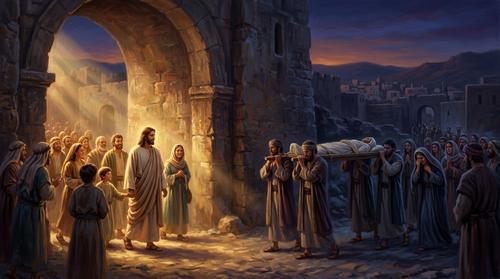
Two Processions Meet at the Gate
Folks, I want you to picture this scene with me. There are two processions coming toward the gate of the city of Nain, and they are heading in opposite directions.
One procession is coming out of the city. It's a funeral. There's a bier — think of it like a stretcher or a flat wooden frame, carried on the shoulders of several men, with the body laid open on top for all to see, wrapped in cloth but with no lid or box enclosing it. Behind it walks a widow, and Luke tells us plainly, this was her only son. Do you understand what that means for a widow in that day? Her husband was already gone. Now her son — her last living hope, her provider, her protection in a world that had no safety net for a woman alone — her son is gone too. Scripture says "a sizeable crowd from the city was with her." The whole town has turned out because they know what this loss means. This is death walking out through the gate.
The other procession is coming into the city. It's Jesus, and His disciples, and a great crowd following Him. This is life walking in through the gate.
And right there — right at the gate of Nain — these two processions collide. Death coming out. Life coming in. And I want you to notice something before we go any further: nobody sent for Jesus. Nobody ran ahead and said, "Lord, come quick, there's a boy who died." This isn't like the story of Lazarus, where Mary and Martha sent word. This isn't like Jairus's daughter, where the father came and fell at Jesus' feet begging. Nobody asked Jesus to be here.
He just... saw her.
Luke writes, "And when the Lord saw her, He felt compassion for her." That word "saw" — Jesus wasn't looking for a miracle to perform that day. He was walking into a town with His disciples, minding His own business, so to speak, and He saw a grieving widow, and something in Him moved.
I think about this every time I visit someone in the hospital, or stand at a graveside with a family. Nobody has to convince Jesus to care. He doesn't need us to beg Him, to twist His arm, to remind Him that suffering matters. He sees. He feels compassion. That word "compassion" in the Greek carries the sense of being moved in your very gut — it's not a polite sympathy, it's a deep, physical ache for someone else's pain.
You know, this reminds me of another mother's tears — St. Monica. For nearly twenty years, she wept and prayed over her son Augustine, who was living a wayward life, chasing every pleasure and philosophy except the truth. She followed him from city to city, worn down by grief, begging God to reach the heart of her boy. One day, in tears, she poured out her sorrow to a bishop, asking him to sit her son down and argue him into the faith. The bishop gently refused, but he said something to her that she carried in her heart from that day forward: "Go your way, and God bless you, for it is not possible that the son of these tears should perish."
And he was right. Not long after, in a garden in Milan, Augustine finally surrendered his life to Christ — and he would go on to become one of the great saints and teachers of the Church. Monica didn't have to convince God to care about her son. God was already moved by her tears, long before the answer came. He was working in the silence, in the waiting, in the years she couldn't see anything changing at all.
Friends, that widow at the gate of Nain didn't have to earn that kind of compassion, and neither did Monica. Jesus showed both of them the same thing: He doesn't wait for our theology to catch up, or for our patience to run its full course. He moves toward sorrow on His own initiative, gut-wrenched with compassion, before we even ask Him for anything at all. And whatever tears you're carrying right now — that's still who He is.
Before the widow says a word, before anyone asks for anything, Jesus is already moved toward her sorrow. That's the God we serve — not one who waits to be invited into our grief, but One who comes walking straight toward it, on His own initiative, because He loves us.
So here's my first word for you this morning: wherever you are carrying a bier out the gate of your own life — whatever grief, whatever loss, whatever thing feels like it has died and there's no bringing it back — know this. Jesus sees you. He is not waiting for a formal invitation. He is already moving toward you with compassion. The two processions are about to meet.
"Young Man, Arise" — Christ Speaks Life Into Death
Now watch what happens next. Jesus says to the widow, "Do not weep." Now, on its own, that could sound almost cruel, couldn't it? Imagine someone at a funeral just telling the grieving mother, "Don't cry." That would be an empty thing to say — unless the One saying it is about to do something about the reason for the tears.
And He does. Luke says, "he came up and touched the bier, and the bearers stood still." Now, under Jewish law, touching a dead body made you ceremonially unclean. The men carrying that bier would have stepped back in surprise when this stranger walked up and put His hand on it. But Jesus wasn't worried about becoming unclean, because He was about to make something clean, something alive, something whole.
And then He speaks the words that changed everything: "Young man, I say to you, arise!"
I want you to compare this, just for a moment, to the great prophets who came before Jesus. Remember Elijah, in 1 Kings 17, when the widow of Zarephath's son died? Elijah took the boy up to a room, and he cried out to the LORD — he pleaded, "O LORD my God, have you brought calamity even upon the widow with whom I sojourn, by killing her son?" And then he stretched himself on the child three times before the Lord heard him and the boy's life returned.
Elijah was a great man of God, a mighty prophet — and yet even he had to plead with God, had to pray, had to intercede for the power to come from somewhere else.
Jesus doesn't pray. Jesus doesn't plead. Jesus doesn't ask the Father for permission in that moment recorded for us. He simply speaks: "Young man, I say to you, arise!" And the text says the dead man sat up and began to speak. There is nobody, in all the history of Israel's prophets, who spoke to death with that kind of authority — as if death were a servant, obligated to obey.
St. Athanasius, writing centuries ago in his great work on the incarnation, points out that when the crowd at Nain says, "God has visited His people," they weren't just being polite. They had grasped, in that moment of fear and wonder, that something greater than a prophet had walked among them — that God Himself had drawn near to His people in the flesh, and death itself had bowed to His voice. That's why Luke tells us "fear gripped them all." This wasn't ordinary fear. This was the trembling that comes when you realize you have just watched the Author of Life exercise His own authority over the grave.
Now here is where I want to bring this home to you, because this story isn't just an ancient miracle to admire from a distance. This is a picture of what Christ does for every single one of us.
Before we know Christ, Scripture tells us plainly, we were dead — dead in our trespasses and sins (Ephesians 2:1, ESV-CE). We are that boy on the bier. We cannot raise ourselves. We cannot plead loud enough, try hard enough, or reform ourselves into new life. We need Someone to come, touch the bier of our dead heart, and speak the word.
And that is exactly what Christ does. He speaks — through His Word, through the sacrament of Baptism, through the sacrament of Confession, through the voice of His Church calling sinners to repentance — and He says to the soul dead in sin: "Arise." Not "try harder." Not "clean yourself up first." Arise. And the dead sit up and begin to speak — begin, for the first time, to praise the God who made them.
Our own Catechism teaches this same truth. The soul that falls into mortal sin loses sanctifying grace — that living share in God's own life within us — and becomes, in the truest sense, spiritually dead, just like that young man on the bier. And just as Christ needed no long ritual, no lengthy pleading, to speak life back into him, Christ has given His Church the ordinary means to speak that same life-giving word over us today. Every time a penitent kneels in the confessional and hears the priest say, by Christ's own authority, "I absolve you of your sins," that is Christ Himself, still standing at the gate, still touching the bier, still saying to a soul that was dead: "Arise."
Folks, is there a part of you this morning that has been lying on that bier a long time? Some sin, some habit, some grief you've let bury you? Christ is not waiting for an invitation. He is walking toward you right now, and He is saying, "Arise." The only question is whether you will let His voice do what no effort of your own ever could.
From Being Raised to Bearing the Load
Now, here's the thing about being raised from the dead — it's not the end of the story. That young man in Nain didn't just sit up, get handed back to his mother, and go on living exactly as he had before. He was raised for something. He was raised to live, to walk, to love, to serve his mother in the years God had given back to him.
And that's exactly the pattern the apostle Paul lays out for us in Galatians. Turn with me there — Galatians chapter 5, verse 25, through chapter 6. Paul writes: "If we live by the Spirit, let us also keep in step with the Spirit... Brothers, if anyone is caught in any transgression, you who are spiritual should restore him in a spirit of gentleness... Bear one another's burdens, and so fulfill the law of Christ... And let us not grow weary of doing good, for in due season we will reap, if we do not give up." (Galatians 5:25, 6:1-2, 9, ESV-CE)
Do you see the movement here? First, we live by the Spirit — we are raised, like that young man at Nain. But being raised isn't a private thing that ends with us. It leads directly to walking, and walking leads to bearing — bearing one another's burdens.
Paul says, "if anyone is caught in any transgression, restore him in a spirit of gentleness." St. Jerome, commenting on this passage long ago, used a beautiful picture to describe what "restore" means here. The Greek word Paul uses — katartizo — is the same word used for a doctor setting a broken bone. Jerome said that just as a physician doesn't crush the bone further or scold it for breaking, but handles it gently, carefully, setting it back into place so it can heal and grow strong again — that's how we are to treat a brother or sister who has stumbled. Not with harsh words. Not with a lecture standing over them. But gently, like a doctor setting a bone, so that what was broken can be made whole and useful again.
Isn't that beautiful? When someone in this church family falls — and someone will, because we are all still weak — our job isn't to point fingers or pile on shame. Our job is to kneel down beside them like a good physician and gently, patiently, help set things right.
Then Paul says, "Bear one another's burdens." Not "bear your own burden and hope others notice." Bear one another's. This is family language. This is the language of a people who have all been raised from the same death and now belong to one another.
And then Paul gives that great agricultural picture — sowing and reaping. "Do not be deceived: God is not mocked, for whatever one sows, that will he also reap... And let us not grow weary of doing good, for in due season we will reap, if we do not give up." St. Augustine, in his sermons on this text, reminds us that a farmer doesn't see the harvest the day he plants the seed. There's a long season of waiting, watering, watching, sometimes discouragement, before the harvest ever shows itself. But the farmer who gives up halfway through the season loses everything he planted. Augustine's warning is simple: don't grow weary. The visiting of the sick, the carrying of another's grief, the patient restoring of someone who has fallen — none of that feels like harvest in the moment. It feels like plowing hard ground. But Paul promises: in due time, we will reap, if we do not grow weary.
So here is the full arc, and I want you to see it clearly. Christ meets us at the gate. He raises us from death with His own voice of authority. And then He sends us out — not to sit quietly enjoying our own resurrection, but to walk by the Spirit, to gently restore the fallen, and to carry one another's burdens as the harvest of new life growing in us.
So let me leave you with this call this morning. Two things, and only two things, but I pray they take root deep.
First — if you are still lying on that bier this morning, if some part of your soul is dead and has been for a long time, hear the voice of Christ speaking over you right now: "I say to you, arise!" Don't wait until you feel ready. The dead man didn't prepare himself to be raised. He simply heard the voice and obeyed it. Hear it today.
Second — if Christ has already raised you, if you are walking by the Spirit this morning, then go this week and carry a burden for somebody. Find someone who has stumbled and set that bone gently, like Jerome said, like a good physician. Find someone whose grief feels too heavy, and help them carry it, the way the whole town of Nain walked with that widow to the gate. Don't grow weary in it. The harvest is coming, even if you can't see it yet.
Christ met death at the gate of Nain, and death lost. He will meet whatever you're carrying out of your own gate this morning, and He will say the same word He said then: Arise. And then, having been raised, go and bear the load for somebody else. That is the whole Gospel in miniature — from the gate to the burden. Let's live it out this week.-F.D.